Agility Robotics' Nasdaq debut invites scrutiny of humanoid robot market
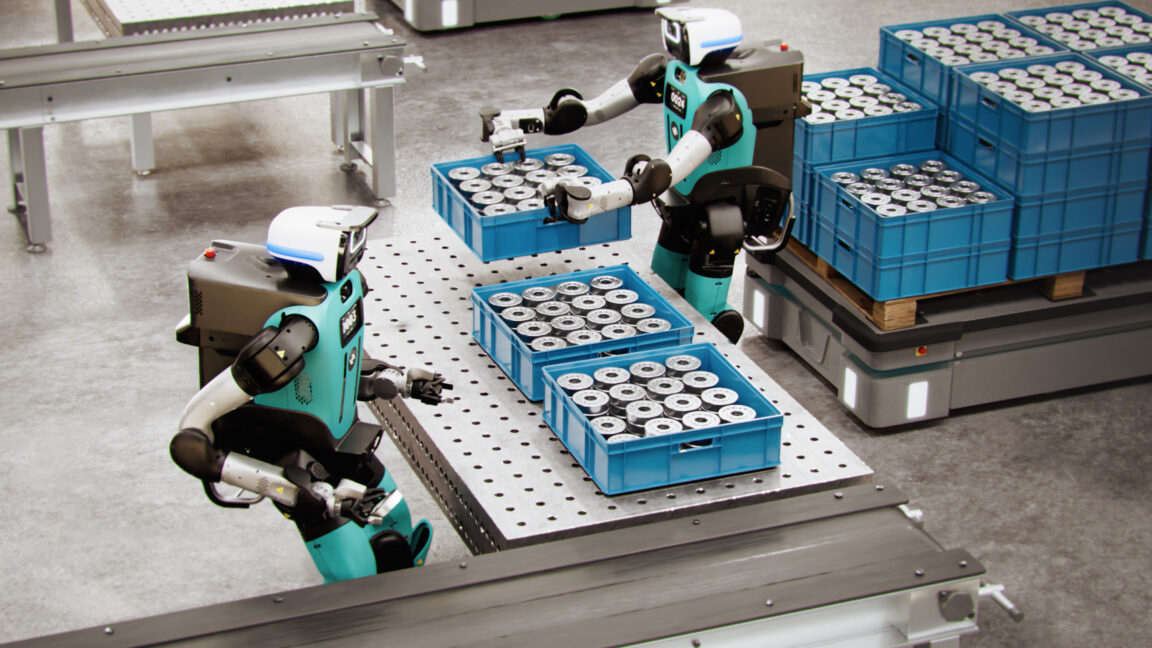
Humanoid robots remain unproven at scale and have not yet achieved widespread commercialization, compared with industrial robots that have decades of proven track records in warehouses and factories. That frank acknowledgment is among the risks outlined in a securities filing by Agility Robotics—the first dedicated developer of humanoid robots to become a publicly traded company in the United States.
The robotics company, headquartered in Salem, Oregon, previously became the first to achieve full-time commercial deployment of humanoid robots at a customer warehouse in 2024. Now, Agility’s public listing on the Nasdaq stock exchange as of November 5 has come with financial disclosures detailing how the company plans to build a business around renting out or selling humanoid robots to perform manual labor.
“When we are doing robots as a service, it is much lower risk for customers to use it because they are getting a return on investment on day one,” Jonathan Hurst, co-founder and chief robot officer at Agility Robotics, told Ars. “Because they’re paying a rate that is comparable to the human labor rate, and that makes the economics pretty straightforward.”
Agility is one of many startups attempting to commercialize humanoid robots. But the company has stood out from the competition through its lead in deploying and operating Digit humanoid robots with multiple customers, including the warehouses of logistics company GXO, the South Carolina factory of German automotive manufacturer Schaeffler, and the automotive production lines of Toyota Motor Manufacturing Canada. As Agility’s very first customer, GXO announced it would expand deployments of Digit robots beyond a warehouse in Georgia to additional facilities in North Carolina and Tennessee.
The filings accompanying Agility’s journey toward becoming a publicly traded company—based on a merger with a special purpose acquisition company—also provide a rare look at the business prospects and potential unit economics of humanoid robots. Most of its startup competitors remain privately held companies that have not been nearly as forthcoming.
Another exception has been China’s humanoid robotics company Unitree, which opened its books when it went public on the Shanghai Stock Exchange STAR Market in August 2026.
Robot rental or ownership
Agility described the “illustrative unit economics” for both its “robots-as-a-service” subscription business and an “ownership model,” which would involve corporate clients purchasing robots outright, in an S-4 registration statement filed with the US Securities and Exchange Commission on September 4.
With the subscription model, customers would pay a one-time cost of about $25,000 per robot for delivery and deployment to a work site, along with a recurring monthly fee of $8,500 for software and maintenance.
Customers can also purchase the robot’s hardware outright for a one-time payment of $200,000, along with another one-time cost of $20,000 for delivery and deployment. But that still comes with an annual subscription fee of $36,000 for software and maintenance, or about $3,000 per month.
In exchange for renting or purchasing the robots, customers would get access to the latest Agility robot, known as Digit 5, starting in 2027. The bipedal robot has swappable end-effector “hands,” can lift up to 50-pound loads, and can perform more than 20 hours of work in a 24-hour period with the help of a fast-charging battery system.
The fast-charging battery technology provided by the UK-based company Nyobolt requires just nine minutes to deliver 90 minutes of robot runtime. “We worked with them for well over a year to design the pack that goes in our robot,” Hurst told Ars. “So the battery pack is fully custom and is ours, and we have the exclusive agreement with Nyobolt around using their [battery] chemistry in humanoid robots.”
The Digit 5 also comes with an onboard safety system that enables it to detect humans moving nearby and take appropriate actions, like standing still or squatting to minimize the risk of harm. That could unlock more opportunities to deploy Digit 5 beyond the confines of isolated work cells within warehouses and factories, said Pras Velagapudi, chief technology officer at Agility, in a previous conversation with Ars.
During a presentation for analysts and investors on October 6, Agility’s chief financial officer, Michael Beer, described the Digit subscription model as allowing customers to replace $200,000 in annual labor costs with $100,000 in annual robot costs, while buying a Digit robot outright could replace $1.1 million in labor costs with about $400,000 in robot costs over five years.
Agility’s business costs and revenue
Meanwhile, Agility described its own annual operating costs per robot as being $15,000 to provide the necessary software and maintenance, along with a one-time cost of $15,000 for Agility to initially deploy each robot.
The robotics company also estimated each Digit v5 humanoid robot as initially costing Agility $150,000 based on the bill of materials. Each robot is estimated to have a useful operational lifespan of about five years.
But Agility anticipates that bill of materials cost falling to $75,000 per robot once it ramps up to annual production of 1,000 robots, and eventually $30,000 per robot if the company can produce 10,000 robots per year. The company plans to gradually ramp up production at its RoboFab manufacturing facility in Oregon.
When balancing such business costs versus revenue, Agility anticipates that it could earn about $500,000 per robot on an annual basis through the subscription model, and about $400,000 per robot each year if a customer purchases the Digit robots outright while paying ongoing software and maintenance fees.
The subscription revenue calculations disclosed in Agility’s S-4 filing were based on an unidentified customer’s $300 million order covering 1,000 Digit 5 robots over a three-year subscription contract.
However, such a customer order does not mean Agility is guaranteed to earn $300 million, because the contract requires the robotics company to deliver on certain “contractual milestones, product features and specifications.”
The robotics company’s financial disclosures also bluntly state that “Agility has incurred net losses since inception and expects to continue to incur operating and net losses for the foreseeable future.” In 2025, the company earned just $1.8 million in revenue against $140 million in operating loss, which shows it’s still in the early stages of building a sustainable business.
Future risks and prospects
Agility said it continues to devote “substantially all of its resources to research, development, and commercialization of its humanoid robot,” while continuing to expand the RoboFab manufacturing facility. On October 21, Agility also announced plans to build a new facility in Pittsburgh, Pennsylvania, for supporting Digit robot deployments and further developing the robot’s software and AI.
Beyond the challenges of building its own business, Agility’s financial disclosures also cautioned that “competition in the humanoid and robotics market is intensifying rapidly, with well-funded entrants including Boston Dynamics, Tesla, Apptronik, Figure AI, 1X Technologies, Sanctuary AI, Hexagon, and NEURA Robotics, among others, actively developing competing humanoid systems.”
Many of those companies have advantages, such as “significantly greater brand recognition, customer relationships, and financial, technical, manufacturing, and other resources,” Agility’s S-4 filing acknowledged. It also listed business risks involving uncertain AI-driven robotic performance in the real world, safety issues in sharing workspaces with human workers, changing regulations, and cybersecurity threats.
Still, Agility co-founder Hurst described a large potential market with “millions of unfilled roles” involving manual tasks that would typically require higher-cost but relatively low-skilled human labor. Within the next year, Hurst expects multiple Agility customers to be sharing videos of the Digit robots “just very boringly doing their work” to the point where “all of the excitement and hype and novelty of humanoids has worn off.”
“It’ll look a bit like the dawn of the automotive market, and different companies will have different niches—some companies will build the Ford F-150 and some companies will build a Mazda Miata,” Hurst told Ars. “There’s going to be a bunch of different niches for multi-purpose human-centric machines like these.”
Although Hurst sees Agility’s path eventually leading to a general-purpose autonomous robot in the future, he has consistently dismissed the idea of any company immediately deploying humanoid robots to riskier and less structured environments, like people’s homes. “Digit 5 is not going to walk into your living room and do dishes and stuff like that,” he said. “Nobody is.”
Whatever happens with Agility’s journey in the coming years, it will be instructive for anyone interested in the broader trajectory of the humanoid robot industry.
 1.
After Texas' blue wave, what happens to Elon Musk and SpaceX?
Related Topics
Keywords
Related Stories
Ember’s smallest self-heating mug is on sale for just $33
We’ve been fans of Ember’s temperature-controlled mugs for years, though given the price tag, we admit that they’re somewhat of a luxury purchase. Thankfully, if you’ve been looking for a more affordable option, Woot is selling the Ember Cup in black for $32.99 ($67 off) with a…

TikTok launched a dedicated TikTok Shop app
TikTok has released a standalone app for TikTok Shop in a few countries, as spotted by social media consultant Matt Navarra. According to its App Store listing, the TikTok Shop app offers: - Personalized picks inspired by your interests - LIVE streams & short videos to see…

Nintendo says it’s not planning another Switch 2 price hike
Nintendo president Shuntaro Furukawa said during the company's latest earnings call that it's "not considering additional changes" to the Switch 2's price, Reuters reports. The Switch 2 got a $50 price hike earlier this year, bringing its starting price up to $499. Nintendo said…

The FAA is finally ditching floppy disks
The air traffic control tower is seen San Diego International Airport on May 27th in San Diego, California. | Photo by Kevin Carter / Getty Images It's the year 2026 and the Federal Aviation Administration is still running critical pieces of American airspace on 3.5-inch…

Top Stories

HERITAGE & IDENTITY OP-ED: Voices of Knoflokskraal — belonging and everyday survival on contested land

PAINT POWER: Gqeberha artist turns vandalised mural into an ocean-themed second chance
REFUND WRANGLE: Hospitality agency enters business rescue amid R48m ticket claim scandal

BATTLE PLAN: Erasmus unleashes full-strength Springboks to crush Italy in Nations Championship

Paraguay President Santiago Peña resigns after bank collapse

No budget resolution reached yet, says O'Neill
VIDEO: EFF looks to ward victories to rebuild trust in eThekwini

Greece: Students march in Athens demanding more education funding

Latest
HERITAGE & IDENTITY OP-ED: Voices of Knoflokskraal — belonging and everyday survival on contested land
PAINT POWER: Gqeberha artist turns vandalised mural into an ocean-themed second chance
REFUND WRANGLE: Hospitality agency enters business rescue amid R48m ticket claim scandal
BATTLE PLAN: Erasmus unleashes full-strength Springboks to crush Italy in Nations Championship
Paraguay President Santiago Peña resigns after bank collapse
No budget resolution reached yet, says O'Neill
VIDEO: EFF looks to ward victories to rebuild trust in eThekwini
Greece: Students march in Athens demanding more education funding