"At Home in Space" opens, caps Air and Space Museum renovation
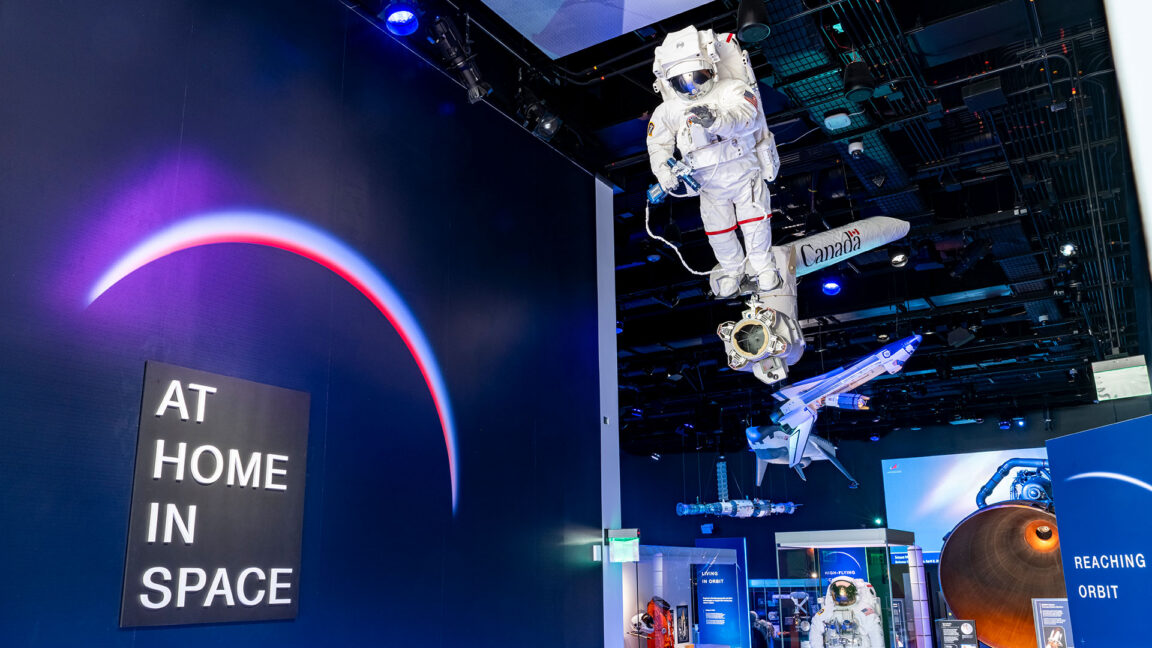
After seven years of work and nearly $1 billion, the Smithsonian has completed the renovation of the National Air and Space Museum’s flagship building in Washington, DC.
On October 30, the museum debuted its last-to-open spaceflight exhibition, returning “home” with a gallery devoted to establishing a spacefaring civilization.
“Welcome to ‘At Home in Space’!” said curator Jennifer Levasseur, who guided us through a virtual tour of the gallery. “This is the story of long-duration spaceflight in the last few decades. We generally call it ‘reaching orbit.’”
“It’s the prep story, the space shuttle story. It’s what allows us to end up at a place where we have 25-plus years of long-duration spaceflight experience, the capacity for humans to be living in space on the International Space Station (ISS), and then it carries that story forward. So the middle of our story then becomes the ISS, and the end of the story are the next steps,” said Levasseur.
Entering “At Home”
Over the past several years, the National Air and Space Museum has introduced new galleries showcasing how US astronauts first entered space and landed on the Moon (“Destination Moon”); how robotic probes have explored every planet in our solar system (“Kenneth C. Griffin Exploring the Planets”); how technologies and infrastructure impact our daily lives (“RTX Living in the Space Age Hall”) and what approaches spaceflight will take in the years to come (“Futures in Space”).
“At Home in Space,” which follows the similarly themed “Moving Beyond Earth,” immerses guests in the equipment, spacecraft, and orbital platforms that have enabled humanity from simply visiting space to living there, setting up the near future for bases on the Moon and Mars.
“We have a great way to attract people into the gallery, which is this overhead mock-up of an astronaut on the end of the robotic arm, and then the backdrop to that is this photo mural—a full-size photo print—of the ISS,” said Levasseur. “Our astronaut up here is intended to be [an actual] person, but I’m not going to share who that is. They are wearing an Expedition 60 patch, so that’ll give you a little clue.”
Outer space outfits
Some of the gallery’s artifacts include a space shuttle main engine, Robonaut 1A (a prototype humanoid robot), and an extravehicular mobility unit (EMU) spacesuit.
“It’s pretty damn special,” said Levasseur of the EMU. “This, as far as I know, is the first and potentially only public display of a fully flown set of EMU equipment in the world. I know NASA has one in its EVA office, but it is not on public display.”
Unlike Apollo-era spacesuits sized to each astronaut, the EMU was designed to be reused, so its components can be swapped out to fit astronauts of different sizes. Introduced during the early years of the space shuttle program, the same EMU suits are still used on the International Space Station for US spacewalks.
The museum’s example is only missing a functioning portable life support system (PLSS), as all the backpacks are still needed for use. So the suit on display only has a PLSS shell for now, according to Levasseur.
The gallery also features Guy Bluford’s and Sally Ride’s in-flight suits, the “shirt-sleeve” outfits the first African American and first US woman wore on the space shuttle (on separate missions).
“Sally is notably missing her jacket, which was a late change to our plan. We were given a drawing of this, a 3D mockup of its display case, and our designers then put it in this way without the jacket on. And we thought, ‘Hey, that’s actually kind of a nice contrast. Let’s keep the jacket out,’” Levasseur told collectSPACE.
The gallery also includes recovered components from the Challenger and Columbia tragedies. It is only the second public display of fallen orbiter debris after a Kennedy Space Center Visitor Complex exhibit that opened in Florida in 2015.
“We wanted to honor the individuals who were lost during the shuttle program,” said Levasseur. “So we have an elevon hinge from Challenger that washed up on the beach a few years ago and a little wiring panel fragment from inside the payload bay. And then from Columbia we thought it was appropriate to help tell that story with a piece of RCC [reinforced carbon-carbon]. This is a T-panel from the starboard wing. We also have a CD [compact disc] on a long-term loan from David Brown’s family.”
Inside ISS
Visitors can also walk through a full-size mock-up of the space station’s Destiny module, the US national laboratory on the station, and view its equipment on both sides, as well as above and below.
“Originally, the detailing on the floor was going to be a mosaic of real images, but we found that for accessibility reasons people might come in and see the cables and worry that they were real, creating a tripping hazard,” said Levasseur. “On the flip side, and I had to fight to get these, we had to have labels to indicate activity happens on the floor and happens on the overhead. People need to see this is a literally three-dimensional space.”
The module has interactive elements on one side and showcases some of the crew equipment-related artifacts, including coffee cups engineered for use in microgravity.
“This is probably the best section in my mind because it has fun stuff,” said Levasseur, pointing out the flown miniPCR biotech toolkit and MinION portable device used to sequence DNA in space for the first time.
“My absolute favorite thing to work on in this gallery answers the questions: What does space smell like, and what does the ISS smell like? We have little scent oils inside each of these that allow people to smell them,” she said.
Nearby, the first 3D printer used in space is also on display. In 2014, Made In Space (now part of Redwire) and NASA flew the printer, which produced hundreds of objects, from astronaut tools to space station repair parts.
Awaiting Artemis
The gallery concludes with a space reserved to exhibit the Artemis I capsule, the spacecraft that flew without astronauts to the Moon in 2022. A Lockheed Martin scale model of Orion holds the place until NASA delivers the real spacecraft to the Smithsonian, which is expected later this year.
“This is the piece of Wright Flyer fabric that went to the moon with Artemis II, so that’s on display here, too,” Levasseur said, concluding the tour.
The renovation of the National Air and Space Museum also included refacing the exterior cladding, replacing mechanical systems, and other improvements. The first half of the museum reopened in 2022 with eight new or reimagined galleries, the Northrop Grumman Planetarium, museum store, and the Mars Café. The second phase opened in 2025 with five new galleries, and five additional galleries opened July 1.
Following “At Home in Space,” “Modern Military Aviation” will open on November 11.
“We are thrilled to complete the most extensive project the museum has ever undergone,” Chris Browne, John and Adrienne Mars Director of the museum, said in a statement. “With the opening of these last two galleries, the public will once again be able to visit the entirety of the museum and learn from and engage with the nation’s world-class aerospace collection.”
Admission to all of the National Air and Space Museum galleries remains free, but timed-entry passes for the building are required to visit.
 1.
This $48 e-paper display can be whatever you want it to be
Related Topics
Keywords
Related Stories
Apple is ‘not able to predict’ when it’ll have enough iPhone Duos to go around
Apple CEO John Ternus doesn't have a timeline for when iPhone Duo supply constraints could lift. During an interview with Reuters, Ternus said the company is "working hard to get it to as many customers as quickly as possible, but at this point, we're not able to predict when…

Why large dogs age faster than small ones, and other October research highlights
Plus invisible tattoos, medieval skeleton gets an ID, trapping a single antimatter particle, and more.
Apple set an iPhone sales record even without a new standard iPhone
Apple had a record-breaking quarter for iPhone sales - despite not releasing a standard model during its latest refresh. In its fourth-quarter earnings report released on Monday, Apple says it earned $57.58 billion in iPhone revenue, a 17 percent jump from the same time last…

Third person dies of bird flu since virus started jumping to livestock
The threat is still considered to be low, but the virus continues to spread.

Top Stories

UK and EU agree draft deal to scrap Brexit red tape over food exports
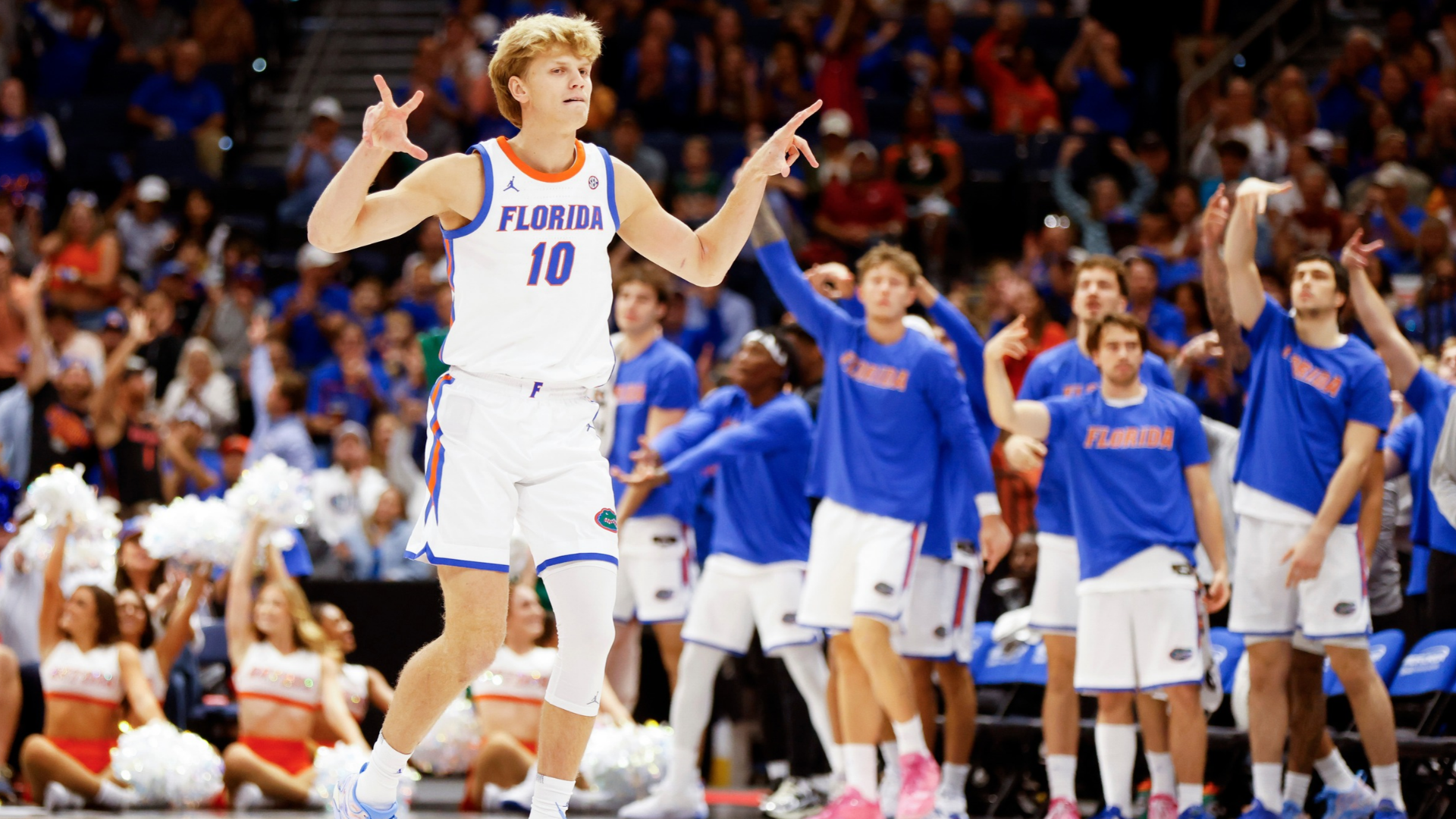
No. 1 Florida opens season with convincing victory vs. Miami: Gators show why they deserve No. 1 ranking

Man and boy arrested after allegedly attacking One Nation volunteer with baseball bat in Australia

European force to hold first Ukraine support exercise in Poland

North Korea denies being behind record $6.3bn Binance hack

Missouri's CJ Gunn ruled ineligble by SEC, Tigers starting C Jaylen Carey indefinitely suspended

Russian strikes kill 26 in Ukraine after longest ceasefire ends

NFL reinstates James Pearce Jr. after eight-game suspension: Why EDGE returns at critical time for Falcons
Latest
UK and EU agree draft deal to scrap Brexit red tape over food exports
No. 1 Florida opens season with convincing victory vs. Miami: Gators show why they deserve No. 1 ranking
Man and boy arrested after allegedly attacking One Nation volunteer with baseball bat in Australia
European force to hold first Ukraine support exercise in Poland
North Korea denies being behind record $6.3bn Binance hack
Missouri's CJ Gunn ruled ineligble by SEC, Tigers starting C Jaylen Carey indefinitely suspended
Russian strikes kill 26 in Ukraine after longest ceasefire ends
NFL reinstates James Pearce Jr. after eight-game suspension: Why EDGE returns at critical time for Falcons