BRICS+ Series: Gulf powers rush to Tehran as the clock runs down to polling day
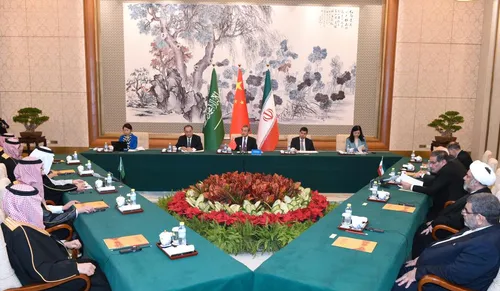
Wang Yi, a member of the Political Bureau of the Communist Party of China (CPC) Central Committee and director of the Office of the Foreign Affairs Commission of the CPC Central Committee, presides over the closing meeting of the talks between a Saudi delegation and an Iranian delegation in Beijing, capital of China, March 10, 2023.
Three of the Middle East’s most consequential states sent senior figures to Tehran on Monday in an attempt to stop a stalled war from reigniting. Saudi Arabia’s defence minister, Prince Khalid bin Salman, travelled alongside Pakistan’s army chief, Asim Munir, and Turkey’s intelligence chief, Ibrahim Kalin, to meet President Masoud Pezeshkian and other senior Iranian officials. Riyadh said the mission was meant to encourage dialogue and back the mediation efforts of Qatar and Pakistan, while Iranian state media reported that all four countries had agreed to keep talking.
The visit matters chiefly because of its timing. The war began in February, when US and Israeli strikes killed Iran’s supreme leader, Ayatollah Ali Khamenei, along with much of his military leadership. Donald Trump has since promised not to attack Iran before the American midterm elections on 3 November, yet speculation is mounting that he may order fresh strikes once the ballots are counted. Two US officials told CNN that sufficient forces are now in the region, and that any new operation would go well beyond the limited raids on radars and launchers seen in recent months.
Saudi Arabia has more reason than most to want calm. Iran and its proxies have struck Saudi oil facilities and civilian infrastructure throughout the conflict, and the Houthis in Yemen have lately escalated. Their attacks on Riyadh’s King Khalid International Airport have killed at least 13 people, wounded more than 300 and forced the airport to close. President Trump has accused the Houthis of stepping up attacks to push up energy prices before the election, and has warned that he will return to the matter once the vote is over. Reuters has reported that Iran’s Revolutionary Guards encouraged the escalation, which Tehran denies. Monday’s meeting was the first high-level contact between Iran and Saudi Arabia since the Houthi surge began.
Oil and shipping explain why the stakes reach far beyond the Gulf. Iran has largely stepped back from heavy missile barrages on its neighbours in favour of economic pressure, chiefly by menacing the Strait of Hormuz, through which a fifth of the world’s oil and gas normally passes. A record 12 vessels reported attacks in and around the strait in the week to 11 October, and although Middle Eastern oil exports have recovered to above their pre-war level, shipping costs remain high. Brent crude has recently topped $105 a barrel, which is awkward for a president whose handling of the war 65 per cent of Americans disapprove of, according to Pew.
The delegation’s composition is also telling. Saudi Arabia, Turkey and Pakistan form the Mecca Alliance, a new pact under which an attack on one is treated as an attack on all, uniting Pakistan’s nuclear arsenal, Turkey’s military strength and Saudi financial muscle. Analysts see it as part of a broader effort to build a more independent regional security architecture as doubts grow about Washington’s reliability. Tehran has urged its neighbours to expel American bases, and some Iranians, including the former foreign minister Mohammad Javad Zarif, regard the initiative as a chance to loosen the region’s dependence on the United States.
Few expect a breakthrough. Hamidreza Azizi of the International Crisis Group argues that Tehran wants credible guarantees against renewed attack, and it is hard to see how Riyadh, Ankara or Islamabad could supply them or sway President Trump. Unless the visitors bring something genuinely new, he says, the trip looks more like a last-minute effort to avert war than the start of a diplomatic process. The Saudis’ position is delicate. They lobbied against resuming major combat in August, yet Washington would need Saudi airspace to carry it out.
That leaves the region watching the calendar. Within days, the political constraint on Mr Trump falls away, while the military and economic pressures on every party remain. The Gulf’s diplomats have bought themselves, at best, a little time. Whether they can turn it into something durable depends on whether Washington and Tehran are willing to give them anything to work with. For ordinary people from Riyadh to Karachi, the cost of failure will be measured in missile alerts and fuel bills.
Past chairman of the BRICS Business Council and co-chairman of the BRICS Media Forum and the BRNN
**The Views expressed do not necessarily reflect the views of Independent Media or IOL.
** MORE ARTICLES ON OUR WEBSITE https://bricscg.com/
** Follow @brics_daily on Twitter for daily BRICS+ updates and instagram @brics_daily
Keywords
Related Stories
Ebola: No new cases in Nigeria as two suspected cases in North-east test negative
Details obtained exclusively by PREMIUM TIMES revealed that a 34-year-old pilot and his wife, a medical doctor, are the two people suspected of having Ebola virus disease in Adamawa State, North-east Nigeria. The post Ebola: No new cases in Nigeria as two suspected cases in…

Ebola: Saudi Arabia suspends travel to Kenya, halts visa issuance
The Saudi Press Agency (SPA) announced the measures in a statement published on its official X account on Friday, 30 October, saying they followed epidemiological assessments by the country’s health authorities The post Ebola: Saudi Arabia suspends travel to Kenya, halts visa…

Group seeks end to health workers’ absenteeism in PHCs
“Our expectation is that the government and other policymakers will take renewed action to ensure that these interventions are implemented across the state,” the group's coordinator said. The post Group seeks end to health workers’ absenteeism in PHCs appeared first on Premium…

Catholic diocese, CAN reject inclusion of clerics in APC campaign list
PREMIUM TIMES reports that the APC in the state had included Mr Obodo and many other Christian clerics in the party's governorship campaign council. The post Catholic diocese, CAN reject inclusion of clerics in APC campaign list appeared first on Premium Times Nigeria.

Top Stories

Hamilton takes first pole for Ferrari at Mexico City Grand Prix

These firms you've never heard of are feeding fears the AI bubble could burst

How the downfall of Serbia's Vučiċ mirrored that of Hungary's Orbán

College football winners, losers: Oregon's Dylan Raiola bounces back, Wisconsin falls flat

On 'tense' Antonelli's big weekend, this was Hamilton's day

Thick fog to create hazardous driving conditions into next week
Oklahoma offense stuck in neutral: Loss to South Carolina highlights key decisions ahead for Brent Venables

No more washing up: How Airbnb's new house rules have divided hosts and guests
Latest
Hamilton takes first pole for Ferrari at Mexico City Grand Prix
These firms you've never heard of are feeding fears the AI bubble could burst
How the downfall of Serbia's Vučiċ mirrored that of Hungary's Orbán
College football winners, losers: Oregon's Dylan Raiola bounces back, Wisconsin falls flat
On 'tense' Antonelli's big weekend, this was Hamilton's day
Thick fog to create hazardous driving conditions into next week
Oklahoma offense stuck in neutral: Loss to South Carolina highlights key decisions ahead for Brent Venables
No more washing up: How Airbnb's new house rules have divided hosts and guests