Court dismisses Duduzile Zuma-Sambudla’s bid to have July unrest charges dropped
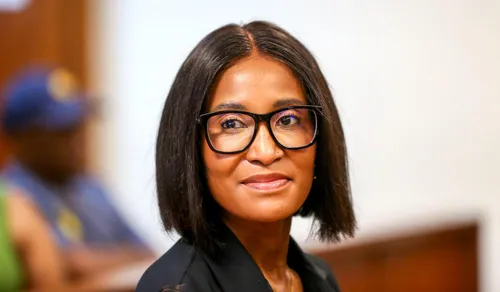
Duduzile Zuma-Sambudla the daughter of former President Jacob Zuma at Durban High Court
The Durban High Court has dismissed Duduzile Zuma-Sambudla’s Section 174 application, meaning she will face legal arguments on charges linked to the July 2021 unrest.
It has refused to discharge Zuma-Sambudla, daughter of former president Jacob Zuma, from charges of incitement to commit public violence and terrorism linked to the July 2021 unrest, ruling that the evidence must be assessed as a whole at the end of the trial.
Judge Mbuzeni Mathenjwa said it would be in the interests of justice for the court to conduct a holistic evaluation of the evidence after hearing the defence case.
Zuma-Sambudla is accused of using social media platform X to incite violence during the July 2021 unrest, following the arrest of her father. The State alleges that she shared posts, videos and pictures that encouraged violence.
After the State closed its case, Zuma-Sambudla, through her lawyer, advocate Dali Mpofu SC, brought an application in terms of Section 174 of the Criminal Procedure Act, seeking to be discharged of the charges.
The State opposed the application, arguing that it had presented a prima facie case against her.
“In the circumstances of this case, it will be only at the end of the trial that the court would be able to determine whether the accused is guilty or not,” Mathenjwa said.
He said the court would then be in a position to make a final assessment of the credibility of witnesses, weigh the probative value of the evidence and determine whether the State had proved its case beyond a reasonable doubt.
Advocate Dali Mpofu SC speaking to MK convener Willies Mchunu, former President Jacob Zuma and ABC leader Philani Mavundla at Durban High Court.
Mathenjwa noted that the State had called seven witnesses, some of whom were involved in investigating the alleged offences.
He explained that, at the Section 174 stage, the court was not required to make a final determination on the credibility of witnesses or whether the State had proved its case beyond a reasonable doubt.
However, he said an accused could be discharged at the close of the State’s case if the evidence was so poor that no reasonable person could accept it.
“In the interest of justice, the court has to consider the evidence holistically at the end of the trial,” he said.
“For these reasons, the application to discharge the accused at the closure of the State case must fail. The application in terms of Section 174 of the Criminal Procedure Act is refused,” he ordered.
After the ruling, the matter was stood down to arrange dates for its continuation.
When proceedings resumed, Mpofu informed the court that the defence would not be calling any witnesses and was closing its case.
“This is the stage at which the case for the defence commences. My instructions are to inform the court that the accused person closes her case, meaning next it’s legal arguments,” he said.
The matter was postponed to May 17, 2027, for legal arguments.
Outside court, National Prosecuting Authority (NPA) spokesperson Natasha Ramkisson-Kara said the ruling meant that the charges against Zuma-Sambudla were valid.
Related Topics
Keywords
Related Stories
I have a picture for you! 01 November-06 November
The First Thing newsletter's Ever-lasting Subscriber Photo Gallery.

ENVIRONMENTAL JUSTICE: African climate voices demand fair funding and influence before COP31
The winds, drought and excessive rains of climate change are blowing in Africa and it’s time for the Global North to listen and deliver on its climate finance promises. At COP31 in Turkey, which runs from 9-20 November, African countries will need greater weight in…

Diwali lamingtons with jam and coconut
These soft cake squares are coated in raspberry jam and desiccated coconut for a simple twist on the classic lamington.

ActionSA to negotiate for Nasiphi Moya to serve another five years as Tshwane mayor
ActionSA National Chairperson Michael Beaumont has thrown his weight behind Dr Nasiphi Moya serving another term as Tshwane mayor, saying the party will negotiate to ensure she remains at the helm of the metro for five more years.
Top Stories
I have a picture for you! 01 November-06 November
ENVIRONMENTAL JUSTICE: African climate voices demand fair funding and influence before COP31

Met chief says he wouldn't be surprised if more allegations made about Brand after rape conviction
Diwali lamingtons with jam and coconut

Train worker recalls repelling attacker with frying pan
ActionSA to negotiate for Nasiphi Moya to serve another five years as Tshwane mayor

Katherine Ryan says she feels 'grief and relief' after Russell Brand conviction

Two Gloucester schools in lockdown after boy hurt in incident
Latest
I have a picture for you! 01 November-06 November
ENVIRONMENTAL JUSTICE: African climate voices demand fair funding and influence before COP31
Met chief says he wouldn't be surprised if more allegations made about Brand after rape conviction
Diwali lamingtons with jam and coconut
Train worker recalls repelling attacker with frying pan
ActionSA to negotiate for Nasiphi Moya to serve another five years as Tshwane mayor
Katherine Ryan says she feels 'grief and relief' after Russell Brand conviction
Two Gloucester schools in lockdown after boy hurt in incident