EPA throws in the towel on policing air pollution from factory farms
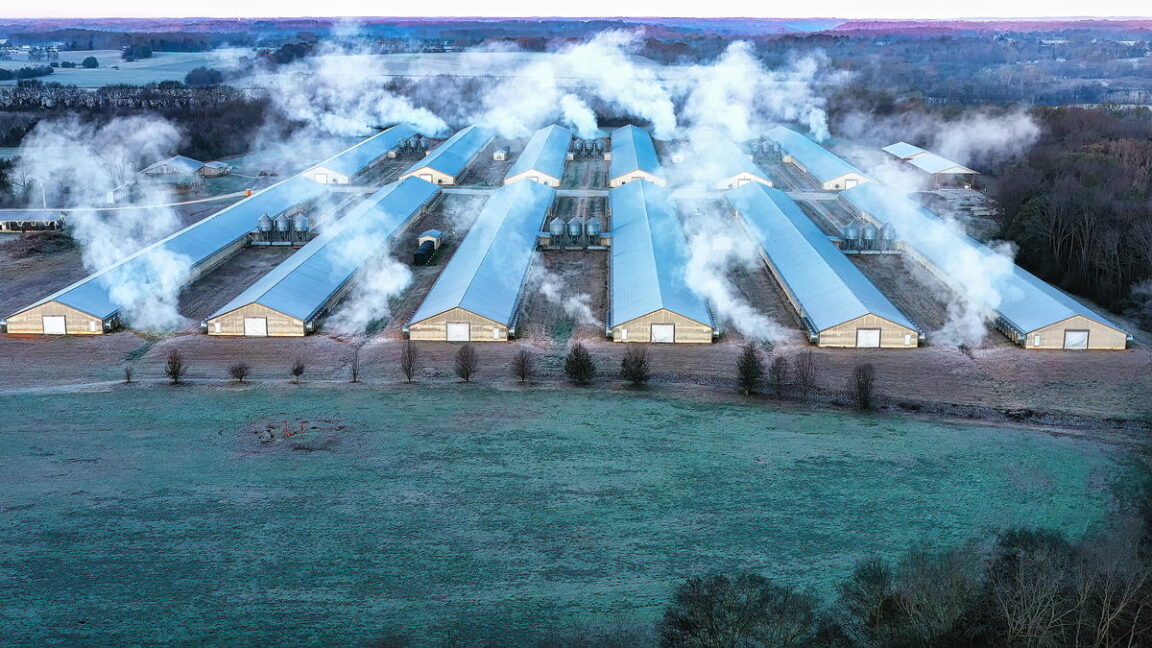
The Environmental Protection Agency late last week announced it would end a 20-plus-year effort to develop methods to monitor air pollution from factory farms, effectively shuttering the agency’s stop-and-start attempts to regulate the potentially pollutant-spewing facilities under the Clean Air Act.
The announcement came just days before the midterm elections and was characterized by the agency as a long-awaited reprieve for farmers, a historically important constituency for Trump and the Republican Party.
When tens of thousands of animals are packed into one place, pollution from their waste is blown from ventilation fans or emanates from giant lagoons of liquid effluent. Livestock facilities emit fine particulate matter, ammonia, nitrogen oxides, sulfur dioxide, and volatile organic compounds, all contributing to a toxic mix. Research has shown that emissions from these operations are a major cause of air pollution, causing nearly 12,700 deaths in the United States a year.
Strictly speaking, concentrated animal feeding operations, or CAFOs, are required to get permits under the Clean Air Act and report emissions of these pollutants under the Comprehensive Environmental Response, Compensation and Liability and Act and the Emergency Planning and Community Right-to-Know Act. But through a deal crafted in tandem with the EPA and the livestock industry, they’ve been given amnesty from doing so for more than 20 years.
The arrangement goes back to the early 2000s when the agency attempted to prosecute CAFOs for exceeding limits on some of these pollutants. The industry pushed back, arguing there was no adequate way of measuring them. So the agency worked with industry groups to develop what was dubbed the Air Consent Agreement, through which the EPA granted thousands of CAFOs safe harbor from legal action in exchange for their participation in a study that was funded by the industry.
The goal of the study, the agency said, was to develop tools and models that CAFOs could use to “determine whether they emit pollutants at levels that require them to apply for permits under the CAA or submit notifications under CERCLA or EPCRA” and “produce a scientifically sound basis for measuring and estimating air emissions” from these facilities.
But since the adoption of the agreement in 2005, the agency has failed to produce any air “emissions estimating methodologies,” even prompting a 2017 report from the agency’s Office of Inspector General that faulted it for slow-walking the process.
Meanwhile, the Trump administration and Congress have also gutted reporting requirements for factory farms to report air pollutants under CERCLA, also known as the Superfund Act, and EPCRA.
“As EPA has been saying it’s proceeding with this plan, it’s been dismantling all of its own tools to regulate emissions,” said Tarah Heinzen, the legal director for the advocacy group Food & Water Watch, which has tracked the proceedings from the beginning and filed dozens of lawsuits attempting to push regulators to control pollution from CAFOs. “Now it has announced it has no intention, basically, of ever holding factory farms accountable under the Clean Air Act, either.”
In its October 30 announcement, the agency noted that in the two decades since the study, known as the National Air Emissions Monitoring Study, was conducted, many farms have modernized their barns and manure systems.
“Good science requires good data, and these data are too old and too limited to support methods that farms could rely on,” said Abigale Tardif, the acting assistant administrator for the agency’s Office of Air and Radiation, in a statement. “We would rather tell farmers that plainly than issue numbers we cannot stand behind.”
Rob Brenneman, president of the National Pork Producers Council, which has long pushed for the decision, said in a statement: “This move confirms what farmers have long known: Every farm is different, and there is no one-size-fits-all model to apply to them.”
Heinzen noted that the agency’s decision simply means that this administration has no intention of regulating air emissions from CAFOs, but for now, the Clean Air Act still requires permits for facilities that exceed emissions thresholds. The amnesty granted to these facilities will no longer be in effect now that the agreement has concluded.
“There’s no EPA-issued methodology to estimate emissions,” she said. “That doesn’t mean that there aren’t good studies out there of emissions from different types of animal feeding operations that can be used.”
Heinzen pointed to California, which has models for livestock emissions that it uses to enforce its own air regulations. “We just don’t have one set of national emissions factors from EPA,” Heinzen said. “That does not absolve these factory farms from their obligation to comply with federal law.”
Still, under this administration, it’s clear air emissions from factory farms won’t be measured and monitored any time soon. “No one’s going to estimate anything,” Heinzen noted. “As EPA said in its press release, we’re certainly not about to try to enforce the law.”
The Air Compliance Agreement did not extend to methane. The US livestock industry is the single-biggest source of methane in the country, but Congress effectively blocks livestock facilities from reporting methane emissions in annual spending bills.
Georgina Gustin covers agriculture for Inside Climate News, and has reported on the intersections of farming, food systems and the environment for much of her journalism career. Her work has won numerous awards, including the John B. Oakes Award for Distinguished Environmental Journalism, and she was twice named the Glenn Cunningham Agricultural Journalist of the Year, once with ICN colleagues. She has worked as a reporter for The Day in New London, Conn., the St. Louis Post-Dispatch and CQ Roll Call, and her stories have appeared in The New York Times, Washington Post and National Geographic’s The Plate, among others. She is a graduate of the Columbia University Graduate School of Journalism and the University of Colorado at Boulder.
This story originally appeared on Inside Climate News.
 1.
Coming in 2027: Apple’s $1,000 home robot for FaceTime and switching on lights
Related Topics
Keywords
Related Stories
Canva is announcing changes and layoffs affecting 22 percent of its staff
Canva is making significant changes affecting 1,271 people, which is 22 percent of its staff, co-founder and CEO Melanie Perkins announced today. "For some people, this will mean changes to their roles or being asked to relocate to centralised hubs," says Perkins. "Sadly, it…

Sonos adds new Presets and prepares for the 27voice AI beta
Sonos is rolling out a big app update that includes new Presets and early access to its AI voice assistant. You can create a preset to play music at a specific volume in a certain room, which will appear directly on the homescreen so you can quickly start playback. If you're in…

Valve is making changes to deal with a ‘significant increase’ in Steam game submissions
In a new post today, Valve acknowledged that it's seen "a significant increase in submissions for store and page review in recent months" and says it's "running a little behind" by taking "up to 12 business days" for reviews instead of the typical 3-5 days. Indie developers have…

Binance says hackers used fake job interviews and an internal AI tool to pull off the $6.3 billion heist
The largest crypto theft to date was pulled off by combining some well-known hacking techniques over the course of a few months, according to Binance. A postmortem from the company says the process that started with one developer downloading a tampered installer in June…

Top Stories

LOCAL ELECTIONS 2026: IEC tightens security amid ballot disruptions, arrests and election intimidation
Canva is announcing changes and layoffs affecting 22 percent of its staff

PAYMENT MODELS: Riding the e-commerce buy now, pay later hype train while it lasts

Champions League expert picks, predictions, best bets: Manchester City aim for turnaround vs. RB Leipzig

2027: Tinubu’s performance enough for his re-election, says education minister Tunji Alausa

Dave Richard's Week 9 Trade Chart and rest of season rankings: Jets, Raiders RBs in flux

NBS: Enugu records lowest ‘tax revenue-to-IGR ratio’

Manchester United stun Roma with three-goal second-half Champions League comeback after dreadful start
Latest
LOCAL ELECTIONS 2026: IEC tightens security amid ballot disruptions, arrests and election intimidation
Canva is announcing changes and layoffs affecting 22 percent of its staff
PAYMENT MODELS: Riding the e-commerce buy now, pay later hype train while it lasts
Champions League expert picks, predictions, best bets: Manchester City aim for turnaround vs. RB Leipzig
2027: Tinubu’s performance enough for his re-election, says education minister Tunji Alausa
Dave Richard's Week 9 Trade Chart and rest of season rankings: Jets, Raiders RBs in flux
NBS: Enugu records lowest ‘tax revenue-to-IGR ratio’
Manchester United stun Roma with three-goal second-half Champions League comeback after dreadful start