Ex-Israeli diplomat calls opposition's refusal to work with Arab parties 'reckless'
Middle East
By
Steve Inskeep
,
Majd Al-Waheidi
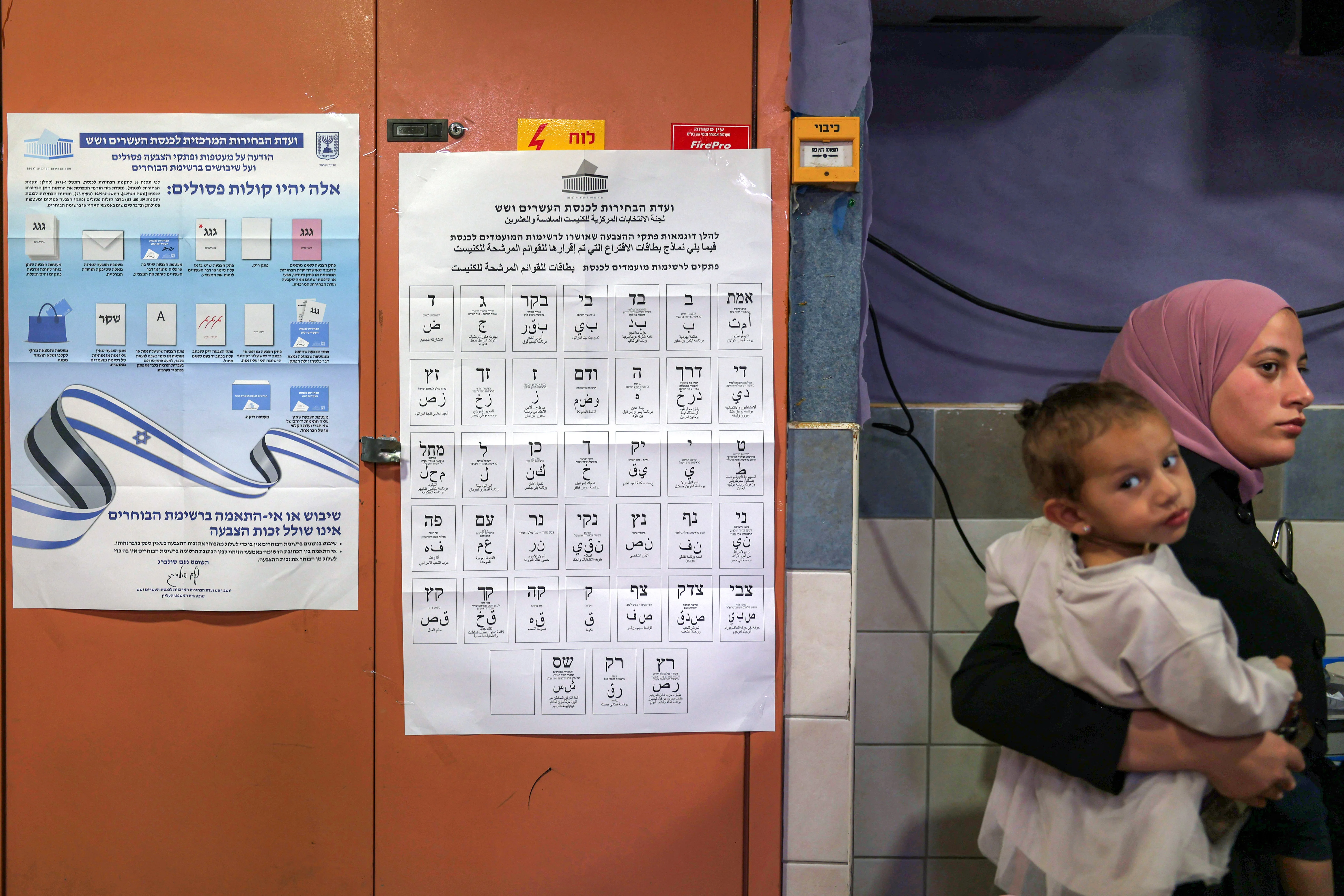
A woman carries a child past a sign displaying political parties' electoral symbols at a polling station in the southern Bedouin city of Rahat, Israel, on Oct. 27, during Israel's parliamentary election. Hazem Bader/AFP via Getty Images hide caption
Middle East
Partial results from Israel's contentious election show no clear winner
The strong showing by Arab-led parties in Israel's election has raised a question for the opposition: Will its leaders work with them to form a government?
Political observers doubt such a partnership will materialize, given the unwillingness of several opposition leaders to work with Arab-led parties. Alon Pinkas, an Israeli political analyst and former diplomat who advised former Prime Ministers Ehud Barak and Shimon Peres, called that reluctance "myopic and reckless."
Pinkas told Morning Edition that opposition leader Gadi Eisenkot could either form a coalition with the parties or establish a minority government with their outside support, allowing them to back major legislation and confidence votes without formally joining the coalition.
But both Eisenkot and Prime Minister Benjamin Netanyahu have rejected working with Arab-led parties, which draw much of their support from Palestinian citizens of Israel. Netanyahu went further, calling the prospect of a government relying on their support "a shame and a disgrace."
Speaking with NPR's Steve Inskeep, Pinkas challenged arguments that relying on Arab-led parties would undermine Israel's identity as a Jewish state. He questioned why the same reasoning would not apply to ultra-Orthodox Jewish parties, which he said describe themselves as non-Zionist.
Pinkas attributed growing support for Arab-led parties to rising crime and murder rates in Arab communities, particularly violence involving organized crime groups. He said Netanyahu's government had "willfully ignored their plight" by failing to deploy police or investigate the killings.
As for Netanyahu's chances of forming a government, his assessment was emphatic: "Mr. Netanyahu cannot. I repeat, cannot form a government."
Listen to the full interview by clicking on the blue button above.
The digital version of this interview was edited by Treye Green.
NPR does not offer or accept money for coverage or interviews.
Anyone who makes such an offer or request is not an NPR employee and does not represent NPR.
Related Topics
Keywords
Related Stories
How the downfall of Serbia's Vučiċ mirrored that of Hungary's Orbán
Defeat for Serbia's Aleksandar Vučiċ in last weekend's vote was a carbon copy of Viktor Orbán's fall in Hungary.

India's opposition set to hold mega rally seeking election chief's resignation
It comes amid growing protests over a voter roll revision exercise feared to leave 130 million voters off rolls.

I've been stuck on a tiny Pacific island for years and can't get a transit visa to fly home
Ruchira Ranasingha, 50, has been stranded in the Cook Islands since 2023 and wants to return to Sri Lanka.

France seethes again as youth-led protests sweep Europe
French Interior Minister Laurent Nuñez warned of a "very high risk" of disorder, especially after dark on Halloween, as some 320,000 people nationwide took to the streets.

Top Stories

Hamilton takes first pole for Ferrari at Mexico City Grand Prix

These firms you've never heard of are feeding fears the AI bubble could burst
How the downfall of Serbia's Vučiċ mirrored that of Hungary's Orbán
College football winners, losers: Oregon's Dylan Raiola bounces back, Wisconsin falls flat

On 'tense' Antonelli's big weekend, this was Hamilton's day

Thick fog to create hazardous driving conditions into next week
Oklahoma offense stuck in neutral: Loss to South Carolina highlights key decisions ahead for Brent Venables

No more washing up: How Airbnb's new house rules have divided hosts and guests
Latest
Hamilton takes first pole for Ferrari at Mexico City Grand Prix
These firms you've never heard of are feeding fears the AI bubble could burst
How the downfall of Serbia's Vučiċ mirrored that of Hungary's Orbán
College football winners, losers: Oregon's Dylan Raiola bounces back, Wisconsin falls flat
On 'tense' Antonelli's big weekend, this was Hamilton's day
Thick fog to create hazardous driving conditions into next week
Oklahoma offense stuck in neutral: Loss to South Carolina highlights key decisions ahead for Brent Venables
No more washing up: How Airbnb's new house rules have divided hosts and guests