Expert warns SAPS must act on threats before political killings escalate ahead of elections
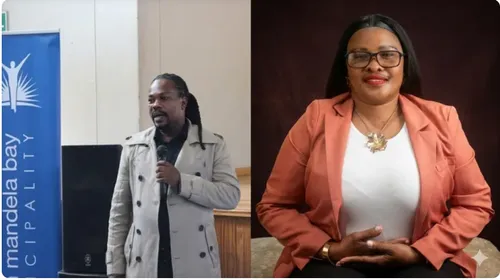
ANC Nelson Mandela Bay Ward 27 councillor Sicelo Mleve (left) and DA Dunoon by-election ward candidate Sinovuyo Dyokwe (right) were brutally killed
A warning by independent crime analyst Calvin Peter Rafadi that police must act earlier on threats against politicians. This comes as a spate of killings involving politically connected people raises fears over candidate safety ahead of the 2026 local government elections.
Among those killed was DA ward candidate Sinovuyo Dyokwe, who was shot and killed in Dunoon, Cape Town, after reportedly spending the day assisting with voter registration efforts.
On the same day Build One South Africa (BOSA) Gugulethu ward candidate Leon Ngcikwe’s was killed on his way back home from a registration drive to drop his daughter, leaving again to drop off the rest of his colleagues.
ANC councillor Sicelo Mleve was also killed in Zwide, Gqeberha, while two MK Party members were killed in Bekkersdal on the West Rand.
The murders have placed renewed focus on SAPS, Crime Intelligence and election security structures as political parties prepare for campaigning ahead of the November polls.
Rafadi urged the SAPS Crime Intelligence Division to strengthen its risk and threat assessment units and prioritise outstanding cases and inquiries.
He said enhancing these capabilities would allow police to take a more proactive approach to preventing political assassinations, particularly as South Africa prepares for the upcoming local government elections.
According to Rafadi, many victims of politically motivated killings often received threats before they were attacked.
For this reason, he said all threat-related complaints reported at local police stations should be promptly referred to SAPS Crime Intelligence for comprehensive risk and threat assessments.
Rafadi said where credible threats were identified, Crime Intelligence could recommend appropriate protective measures, including the deployment of undercover police personnel where justified.
He also suggested that political parties should consider strengthening the safety of their candidates through additional registered private security where necessary, in line with existing cooperation and security memorandum arrangements with law enforcement agencies.
Rafadi said improving intelligence-led policing and early threat detection would significantly enhance the prevention of politically motivated violence and help safeguard democratic processes during the election period.
His warning comes as Acting Police Minister Firoz Cachalia has indicated that SAPS has started responding to the recent killings through specialised policing structures.
According to reports, the Political Killings Task Team has been brought in to assist with investigations into the latest murders involving politically connected people.
Cachalia has also raised concern about the possibility of further violence ahead of the elections, while indicating that investigators would still need to determine whether each case was politically motivated or linked to other criminal activity, including organised crime.
He has previously indicated that election security planning would include intelligence gathering, threat assessments, monitoring political gatherings and identifying hotspot areas.
Security structures have also reportedly been set up at national and provincial level, with SAPS and the Electoral Commission of South Africa involved in committees responsible for safety and security planning around the elections.
The Electoral Commission of South Africa said election security remained the responsibility of police and the broader security cluster.
In response to questions from Weekend Argus about what plans were being put in place to ensure candidates were protected following the recent murders, the IEC said: “Thank you for reaching out to the Electoral Commission. However election security remains the responsibility of the police, we kindly request you direct your query to the security cluster.”
The IEC was asked what specific steps it was taking to help ensure the safety of candidates and party representatives ahead of the local government elections.
The Commission was also asked whether it had requested or received any threat assessments from SAPS or NATJOINTS following the recent killings, and how the IEC and law enforcement would identify high-risk wards, candidates or campaign areas where extra security may be needed.
However, the IEC referred the matter to the security cluster.
JP Smith, the City of Cape Town’s Mayco member for safety and security, said he had asked for an update from City investigative staff who were liaising with SAPS as the City attempted to follow up on potential extortion matters brought to its attention.
“I have asked for an update from the City investigative staff who are liaising with SAPS as we attempt to follow up on potential extortion matters brought to our attention - the investigation is being actively pursued,” Smith said.
“SAPS would need to draw in the PKTT, but we are informed that the investigation is being overseen by senior Provincial SAPS leadership.
“There were also killings in Gauteng, KZN and the Eastern Cape, so there are early signs of the LGE26 being plagued by political violence and SAPS will need to prioritise resources or the PKTT to investigate and develop crime intelligence on this to ensure free and fair elections,” Smith said.
BOSA’s Roger Solomons said the safety of the party’s candidates, volunteers and campaign teams was a top priority.
He said BOSA had implemented internal protocols requiring campaign teams to conduct risk assessments before engagements, avoid unnecessary high-risk situations, maintain regular communication with provincial and national leadership, and promptly report incidents of intimidation or threats.
Solomons said there had been instances where candidates raised concerns about intimidation or tensions in certain communities.
Where concerns were reported, he said they were treated seriously, documented and escalated to the appropriate authorities where necessary.
“At this stage, we are not aware of any incidents that have prevented our candidates from continuing to engage communities,” Solomons said.
He said BOSA assessed security requirements based on the circumstances in each area and would implement appropriate measures in consultation with law enforcement and security professionals if credible threats arose.
“Our preference is that all candidates, irrespective of political affiliation, should be protected by effective policing and a secure electoral environment, rather than requiring private security to participate in a democratic election,” Solomons said.
He said recent incidents showed that more needed to be done.
“Political violence has no place in a constitutional democracy, and every attack on a candidate or political activist undermines the integrity of our electoral system. BOSA calls on law enforcement agencies to investigate all politically motivated crimes swiftly, prosecute those responsible without fear or favour, and ensure visible policing in areas identified as high risk,” he said.
GOOD secretary-general Brett Herron said the killing of politically connected people was frightening and reflected a wider sense of instability in society.
“The killing of politically connected people is obviously scary, as is the general societal feeling among so many people that there is little in their lives to lose if they indulge in anti-social and/or illegal behaviour.
"We don’t have special plans in place to protect our candidates, but rely on the protection their close community connections afford them. Should we pick up any need for further action we will act appropriately.”
Related Topics
Keywords
Related Stories
UN peacekeeping mission in Western Sahara ends after 35 years, UN chief says
Nov 1 (Reuters) - The 35-year-old UN peacekeeping mission in the Western Sahara region will come to an end after the Security Council failed to renew its mandate, the UN chief said on Sunday.
CONGRESS IN THE BALANCE: A blue tsunami, a tide, or chaos as usual — the US midterm election
With just hours to go before the American midterm election takes place, the day before South Africa’s own local election, control of both houses of the American Congress hangs in the balance.
DIVISIVE WORDS: ‘We never called for literal killing’ — Malema appeals for farm killings to stop.
EFF leader Julius Malema says the chant “Kill the boer, kill the farmer” was never meant literally and has appealed for farm killings to stop.
TRC ROULETTE : Victims’ families place key hidden evidence before Khampepe inquiry
A physical inspection of old lever arch files by the legal team representing the families of apartheid victims at the Khampepe Commission strengthens Anton Ackermann’s claim that a disputed 2006 memo was forged, reshaping the Khampepe inquiry into delayed apartheid prosecutions.
Top Stories
UN peacekeeping mission in Western Sahara ends after 35 years, UN chief says
Week 8 overreactions: Time for Vikings to bench Kyler Murray? Colts should fire Steichen?

NFL Week 8 winners and losers: Cowboys suffer epic collapse, Joe Burrow delivers historic heroics

How Antonelli 'blew everyone away' to make Formula 1 history

Why is Ashton Jeanty not getting carries? Another Raider emerges as Vegas' top RB in Week 8

Russia and Ukraine accuse each other of hacking emergency alert apps

NFL Week 8 grades for every team: Cowboys get an 'F' for choking, Steelers surge to 'A+'

Ukraine air raid app apparently hacked as users receive false radiation threat, Air Force says
Latest
UN peacekeeping mission in Western Sahara ends after 35 years, UN chief says
Week 8 overreactions: Time for Vikings to bench Kyler Murray? Colts should fire Steichen?
NFL Week 8 winners and losers: Cowboys suffer epic collapse, Joe Burrow delivers historic heroics
How Antonelli 'blew everyone away' to make Formula 1 history
Why is Ashton Jeanty not getting carries? Another Raider emerges as Vegas' top RB in Week 8
Russia and Ukraine accuse each other of hacking emergency alert apps
NFL Week 8 grades for every team: Cowboys get an 'F' for choking, Steelers surge to 'A+'
Ukraine air raid app apparently hacked as users receive false radiation threat, Air Force says