Global market rout deepens after midterms intensify AI fears
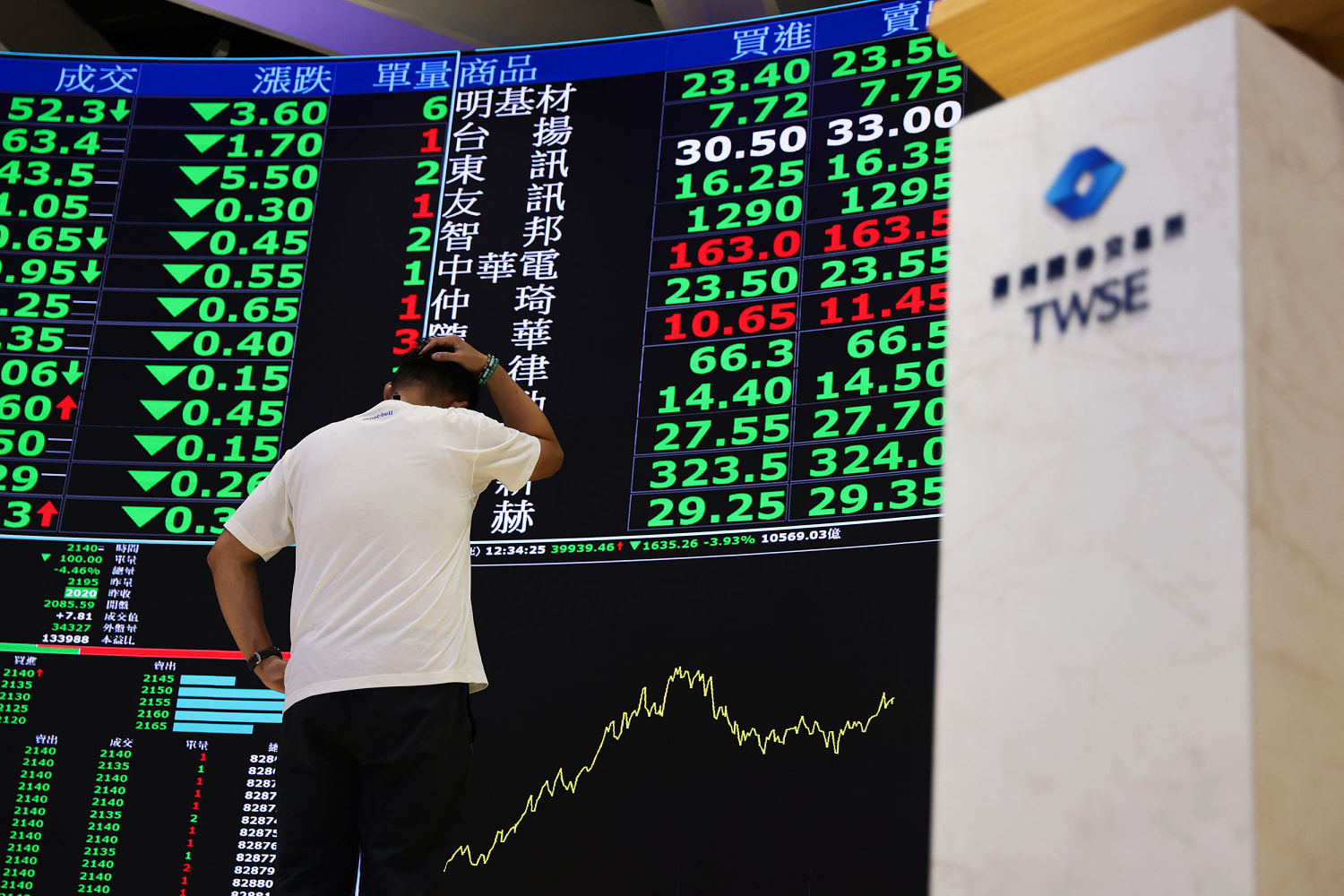
HONG KONG — An intensifying rout of tech stocks hit global markets Friday, with a surge of red tickers spreading from Wall Street to Asia and Europe after the blue wave of the U.S. midterm elections fueled fears over AI development. The steep losses in Asia — Japan’s Nikkei suffered its worst week since 2020 — came after a dramatic plunge in U.S. tech stocks following the success of anti-AI candidates, which deepened concerns about the durability of the artificial intelligence boom. Some $2.3 billion in market value was wiped off the tech-focused Nasdaq 100, which dropped 6.3% Thursday. Another $2.8 trillion was erased from the S&P 500’s market value as it fell 4.4% — the worst day for both indexes in 18 months, when President Donald Trump’s global tariffs rocked markets. U.S. futures were mixed early Friday, but European shares also opened lower after the dramatic sell-off continued in Asia. South Korea’s Kospi index tumbled more than 8%, triggering a temporary market-wide trading halt. There, AI data center memory suppliers Samsung and SK Hynix plunged more than 10% in the early hours, before recovering some of their losses. Japan’s Nikkei 225 index fell as much as 6%, entering bear-market territory. In Taiwan, home to some of the most critical AI companies, including chip supplier TSMC, the benchmark TAIEX index dropped 9%. The picture was little better in Europe. London’s FTSE 100 index fell by nearly 2%, while the French and German indexes, CAC40 and DAX, took similar hits. “Markets are being punished according to their dependence on the U.S. AI infrastructure cycle,” Charu Chanana, chief investment strategist at Singapore-based SAXO Markets, told NBC News in emailed comments. The companies in Taiwan, South Korea and Japan are “clearly highly linked to the global AI capex cycle and hence I am not surprised to see the magnitude of correction today following the sharp correction in the U.S.,” Tai Hui, J.P. Morgan’s APAC chief market strategist, told NBC News in emailed comments. The plunge came after the stunning midterm results that will see a crop of anti-AI and data center opponent politicians take office, including Gov.-elect Gina Hinojosa in Texas, the largest data center market in the country. The Democratic Congress could tighten scrutiny of the industry, including AI infrastructure projects, which could cause delays and additional costs, adding to worries investors have about the profitability of these investments. Asian markets were already in trouble The months leading up to the American elections had already been a rollercoaster for Asian investors, who saw their fortunes soar in June during the AI stock boom, but have been suffering from a brutal recent sell-off. A sense that initial valuations of key AI companies were inflated was troublesome enough for markets in Asia, but the Democratic sweep has introduced another layer of uncertainty. Markets had largely expected losses for Trump’s Republicans, but not on this scale. “This matters enormously for Asia because much of the hardware supporting America’s AI ambitions is manufactured here,” Chanana, from SAXO Markets, said. Some of the Asian companies at the heart of the AI supply chain surged to astonishing heights. The Chinese market offered access to frontier AI companies that recently began going public — months earlier than their American counterparts like Anthropic, which is still preparing for its IPO. Model maker Z.ai rose by 2,000% in June after debuting in January. But corrections came swiftly, with Z.ai now down over 80% since its peak and on Friday shedding another 10%. Lofty valuations of other Chinese companies have also cratered, with mainland China’s Star 50 index, which comprises the country’s semiconductor and AI leaders, now at half of its June peak with half a trillion in market value wiped out. On Friday, both the tech-focused Star 50 and the AI Index slumped as much as 5% before recouping some losses. “There is a legitimate argument that parts of China’s AI equity bubble have already burst,” Chanana said. But she added that unlike the U.S., where much of the investment is commercially driven, “China treats AI and semiconductor self-sufficiency as strategic national priorities.” “This means investment can continue for reasons beyond immediate profitability, including technological independence, industrial competitiveness and national security.” That is not the case in South Korea, whose market darlings, memory makers SK Hynix and Samsung, are an integral part of the commercial AI buildout. That makes the country particularly sensitive to any U.S. slowdowns. South Korea’s benchmark Kospi index more than doubled in market value in June, but by Friday had shed most of the gains made this year. Like South Korea, there is acute exposure for Taiwan — key for advanced chip manufacturing and TSMC’s headquarters. Nevertheless, most of the Asian indexes are still higher than they were a year ago: South Korea’s Kospi is up 25%, Japan’s Nikkei 225 is up 13%, and TSEC Taiwan Technology is also up by 47%. “For semiconductor and memory makers in Asia Pacific, as long as global demand for computing power continues to grow, demand for the underlying hardware should remain healthy over the medium term,” J.P. Morgan’s Hui said. “There may be constraints on where the ‘gold’ can be mined, but as long as demand for the gold remains, the picks and shovels will still be needed elsewhere,” he added.
Related Topics
Keywords
Related Stories
Russian extremist group denies sending hoax bomb threats
Scores of flights across Europe have received bomb threats this week, but no explosives have been found so far.

Two dead after bus crashes in France, officials say
One child and one young adult were killed in the crash, local authorities say, with more injured.

Homes and temples glow across India as Diwali celebrations begin
Millions of Indians will mark the festival of lights with glowing lamps, fireworks and traditional sweets

What to know about the presidential wiretapping scandal rocking Indonesia
The scandal involves senior members of President Prabowo Subianto's government, and hint at growing tensions among its elites.

Top Stories
I have a picture for you! 01 November-06 November

ENVIRONMENTAL JUSTICE: African climate voices demand fair funding and influence before COP31

Met chief says he wouldn't be surprised if more allegations made about Brand after rape conviction
Diwali lamingtons with jam and coconut

Train worker recalls repelling attacker with frying pan
ActionSA to negotiate for Nasiphi Moya to serve another five years as Tshwane mayor

Katherine Ryan says she feels 'grief and relief' after Russell Brand conviction

Two Gloucester schools in lockdown after boy hurt in incident


Latest
I have a picture for you! 01 November-06 November
ENVIRONMENTAL JUSTICE: African climate voices demand fair funding and influence before COP31
Met chief says he wouldn't be surprised if more allegations made about Brand after rape conviction
Diwali lamingtons with jam and coconut
Train worker recalls repelling attacker with frying pan
ActionSA to negotiate for Nasiphi Moya to serve another five years as Tshwane mayor
Katherine Ryan says she feels 'grief and relief' after Russell Brand conviction
Two Gloucester schools in lockdown after boy hurt in incident