James Webb Space Telescope forecasts extreme weather on exoplanet that rains rubies and sapphires
Breaking space news, the latest updates on rocket launches, skywatching events and more!
Become a Member in Seconds
Unlock instant access to exclusive member features.
You are now subscribed
Your newsletter sign-up was successful
Want to add more newsletters?
Join the club
Get full access to premium articles, exclusive features and a growing list of member rewards.
Imagine a world where the weather forecast calls for winds blowing at 11,000 miles per hour (18,000 kilometers per hour) and nighttime showers of liquid metal, rubies and sapphires.
This is the chaotic reality astronomers have pieced together for WASP-121b, an "ultra-hot Jupiter" that ranks among the most extreme planets known beyond the solar system.
The gas giant orbits its host star at such a punishingly close distance that a single "year" there lasts just 30.5 hours. At that proximity — so close that if it got any closer, stellar gravity would start ripping it apart — the host star's immense tidal forces have warped the planet from a sphere into a football-like shape. Temperatures on its dayside climb high enough to vaporize metals, while previous studies have suggested that iron may condense and fall as rain on the cooler nightside. Now, astronomers using the James Webb Space Telescope (JWST) have added another piece to the world's meteorological portrait.
By tracking subtle changes in starlight passing through WASP-121 b's atmosphere as the planet crossed in front of its star, researchers detected differences between atmospheric conditions at dawn and dusk, according to the study.
"With its unprecedented observational quality, JWST gives us the most detailed glimpses into distant planets to date," study lead author Cyril Gapp of the Max Planck Institute for Astronomy in Germany, said in a statement.
"By measuring how star light absorption changes as WASP-121 b rotates, we probe its atmosphere longitude by longitude," Gapp said.
The observations suggest that the planet's evening terminator — the region rotating out of daylight — is hotter than its morning counterpart. The finding is consistent with powerful winds transporting heat from the planet's intensely hot dayside toward its cooler nightside, researchers say.
Because WASP-121 b is tidally locked to its star, one hemisphere permanently faces the star while the other remains in darkness. Yet, during a transit, the planet rotates just enough from JWST's vantage point for different regions of its atmosphere to come into view.
By examining how the atmospheric signal changed over time, Gapp and his team found that the evening side absorbed slightly more starlight than the morning side, the study reports. The researchers also detected changes in signals associated with water vapor and carbon monoxide, which they interpret as evidence of temperature differences across the atmosphere.
The hotter evening side appears warm enough to break apart water molecules in the upper atmosphere, the study notes. The cooler morning side, meanwhile, may be partially obscured by clouds made of silicate minerals, although the study notes more sophisticated models will be needed to determine whether such clouds are indeed present.
The findings add to a growing body of research of turbulent weather on WASP-121 b, including recent data from the Very Large Telescope in Chile that revealed complex, layered and violent wind patterns and jet streams spanning half the world.
Previous observations with the Hubble Space Telescope also found evidence that magnesium and iron were escaping from the planet's atmosphere, likely driven by intense ultraviolet radiation from its host star.
The team's new technique could eventually be applied to other ultra-hot planets, allowing astronomers to compare atmospheric conditions across a broader sample of distant worlds, the study notes.
The study was published Wednesday (June 10) in the journal Nature Astronomy.
Sharmila Kuthunur is an independent space journalist based in Bengaluru, India. Her work has also appeared in Scientific American, Science, Astronomy and Live Science, among other publications. She holds a master's degree in journalism from Northeastern University in Boston.
You must confirm your public display name before commenting
Please logout and then login again, you will then be prompted to enter your display name.
Related Topics
Keywords
Related Stories
Ukraine air raid app apparently hacked as users receive false radiation threat, Air Force says
Hours later Russian authorities said its app was also hacked, with fake warnings sent inside the country.

Democrats have high hopes for midterms, but polls have let them down before
Polls have been predicting a Democratic surge, but last-minute deciders and sampling issues mean there's no guarantee.

France launches attempted murder investigation after petrol bomb thrown at police
There were hundreds of arrests as protesters took to the streets in cities across France for the third weekend in a row.

Russian strikes cut power to thousands in Ukraine as Kherson ceasefire ends
A rare humanitarian ceasefire allowed civilians to evacuate the Russian-occupied city of Oleshky.

Top Stories
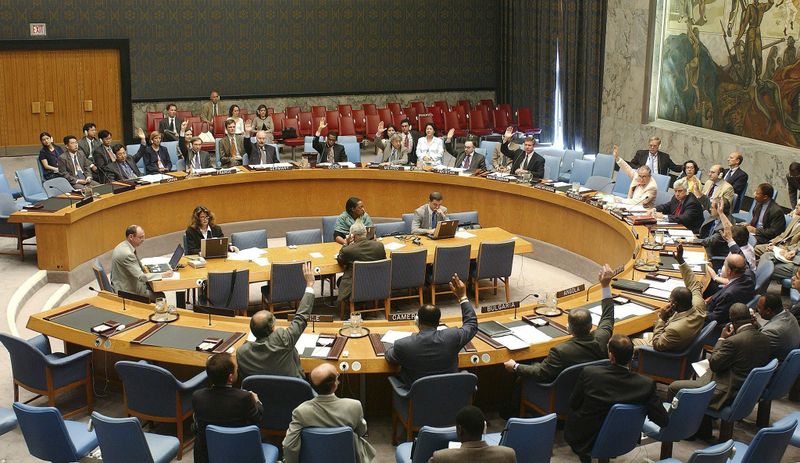
UN peacekeeping mission in Western Sahara ends after 35 years, UN chief says

Week 8 overreactions: Time for Vikings to bench Kyler Murray? Colts should fire Steichen?

NFL Week 8 winners and losers: Cowboys suffer epic collapse, Joe Burrow delivers historic heroics

How Antonelli 'blew everyone away' to make Formula 1 history

Why is Ashton Jeanty not getting carries? Another Raider emerges as Vegas' top RB in Week 8

Russia and Ukraine accuse each other of hacking emergency alert apps

NFL Week 8 grades for every team: Cowboys get an 'F' for choking, Steelers surge to 'A+'
Ukraine air raid app apparently hacked as users receive false radiation threat, Air Force says
Latest
UN peacekeeping mission in Western Sahara ends after 35 years, UN chief says
Week 8 overreactions: Time for Vikings to bench Kyler Murray? Colts should fire Steichen?
NFL Week 8 winners and losers: Cowboys suffer epic collapse, Joe Burrow delivers historic heroics
How Antonelli 'blew everyone away' to make Formula 1 history
Why is Ashton Jeanty not getting carries? Another Raider emerges as Vegas' top RB in Week 8
Russia and Ukraine accuse each other of hacking emergency alert apps
NFL Week 8 grades for every team: Cowboys get an 'F' for choking, Steelers surge to 'A+'
Ukraine air raid app apparently hacked as users receive false radiation threat, Air Force says