Malema calls for progressive alliance as EFF confronts electoral losses
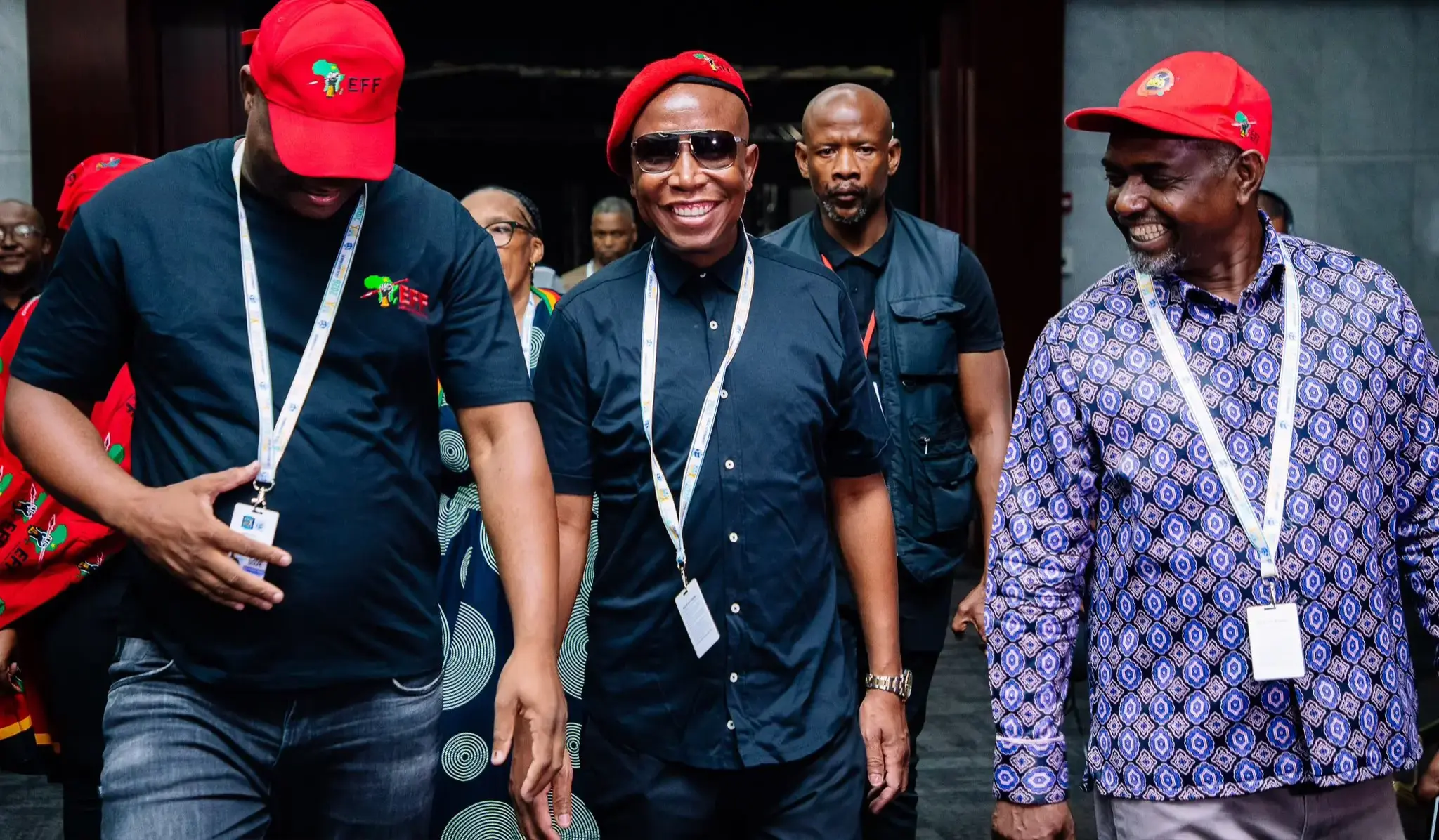
Economic Freedom Fighters (EFF) leader Julius Malema has acknowledged the party's declining electoral support, calling for a renewed alliance among progressive political organisations while promising to redirect party resources towards communities where the EFF secured victories.
Malema said the party had received approximately 1.8 million votes, representing 6.26% of the national vote, compared with 2.4 million votes and 10.31% in the 2021 local government elections. The results represent a loss of 612,326 votes, resulting in the EFF moving from third to fourth position nationally.
"We will not hide from the national picture and will not make excuses," Malema said, acknowledging that the outcome was a setback the party would have to confront. However, rather than focusing solely on the numbers, much of his address centred on what the party needed to do differently, particularly in communities where residents continue to struggle with unreliable water supplies, deteriorating roads and other basic services.
Malema also acknowledged that voter apathy remained a challenge. He argued that some residents had become disillusioned with elections because they continued to experience poor living conditions despite voting for political change. He said political parties could not expect people to keep turning out to vote if they could not demonstrate that their participation made a difference in people's everyday lives.
For the EFF, this would mean moving beyond election campaigns and becoming more involved in addressing problems at community level. Malema announced that the party intended to direct a significant portion of its organisational resources towards the 37 wards it had won, with a 100-day programme targeting some of the immediate challenges facing residents.
"The EFF must start engaging in service delivery programmes in the wards where we won," he said. He pointed to water shortages and deteriorating roads as issues the party intended to prioritise, arguing that councillors should not wait for formal control of an entire municipality before taking responsibility for their communities. He suggested that the EFF could use its own resources to install water infrastructure and undertake smaller road improvements where residents had been waiting for municipal intervention.
Malema also used the address to call for greater cooperation among progressive political organisations, specifically mentioning the EFF, ANC, uMkhonto weSizwe (MK) Party and the South African Communist Party.
He argued that political differences and personal rivalries had weakened organisations that shared similar positions on issues such as land redistribution, affirmative action and economic transformation. He was particularly critical of the ANC's decision to enter into a government of national unity with the Democratic Alliance (DA), accusing the party of prioritising its relationship with the DA over cooperation with organisations whose political programmes were closer to its own.
Malema suggested that even President Cyril Ramaphosa's position should not stand in the way of such cooperation, saying that if his departure was a condition for uniting progressive forces, the ANC should be prepared to consider it.
He argued that protecting individual leaders at the expense of broader political cooperation had contributed to the difficulties facing the former liberation movement.
The EFF leader also rejected suggestions that the DA had stolen votes from his party, arguing that the ANC had helped legitimise the DA by deciding to work with it in national government. He said voters who had previously viewed the DA as an opposing political force could now question why they should not support it at municipal level when the ANC was already governing alongside it.
Coalition negotiations were another point of contention. With several municipalities requiring political parties to work together to form administrations, Malema warned that the EFF would not simply accept unreasonable demands to secure government positions. He also criticised what he described as attempts to portray ActionSA as one of the country's major political parties, arguing that electoral support should determine the influence parties have in negotiations.
Malema reserved some of his strongest remarks for young people who had become disengaged from voting, describing electoral participation as essential to the country's democratic progress. He argued that encouraging people to stay away from the polls would only weaken their ability to influence political decisions.
Despite the losses, he maintained that the EFF remained an important political force and said the organisation would use the results to reorganise and prepare for the 2029 national and provincial elections.
For ordinary South Africans, however, the more immediate test will be whether the party can translate its promises into tangible improvements in the communities it represents.
Malema said the EFF would continue fighting for its political programme whether in government or opposition, insisting that the election results would not mark the end of the organisation's political journey. "We have come too far to let a setback define the end of our game," he said.
Related Topics
Keywords
Related Stories
LOCAL ELECTIONS 2026: ‘Our people are angry’ — MK party threatens to challenge election results
The uMkhonto Wesizwe party has warned that it could approach the Electoral Court of South Africa over alleged irregularities in the 2026 local government elections.

TRY FEST: Nine-try Springboks blitz Italy in Turin to set Nations Championship pace
The Springboks scored a record 66-7 (halftime 45-0) away win over Italy in a Nations Championship match in Turin on Saturday.
SPCA warns against fireworks cruelty as Diwali approaches
The Durban and Coast SPCA has urged residents to follow fireworks rules and protect pets from fear, injury and escape during Diwali celebrations.
Five wards face recounts as IEC processes 197 election objections
The IEC has upheld two of 197 objections to South Africa’s 2026 local election results, ordering recounts in five wards before the final results are announced on Sunday.
Top Stories
LOCAL ELECTIONS 2026: ‘Our people are angry’ — MK party threatens to challenge election results
TRY FEST: Nine-try Springboks blitz Italy in Turin to set Nations Championship pace
SPCA warns against fireworks cruelty as Diwali approaches

Costco members can get $5 off the reimagined Ocarina of Time

Discogs’ Kevin Lewandowski can’t live without his AeroPress
Five people killed, multiple injured in Poland market shooting

No clear winner after tight New Zealand general election
Five wards face recounts as IEC processes 197 election objections
Latest
LOCAL ELECTIONS 2026: ‘Our people are angry’ — MK party threatens to challenge election results
TRY FEST: Nine-try Springboks blitz Italy in Turin to set Nations Championship pace
SPCA warns against fireworks cruelty as Diwali approaches
Costco members can get $5 off the reimagined Ocarina of Time
Discogs’ Kevin Lewandowski can’t live without his AeroPress
Five people killed, multiple injured in Poland market shooting
No clear winner after tight New Zealand general election
Five wards face recounts as IEC processes 197 election objections