NOTES FROM A SMALL PLANET: Peregrine falcons are taking over the high ground
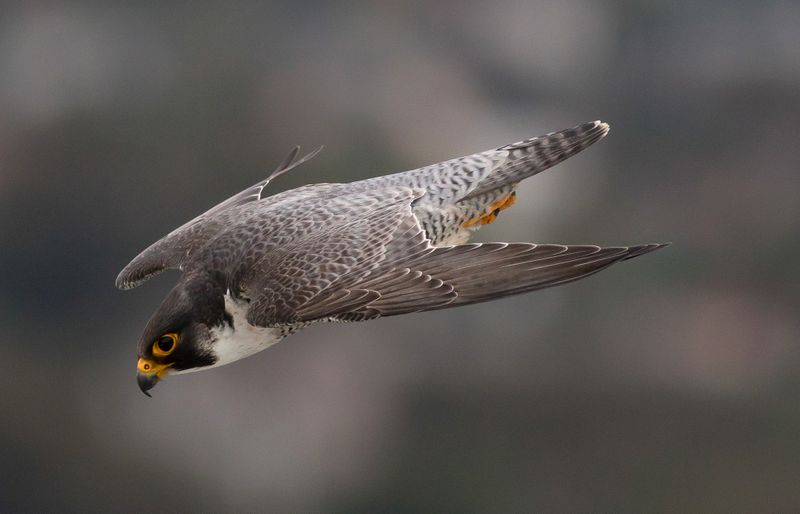
Meet the feathered speedsters thriving above our traffic and the scientist who has spent decades studying them, dodging their claws and occasionally losing his hat.
It is difficult to maintain scientific dignity with your head wedged into a cliff ledge and your rear end being spanked by a furious peregrine falcon.
Dr Andrew Jenkins has tried. Ringing chicks sometimes meant inserting his head and shoulders into a recess, leaving the rest of him inconveniently available to their parents. He would work away while the owners registered their objections.
Peregrines are rockets with claws. They can rake a scalp hard enough to send blood into your eyes, which explains why Jenkins took to wearing a scrum cap. At Cape Point, one bird made off with his cap and carried it around the end of the Peninsula. Presumably, from her perspective, the operation had gone rather well.
For all this ingratitude, Jenkins remains devoted. Fascinated by peregrines as a child in Britain, he went on to spend decades studying them in southern Africa.
A conservation biologist and research associate at UCT, he has followed some individual birds for 16 or 17 years.
He knows the furious ones and the surprisingly relaxed ones. Some females allowed him to lift eggs from beneath them, measure them and put them back. Others became increasingly accomplished at beating him up. All, he insists, are sentient creatures with personality.
The misses
But the most surprising thing about these formidable birds is how often they fail.
Ask Jenkins about hunting success and he offers a distinctly unheroic assessment: “Typically below 10%.”
For the hunts he describes, that means more than nine attacks in 10 produce no dinner. The pigeon, it turns out, has a statistical get-out card.
“It’s a pretty extravagant way to make a living,” he says.
We tend to reduce peregrines to a speed record with feathers. But speed is only useful if it solves the central problem of hunting: catching something that would very much prefer to remain uncaught.
“You have to take it by surprise,” says Jenkins. “Once it knows that you’re there, you’re on a hiding to nothing in most instances.”
A peregrine’s height gives it options. From a cliff, a tall building or a soaring flight, it can watch the traffic below and convert altitude into a devastatingly fast approach. The famous dive, or stoop, is a way of arriving before the intended meal has understood the situation.
There’s calculation in this. Jenkins describes falcons selecting a commuting pigeon from far away, anticipating its flight path and taking an interception route quite different from the pigeon’s own.
The bird is aiming for where lunch will be. Three-dimensional geometry.
Nor is the finish necessarily a thunderous blow from directly overhead. The falcon may descend, level out beneath its quarry and rise behind it. Southern African peregrines, Jenkins explains, commonly “bind” to their prey, gathering it into long toes adapted to grasping a moving bird in midair.
Pigeons and doves feature prominently on the menu, although ambition extends further. One Cape Point pair regularly caught Cape cormorants.
But let the quarry spot the approach and the elegant interception becomes a much less certain business. Evasive action can spoil everything. The falcon must find another opportunity and try again.
Speedsters
Jenkins guesses that much of their hunting happens at about 150 to 200km/h. Even at those speeds, a mistake can be terminal. Among his ringed birds recovered dead or injured were victims of collisions with windows and overhead lines.
Which makes their enthusiasm for city living seem rather perverse. We’ve filled the skyline with hazards, then supplied almost everything else a peregrine could want.
Tall buildings are serviceable cliffs. Ledges offer nesting places. Pigeons and doves provide a plentiful, if evasive, food supply. To a falcon, an office tower can be both nursery and launch pad, with lunch commuting past.
“The things they need are high vantage points and lots of suitable birds to feed on,” says Jenkins. Cities supply both, sometimes better than natural habitats.
Peregrines already have an extraordinary natural range, breeding on every continent except New Zealand and Antarctica.
Buildings have added nesting opportunities across that range, helping these cliff specialists establish themselves in urban centres around the world. Humanity has become an accidental developer of falcon accommodation.
Cape Town offers a particularly striking example. Jenkins estimates that the Cape Peninsula supports about 45 to 50 pairs, a population he describes as among the densest in the world. Over roughly 30 years, the population he studied grew fivefold, with urban nesting accounting for the greatest growth.
Yet he is refreshingly unwilling to pretend the whole story is solved.
“And I have no idea why,” he says of that increase. Decades of data have not fully explained it.
Built cliffs
The advantages of buildings are clearer. Nest boxes provide shelter from spring storms, which can disrupt breeding and encourage birds to settle where their domestic arrangements cause least inconvenience.
Falcons are not tidy tenants. There is noise. There are remains. Some building managers have demanded that boxes be removed, but Jenkins found most people delighted by their resident predators and invested in their welfare.
Around fledging time, often near Christmas, young birds sometimes end up on the ground before mastering the business of staying aloft. Jenkins has spent considerable time returning them to their buildings for another attempt.
Glass remains a danger, particularly the reflective sort that persuades a speeding bird there is open space where there emphatically is not. Nevertheless, his work on survival and breeding suggested that urban advantages outweighed the costs. For these falcons, the city is working.
That’s an unexpected pleasure in a landscape where wildlife so often loses out. Above the traffic, somewhere near the executive floor, a wild predator is watching another sort of rush hour.
Most attempts will end with an empty pair of talons. Occasionally the geometry will come right and a pigeon’s commute will end abruptly.
We built ourselves a city with mountain views. The peregrines got penthouses with room service. Admittedly, the room service takes some catching.
If you find a falcon chick on the ground, call Andrew Jenkins at 082 959 9238. He knows what to do.
Originally published and reported by Daily Maverick.
Read original coverage on Daily MaverickRelated Topics
Keywords
Related Stories
WATCH: Seven North Coast communities oppose proposed cemetery and crematorium
Residents from seven La Mercy-area communities have objected to a proposed 33,800-grave memorial park and six-unit crematorium, citing consultation, traffic, LPG safety and emissions concerns.

PKTT arrests suspected hitman in Aubrey Tsengwa murder case
A 44-year-old man suspected of being a hitman has been arrested in connection with the murder of former Knysna mayor Aubrey Tsengwa.

Bread shortage threatens to plunge more Sudanese into hunger
Nearly three and a half years into Sudan's unrelenting war, soaring costs and a nosediving currency have left people like Sawsan Mahmoud struggling to afford even the most basic staple – bread.

Donald Trump says elections were 'giant step back in history' for the US
President Donald Trump vowed to return “bigger and stronger” after Democrats won control of the US House of Representatives in the midterm elections, which he described as a “giant step back” for the country.

Top Stories

Brobbey wins Colwill battle - player ratings for Sunderland's win over Chelsea

Who was back to his best? Player ratings for Crystal Palace v Liverpool

Apple’s M5 MacBook Air is down to its lowest price since July
WATCH: Seven North Coast communities oppose proposed cemetery and crematorium
PKTT arrests suspected hitman in Aubrey Tsengwa murder case
Bread shortage threatens to plunge more Sudanese into hunger
Donald Trump says elections were 'giant step back in history' for the US
FIREWORKS RISKS: Guy Fawkes fireworks drive Delft dog Max to a horrific death
Latest
Brobbey wins Colwill battle - player ratings for Sunderland's win over Chelsea
Who was back to his best? Player ratings for Crystal Palace v Liverpool
Apple’s M5 MacBook Air is down to its lowest price since July
WATCH: Seven North Coast communities oppose proposed cemetery and crematorium
PKTT arrests suspected hitman in Aubrey Tsengwa murder case
Bread shortage threatens to plunge more Sudanese into hunger
Donald Trump says elections were 'giant step back in history' for the US
FIREWORKS RISKS: Guy Fawkes fireworks drive Delft dog Max to a horrific death