Planet orbits so close to its star that their magnetic fields connect
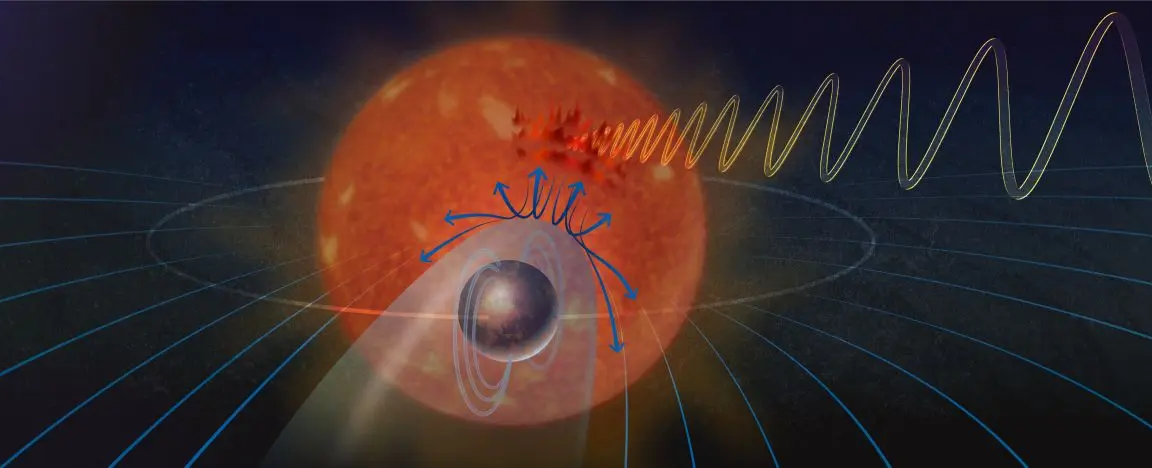
For most of human history, our view of “close to the Sun” was defined by the orbit of Mercury, with its 88-day orbit and barren, baking surface. But from the moment we started discovering exoplanets, it became very clear that our own Solar System was anything but a guide to the rest of the galaxy. Planets with orbits only a few days long are strikingly common, with the proximity to the star creating things that seem bizarre from our perspective: metal vapor in the atmosphere, or atmospheres puffed out to ridiculously low densities.
Now, we can apparently add an additional oddity: overlapping magnetic fields. Researchers have found a star/planet combo that experiences periodic brightening, which they ascribe to the interactions between the magnetic fields of both bodies.
Looking for repetition
This is one of those cases where theory came before discovery. People had already proposed that a planet orbiting close to its host star could interact with it if its magnetic field were sufficiently strong. And, in a number of cases, researchers have found evidence that this is happening, with one case of an extremely young star emitting flares seemingly in response to the orbit of its innermost planet.
An international team of researchers has created the most comprehensive look at flaring in a star with a close-in planet. The star itself is called GJ 436, a red dwarf half the mass of the Sun that resides about 30 light-years from Earth. It has a single known exoplanet that is about four times as massive as Earth, and it completes an orbit every 2.6 days.
The researchers focused on the chromosphere, a thin layer near the exterior of the star that has emissions that are dominated by a relatively small number of ions and is known to be influenced by the star’s magnetic environment. The researchers used specific emissions from hydrogen and calcium ions as a marker for activity in the chromosphere.
We’ve been observing GJ 436 for years, so the team had a huge amount of archival data to search through. The team looked for periodic fluctuations in the emissions at the relevant wavelengths as a potential sign of a fluctuating magnetic influence. They found one, roughly the same period as the planet’s orbit, suggesting that the magnetic interactions were either limited to, or peaked at, one specific orbital configuration.
Why didn’t the signal line up precisely with the planet’s orbit? A model they produced helps explain this by also including factors like the star’s rotation, the uneven distribution of activity across the star’s surface, and the fact that the planet’s axis of rotation (and thus its magnetic field) probably isn’t precisely perpendicular to the plane of its orbit. With all of those factors considered, it’s possible to figure out how all of these details can produce a signal that lags the orbital period by a few hours.
It comes and goes
There were some other oddities, though. One is that there are no signs of enhanced activity from various other elements that are thought to be present in the chromosphere of most stars. The researchers, however, note that the chromosphere itself has multiple layers and propose that the signal they’re seeing is originating in the lower chromosphere.
The second issue was that in some observations, there were no periodic signals at all. Because we have enough archival observation data, however, the researchers were able to track when the signal appeared and disappeared. And they were able to find a periodicity to that—one that lined up precisely with the star’s cyclic activity. (Think of our Sun’s solar cycle, and apply that to a different star.)
The researchers suspect that, during high solar activity, the signal from the planet’s magnetic influence is swamped. At low periods in the cycle, the researchers suspect that there simply isn’t enough activity there for the magnetic interactions to enhance. So, they think that we see the enhanced chromosphere emissions only at intermediate levels of stellar activity.
How is the magnetic influence showing up on the star in the first place? The researchers consider a number of theoretical models, but the only one that produces enough energy at the chromosphere is one where loops of magnetic field connect the fields of the planet and the star. This model allows them to estimate the strength of the planet’s magnetic field, which they put at a minimum of 6 Gauss, over 10 times the strength of Earth’s.
While that all may seem a bit extreme, it’s not especially unusual, even in our Solar System. The magnetic field strength is similar to that of Jupiter, and Neptune’s magnetosphere extends out to far greater distances than the gap between GJ 436 and its planet.
As we noted above, this is the most comprehensive look at magnetic-driven flaring in an exosolar system, but it’s not the first. And there are hundreds of additional systems with close-in planets that we can still examine. So, in time, having measurements of exoplanet magnetic fields may become commonplace.
Science, 2026. DOI: 10.1126/science.adv3075 (About DOIs).
 1.
SpaceX no longer needs NASA, and that's a problem for America's space agency
Related Topics
Keywords
Related Stories
These firms you've never heard of are feeding fears the AI bubble could burst
The amount of debt held by data centres is measured in the tens of billions of pounds.

Keyboards of The Verge
What is a keyboard if not the original brain-computer interface? You can tap on a touchscreen or talk to the computer, but if your work involves getting information out of your head and into the computer, you're probably spending a lot of time using a keyboard. We've written…

Binance CEO says 90 percent of stolen assets have been ‘replenished’
After hackers stole a shocking $6.3 billion from Binance customers in a record-breaking crypto heist, the company's CEO says that 90 percent of the funds have been replaced, and the company plans to cover the remaining 10 percent as well. Binance is covering the stolen funds…

Happy Pikmin Day Eve
This morning, Nintendo announced that tomorrow, November 1st, would be the first annual Pikmin Day. As part of the short Pikmin Day Direct, Shigeru Miyamoto shared new info about Pikmin 4 for the Switch 2, as well as an update for the mobile app Pikmin Bloom, and announced the…

Top Stories

Hamilton takes first pole for Ferrari at Mexico City Grand Prix
These firms you've never heard of are feeding fears the AI bubble could burst

How the downfall of Serbia's Vučiċ mirrored that of Hungary's Orbán

College football winners, losers: Oregon's Dylan Raiola bounces back, Wisconsin falls flat

On 'tense' Antonelli's big weekend, this was Hamilton's day

Thick fog to create hazardous driving conditions into next week

Oklahoma offense stuck in neutral: Loss to South Carolina highlights key decisions ahead for Brent Venables

No more washing up: How Airbnb's new house rules have divided hosts and guests
Latest
Hamilton takes first pole for Ferrari at Mexico City Grand Prix
These firms you've never heard of are feeding fears the AI bubble could burst
How the downfall of Serbia's Vučiċ mirrored that of Hungary's Orbán
College football winners, losers: Oregon's Dylan Raiola bounces back, Wisconsin falls flat
On 'tense' Antonelli's big weekend, this was Hamilton's day
Thick fog to create hazardous driving conditions into next week
Oklahoma offense stuck in neutral: Loss to South Carolina highlights key decisions ahead for Brent Venables
No more washing up: How Airbnb's new house rules have divided hosts and guests