Ramaphosa's leadership failure amid South Africa's anti-illegal migration crisis
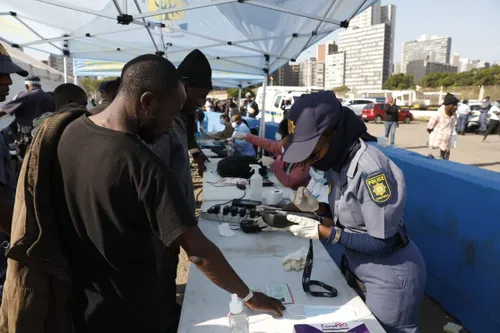
Thousands of Malawian foreign nationals were moved from the Sherwood Hall grounds to the Durban drive-in site to try and fast track their processing and repatriations
THIS raging wave of anti-immigrant sentiment is exposing a leadership vacuum in South Africa and across sub-Saharan Africa. As the June 30 deadline approaches, both African governments whose citizens live in South Africa and the South African government are trying to manage the fallout from the migration crisis.
The saying "history has no blank pages" aptly applies to the ongoing anti-illegal immigrant sentiments in South Africa. Attacks on immigrants are not new in South Africa. We witnessed violent attacks in 2008 and again in 2015.
However, never before have we witnessed such widespread vigilantism, well-organised mobilisation, and sustained demands for the deportation of illegal immigrants. This time around, political parties such as ActionSA and the Umkhonto we Sizwe MK party are also jumping on the bandwagon. This is because, for the first time since 1994, we could see South Africans vote not based on party loyalty, but on issues such as immigration.
The harassment and intimidation to which foreigners have been subjected, particularly around the city of Durban, has never been seen before and is unmatched and unprecedented. Anti-immigrant movements, Operation Dudula, and March and March blame illegal immigrants for skyrocketing crime, taking jobs away from South Africans, straining public services, and urban decay.
In recent months, these movements have also accused Somali, Pakistani, and Bangladeshi-owned Spaza shops of selling expired food items, among other things.
In a world that constantly reminds people of US versus THEM, very few appear to have mastered the art of putting oneself in the shoes of the OTHER.
The idea of US (South Africans) v THEM (the other or foreigners), has made us forget that all of us are human beings. As each side refuses to listen to the other, we end up not fully understanding what is driving the wedge between us. Unfortunately, what gets lost in the process is the ability to have empathy and compassion for each other as human beings. The solution is there, but no side is willing to blink first.
So, what can we expect to happen on June 30 and beyond? June 30 is the deadline for illegal or undocumented migrants to leave the country, as per the demand of anti-illegal immigrant movements. As the countdown to the deadline continues and edges closer, there are legitimate fears that the situation could potentially get out of control and result in a repeat of the violence reminiscent of the 2021 riots.
As many people focus on June 30, it is worth considering what will happen between now and the November local government elections and potentially beyond. In other words, what are the chances that the noise of these anti-immigrant movements will die down and recede after 2026?
Suffice it to say that as long as the majority of South Africans live in abject poverty with no sense of dignity, the hostility towards immigrants will persist. Similarly, as long as the governments of countries such as Malawi, Nigeria, Ghana, and Zimbabwe fail to deliver on the promise of a better life in post-colonial Africa, immigrants will keep flocking to South Africa.
As President Cyril Ramaphosa reminded us when he addressed the nation on the immigration issue, no civilian is permitted to demand to see foreigners' immigration status. This begs the question: how will supporters of anti-illegal immigrants be able to tell a legal immigrant from an illegal immigrant?
It is not only foreigners (both those here legally and those here illegally) who are panicking, scared, and anxious about the looming June 30 deadline and its aftermath. Even businesspeople, both South African and immigrant, particularly in KwaZulu-Natal and Gauteng, are bracing themselves.
The reason is simple. The state, particularly its law enforcement agencies, appears consistently ill-equipped or unwilling to deal with lawbreakers and mayhem. As the head of state and government, Ramaphosa has failed spectacularly and dismally to provide much-needed leadership amid the anti-illegal migration crisis and the fallout from it
Now we have the benefit of hindsight in 2026. The embattled Ramaphosa has presided over a weak, incompetent, and corruptible criminal justice system. Had Lt-General Mkhwanazi not exposed the shenanigans within the law enforcement agencies, we would still believe that we have a credible and functional police force.
Acting Police Minister Feroz Cachalia has reassured South Africans and immigrant communities that the South African Police Service (SAPS) will be on high alert and ready to deal with any acts of incitement, harassment, criminality, vandalism, and looting on June 30. But what about now and beyond the June 30 deadline?
While one is tempted to believe Cachalia, the Madlanga Commission of Inquiry has, however, helped to lay bare what is ailing our post-apartheid state, in general, and our criminal justice system, in particular. Since there appears to be an absence of accountability in the country, ordinary citizens are emboldened to keep trying their luck, especially when they see elected representatives get away with wrongdoing and corruption.
As we saw in 2021, thousands of South Africans went on the rampage as they looted and destroyed property, mainly in KZN and Gauteng.
It would have helped a great deal had the masterminds and perpetrators behind the 2021 riots been apprehended and convicted with harsh sentences. That would have sent a very strong message that criminality is not tolerated and served as a deterrent for those planning to wreak havoc on June 30.
As in July 2021, when our intelligence services were caught napping, one would not be surprised if history were to repeat itself. Anything is possible.
If comments South Africans are making on social media and the mood on the ground are anything to go by, one has every reason to be worried and concerned about the outbreak of brazen lawlessness and violence. It does not help that Ramaphosa and the entire GNU appear incapacitated, incapable, and out of touch, with their handling of the situation, judging from their reactive rather than proactive engagement.
While the anti-immigrant movements keep reassuring the nation that they oppose violence, it is not clear what they plan to do should their demands not be met. Also unclear is whether anti-immigrant movements could now be infiltrated by rogue elements seeking to destabilize the country for whatever purpose.
What is crystal clear is that March and March and Operation Dudula do not have total control over some shady individuals and opportunists who are already taking advantage of the situation and carrying out their personal agendas.
Already, a number of foreign-owned barbershops, salons, and spaza shops around Durban have been forced to shut down. This, after thousands of foreigners who live in flats have also been forced to vacate, which explains why so many find themselves homeless and sleeping outside the Home Affairs offices on Che Guevara Road, formerly Moore Road.
As the harassment of foreigners intensifies in the buildup to the June 30 deadline, one wonders what the law enforcement agencies are doing to control the situation.
In 2021, South Africans witnessed the violence we had not seen since the days of apartheid. More than 300 people lost their lives in a few days, and millions lost their livelihoods and jobs as protesters looted business premises in KwaZulu/Natal and Gauteng provinces. For four full days, lawlessness reigned as the law enforcement agencies literally went AWOL and allowed protesters to wreak havoc.
Back then, what South Africans did not understand was that we have law enforcement agencies that are rotten to the core and so inept that they cannot be relied upon to protect property and citizens. As the Madlanga commission of inquiry continues to expose the rot within the criminal justice system, foreigners would be forgiven for worrying that the police force cannot be relied upon to protect them should anti-immigrant protesters unleash violence.
Since the anti-immigrant movements, March and March and Dudula, intensified their campaigns to force illegal immigrants out of the country, we have seen increased cases of hostility and violence towards foreigners, particularly from African countries, thus resulting in the term Afrophobia. The leader of March and March, Jacinta MaNgobese Zuma, has accused illegal foreigners of “playing the victim card” and taking advantage of South Africa’s weak criminal justice system.
In recent weeks, the Gift of the Givers has intervened to assist displaced immigrants, some of whom are Muslims. Apparently, it is said that Gift of the Givers is accusing March and March of being funded by Israel to destabilise the country.
In her Facebook page, the leader of March and March, Jacinta MaNgobese-Zuma, lambasts the Gift of the Givers for making what she calls unfounded and reckless claims.
It remains to be seen what will transpire on June 30 and beyond. The ball is in Ramaphosa’s court to provide leadership as anxious South Africans and nervous immigrant communities hold their breath.
** The views expressed do not necessarily reflect the views of IOL or Independent Media.
Related Topics
Keywords
Related Stories
UN peacekeeping mission in Western Sahara ends after 35 years, UN chief says
Nov 1 (Reuters) - The 35-year-old UN peacekeeping mission in the Western Sahara region will come to an end after the Security Council failed to renew its mandate, the UN chief said on Sunday.
CONGRESS IN THE BALANCE: A blue tsunami, a tide, or chaos as usual — the US midterm election
With just hours to go before the American midterm election takes place, the day before South Africa’s own local election, control of both houses of the American Congress hangs in the balance.
DIVISIVE WORDS: ‘We never called for literal killing’ — Malema appeals for farm killings to stop.
EFF leader Julius Malema says the chant “Kill the boer, kill the farmer” was never meant literally and has appealed for farm killings to stop.
TRC ROULETTE : Victims’ families place key hidden evidence before Khampepe inquiry
A physical inspection of old lever arch files by the legal team representing the families of apartheid victims at the Khampepe Commission strengthens Anton Ackermann’s claim that a disputed 2006 memo was forged, reshaping the Khampepe inquiry into delayed apartheid prosecutions.
Top Stories
UN peacekeeping mission in Western Sahara ends after 35 years, UN chief says
Week 8 overreactions: Time for Vikings to bench Kyler Murray? Colts should fire Steichen?

NFL Week 8 winners and losers: Cowboys suffer epic collapse, Joe Burrow delivers historic heroics

How Antonelli 'blew everyone away' to make Formula 1 history

Why is Ashton Jeanty not getting carries? Another Raider emerges as Vegas' top RB in Week 8

Russia and Ukraine accuse each other of hacking emergency alert apps

NFL Week 8 grades for every team: Cowboys get an 'F' for choking, Steelers surge to 'A+'

Ukraine air raid app apparently hacked as users receive false radiation threat, Air Force says
Latest
UN peacekeeping mission in Western Sahara ends after 35 years, UN chief says
Week 8 overreactions: Time for Vikings to bench Kyler Murray? Colts should fire Steichen?
NFL Week 8 winners and losers: Cowboys suffer epic collapse, Joe Burrow delivers historic heroics
How Antonelli 'blew everyone away' to make Formula 1 history
Why is Ashton Jeanty not getting carries? Another Raider emerges as Vegas' top RB in Week 8
Russia and Ukraine accuse each other of hacking emergency alert apps
NFL Week 8 grades for every team: Cowboys get an 'F' for choking, Steelers surge to 'A+'
Ukraine air raid app apparently hacked as users receive false radiation threat, Air Force says