Reserve Bank says lower inflation, fiscal reform key to reducing South Africa’s borrowing costs | Africa Front
Via IOL South Africa
Reserve Bank says lower inflation, fiscal reform key to reducing South Africa’s borrowing costs
<h2>MONETARY POLICY</h2>
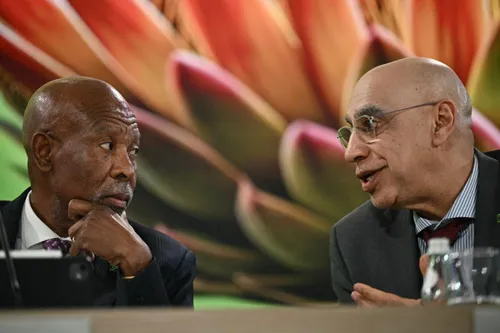
<p>Lesetja Kganyago (right), Governor of South Africa's Reserve Bank (Sarb) and his Deputy Dr Rashad Cassim.</p>
<p>Image: AFP</p>
<p><a href="https://businessreport.co.za/economy/2026-06-02-sarb-siginals-unwavering-commitment-to-3-inflation-target-despite-global-supply-shocks/" target="_blank" rel="noopener noreferrer">South African Reserve Bank (Sarb)</a> Deputy Governor, Rashad Cassim, has highlighted the crucial role of financial markets and the government bond yield curve in shaping <a href="https://businessreport.co.za/2026-06-11-global-turmoil-raises-risks-but-sas-financial-system-remains-resilient-says-kganyago/" target="_blank" rel="noopener noreferrer">monetary policy</a>.</p>
<p>Speaking at a London Stock Exchange Group Insight Series event on Wednesday, Cassim argued that South Africa’s recent <a href="https://businessreport.co.za/economy/2026-06-17-fuel-price-shock-pushes-south-africas-inflation-to-10-month-high-of-45/" target="_blank" rel="noopener noreferrer">progress on inflation and fiscal stability</a> has already delivered significantly <a href="https://businessreport.co.za/economy/2025-07-15-g20-finance-track-meetings-to-address-trade-uncertainty-and-global-economic-imbalances/" target="_blank" rel="noopener noreferrer">lower borrowing costs across the economy</a>.</p>
<p> Cassim said the Sarb’s primary mandate remains protecting the <a href="https://businessreport.co.za/economy/2026-06-09-sarb-says-south-africa-needs-faster-cheaper-digital-payments-before-launching-a-retail-cbdc/" target="_blank" rel="noopener noreferrer">value of the currency</a> to support balanced and sustainable economic growth. However, he noted that financial markets are central to how monetary policy decisions affect households and businesses.</p>
<p>“What we want financial markets to do is arbitrage – in other words, to price everything else against this one safe overnight rate,” Cassim said, explaining how the Sarb’s policy rate influences borrowing costs across the economy, from government debt to mortgages.</p>
<p>Cassim outlined how South Africa’s monetary policy framework has evolved over time, with central banks globally moving away from a complex mix of policy tools toward a simpler system centred on a single interest rate.</p>
<p>He noted that the <a href="https://businessreport.co.za/companies/2025-12-03-sarb-flags-final-year-of-jibar-as-transition-to-zaronia-enters-critical-phase/" target="_blank" rel="noopener noreferrer">Sarb</a> formally retired the term “repo rate” this year after implementing a new monetary policy framework in 2022. Under the current system, banks deposit excess liquidity with the central bank and earn the policy rate on those deposits.</p>
<p>Cassim devoted much of his address to explaining the importance of the government bond yield curve, which reflects borrowing costs across different maturities and serves as a key indicator of market sentiment about inflation, fiscal sustainability and economic risks.</p>
<p>According to Cassim, South Africa experienced one of the steepest yield curves on record during the COVID-19 pandemic. While the <a href="https://businessreport.co.za/economy/2024-09-09-sarb-needs-to-assess-unbanked-quandary-through-the-lens-of-trust-trauma-and-money/" target="_blank" rel="noopener noreferrer">Sarb cut the policy rate</a> to a record low of 3.5% to support the economy, long-term borrowing costs rose sharply as investors reacted to capital outflows, credit rating downgrades and a widening fiscal deficit.</p>
<p>“This was the steepest yield curve on record, with more than 5 percentage points between the front- and back-ends of the curve,” he said.</p>
<p>The situation remained challenging during the <a href="https://businessreport.co.za/economy/2026-06-14-softer-us-inflation-eases-pressure-on-south-africa-but-risks-remain-economists-say/" target="_blank" rel="noopener noreferrer">global inflation surge</a> that followed the pandemic. Although the Sarb increased the policy rate to 8.25% to contain inflation, rising country risk and persistent electricity shortages also pushed long-term yields higher.</p>
<p>Cassim said policymakers viewed the steep yield curve during this period largely as a reflection of fiscal and country risks rather than monetary policy alone.</p>
<p>However, he argued that South Africa has since experienced a significant “macro reset”. Long- and short-term interest rates have declined substantially, and the steepness of the yield curve has returned closer to historical averages.</p>
<p>“With a new inflation target, a strong fiscal commitment to stabilising debt now rather than later, plus reduced bond issuance, markets have priced in markedly lower yields on government debt,” he said.</p>
<p>Cassim noted that this improvement has occurred despite the absence of a significant economic growth recovery.</p>
<p>Looking ahead, he said further gains remain possible if <a href="https://businessreport.co.za/economy/2026-06-14-gdp-rises-in-south-africa-but-consumer-weaknesses-pose-risks-ahead/" target="_blank" rel="noopener noreferrer">inflation expectations</a> can be anchored closer to 3% and fiscal and structural reforms continue.</p>
<p>“Anchoring inflation expectations close to 3% will allow us to set lower short-term rates, probably closer to 6% than 7%,” he said.</p>
<p>The deputy governor also pointed to stronger performance across South African financial markets. The JSE All Share Index has risen nearly 60% since 2023, while the rand has strengthened from close to R20 to the US dollar in 2023 to around R16 more recently.</p>
<p>Cassim stressed that the Sarb does not target asset prices or the exchange rate directly. Instead, policymakers assess how developments in financial markets affect inflation, growth and overall financial conditions.</p>
<p>He said recent geopolitical tensions in the Middle East had tightened financial conditions and prompted markets to scale back expectations for interest rate cuts. This helped inform the Sarb’s cautious approach, which saw rates left unchanged in March before being increased by 25 basis points in May.</p>
<p>“To conclude, as policymakers we are in quite a fortunate position, given that we work with a relatively large and sophisticated financial system and we have efficient passthrough,” Cassim said.</p>
<p>He added that the Sarb remains confident it has the tools necessary to fulfil its constitutional mandate of protecting the value of the currency while supporting sustainable economic growth.</p>
Africa news · Africa headlines · IOL South Africa news · IOL South Africa · Africa Front · breaking news · latest news · South Africa · South Africa news · Africa · African · African news · Reserve · Bank · Lower · Inflation · Fiscal · Reform · Key · Reducing · South · Borrowing · Costs · Rashad
AI is set to end medical and cosmetic testing since accurate models can now predict drug toxicity, organ damage and chemical hazards that experiments could never do before. And it is an opportunity that Africa should embrace.
He said the federation now has sufficient qualified instructors to conduct CAF B coaching courses in states, zones and local government areas The post NFF to decentralise coaching education – Gusau appeared first on Premium Times Nigeria.