Russia bombing kills at least 26 people at aid centre in Ukraine's Zaporizhzhia region

This liveblog is no longer being updated. For more coverage of the war in Ukraine, click here.
This liveblog is no longer being updated.
Finland hockey team to boycott Russia
The Finnish Ice Hockey Association said Monday its national teams won't play against Russia in international tournaments as long as the war in Ukraine is ongoing.
That stance by Finland, and reportedly also Latvia, comes after the Court of Arbitration for Sport ruled last week that the International Ice Hockey Federation must reinstate Russian teams beginning with the world juniors that begin in late December in western Canada.
Finnish Ice Hockey Association spokesperson Henna Malmberg said the organization does not believe it is alone among countries interested in boycotting games against Russia. Media reports in Latvia said that nation's teams would not play Russia, citing legal reasons.
A message sent to the IIHF seeking comment and clarification on what Finland boycotting games against Russia would mean was not immediately returned. The rulebook says in the event of a forfeit “supplementary discipline will be applied by the proper authorities at their discretion."
Death toll in Komyshuvakha rises to 26
Death toll from Russian strikes on Komyshuvakha rises to 24, Ukrainian emergency services say
Multiple Russian strikes kill 18 people in southeastern Ukraine village, Zelensky says
Ukrainian President Volodymyr Zelensky said that Russian forces had bombed a village in southeastern Zaporizhzhia region, killing 18 people and wounding five.
Zelensky, writing on social media, said Russian forces initially dropped aerial bombs on a school in the village of Komyshuvakha used for distributing humanitarian assistance. Nine bombs followed in a repeat strike, including a strike on a shelter used by residents.
Ukraine accuses Russia of using Oleshky ceasefire to regroup troops
Ukraine accused Russia of taking advantage of the US-backed humanitarian ceasefire last week in the southern Kherson region to strengthen its military position there.
In a statement on Monday, Kyiv's General Staff said Russian forces had also used the truce to rotate troops, boost defences and improve battlefield logistics.
"Under the ceasefire introduced for the humanitarian operation in Oleshky, units of the Defence Forces of Ukraine ensured that the ceasefire was observed and acted exclusively within the framework of the agreements reached," it said on X.
"The enemy, by contrast, used the humanitarian pause to improve its positions."
Kremlin spokesman Dmitry Peskov said that he did not have specific information on any movements, but that adjusting positions during a ceasefire was "standard practice" and it was safe to assume Ukraine had done the same.
Russian forces lost ground slightly in Ukraine in October, AFP analysis suggests
Russian forces lost ground slightly across the Ukrainian front in October, according to an AFP analysis of data from the Institute for the Study of War (ISW).
Russian forces ceded 28 square kilometres overall, according to the data from the US non-profit research group.
Moscow has seen a broader slowdown in territorial gains in Ukraine since the start of 2026.
The main movements on the front line in recent months have centred on the eastern cities of Sloviansk and Kramatorsk in the Donetsk region.
In September, AFP's analysis of ISW data showed Ukrainian forces had gained 172 square kilometres during a counter-offensive around the garrison cities of Kramatorsk and Lyman.
The operation continued in October, with Kyiv's troops recapturing an additional 60 square kilometres.
At the same time, Russian forces advanced south of Kramatorsk.
Moscow now controls nearly 20 percent of Ukrainian territory.
Its average gains have slowed from about 400 square kilometres a month in 2025 to 11 square kilometres a month this year.
What we know about the hacked alert systems in Russia and Ukraine
What happened?
Phone notifications were sent to millions across Ukraine late Sunday warning of a "nuclear alert", a "chemical threat" and even "street fights" in Kyiv. One of the messages was in Russian and included a link to a new Telegram account named "Hitcore", the logo of which is a metallic eagle emblazoned over the Russian tricolour flag.
A few hours later, Russia's emergency situations ministry said that a "massive cyberattack" had hit its own application, with "false information" sent to the public. Several regional social media accounts run by the department sent out messages warning of a imminent nuclear attack on Russia. For instance, a Telegram message was sent by authorities in the Belgorod border region warning "nuclear warheads ... have been launched at all regions of Russia", and telling people to "urgently stock up on food for three weeks".
Which apps were affected?
Ukraine's air alert app is widely used to warn of Russian missile and drone attacks. It has been downloaded more than 46 million times and has more than 6.7 million daily users, according to developers, Ajax Systems.
Russia does not have a nationwide air alert system, and beyond border regions does not routinely send warnings to citizens of incoming Ukrainian attacks. Few Russians use the affected application, run by the ministry of emergency situations.
Act of war?
It remains unclear if the attacks were part of the war, carried out by either side, or launched by independent actors or groups. Ukraine's Centre for Strategic Communication, a government-backed project set up to counter Russian propaganda and online threats, said "Russians have hacked" the app. A pro-Russian group calling itself Hitcore claimed responsibility for the hack of the Ukrainian alert system.
Nobody has claimed responsibility for the hack of the Russian system.
🎥 Emotional reunions as residents flee Ukraine’s Oleshky during truce
A temporary ceasefire across Ukraine's Kherson region allowed people to flee the Russian-occupied city of Oleshky over the weekend.
They arrived in the Chernihiv region on Saturday after travelling through Russia and Belarus, with some reuniting with friends and family they had not seen in years.
Hacked emergency app in Ukraine had messages 'in Russian'
Authorities in both Ukraine and Russia said that their emergency alert mobile applications were targeted by cyberattacks late Sunday.
Residents in Ukraine received messages that there was a high nuclear radiation danger in the capital Kyiv, while Russian officials said hackers had sent fake emergency alerts after gaining access to the mobile app for Russia’s Emergency Ministry.
“Seeing the unusual threats, people assumed there was an issue with the emergency app,” in Ukraine, FRANCE 24’s correspondent in Kyiv said. “There was also a message written in Russian.”
Russia expects Trump to carry on seeking peace negotiations after midterms
The Kremlin is expecting US President Donald Trump to continue pursuing his policy of seeking a negotiated peaceful settlement in Ukraine after the midterm elections, spokesman Dmitry Peskov said on Monday.
Peskov added that Russia was closely monitoring the elections, but that they were an internal US matter.
Russia says ceasefire went as planned
Russian human rights commissioner Yana Lantratova said on Monday that the most difficult aspect of carrying out the humanitarian operation in Ukraine's Oleshky was testing whether the ceasefire was holding and clearing roads of mines.
She said that there were no incidents or ceasefire violations and that everything proceeded as planned.
Kremlin says resuming Russian gas transit via Ukraine impossible for now
The Kremlin said on Monday that it would not be possible to resume gas sales to Europe via Ukraine for now given the situation on the ground.
Asked to comment on a Wall Street Journal report that the US is pushing for a resumption of Russian gas supplies to Europe across Ukrainian territory, Kremlin spokesman Dmitry Peskov told reporters such plans would be impossible to implement at the moment.
Russia resumes attacks on Ukraine's Kherson region after truce ends
Russia on Monday resumed attacks on Ukraine's Kherson region, after the end of a local ceasefire in the area, the longest truce in the war raging between the neighbours since 2022.
"At around 8:00 am this morning, Russian occupiers attacked a car with a drone in the Korabelny city district" of Kherson, local authorities said in a statement, adding that a 62-year-old woman and 73-year-old man were wounded and hospitalised.
Russia's October pipeline gas exports to Europe down 4% year-on-year
Russian energy giant Gazprom's average daily natural gas supplies to Europe via the TurkStream undersea pipeline fell 4 percent from a year earlier to 52.1 million cubic metres in October, Reuters calculations showed on Monday.
Turkey is the only remaining transit route for Russian gas to Europe after Ukraine declined to extend a five-year transit agreement with Moscow that expired in January 2025.
A glimpse of what Ukrainians saw overnight
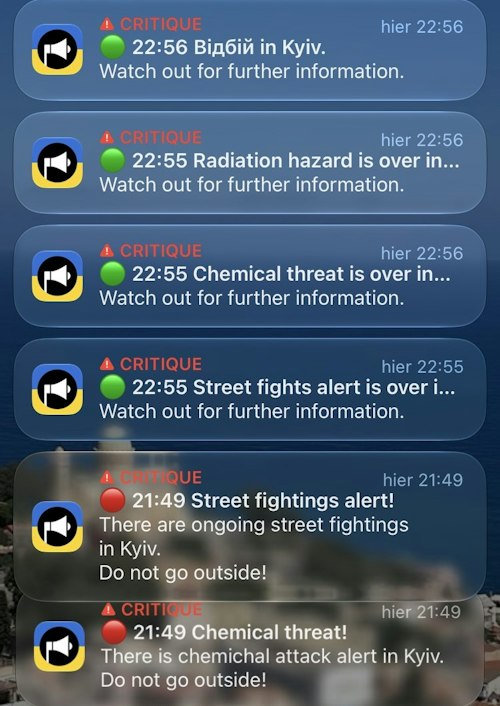
A view of one of Ukraine's Air Alert apps on Sunday
Emergency power cuts take effect in Ukraine's Kyiv and region, provider says
Emergency power cuts took effect in Ukraine's capital of Kyiv and the surrounding region, on orders from national grid operator Ukrenergo, private energy provider DTEK said in a statement on Monday.
Russia hits military facility in Ukraine's Odesa region
The Russian military struck a military facility in the Odesa region of Ukraine and hit a cargo vessel used for military purposes 58 km (36 miles) south of the Black Sea port city of Odesa, the Russian defence ministry said on Telegram on Monday.
An official in Odesa separately said on Telegram that a Russian attack injured four people.
(FRANCE 24 with AFP, Reuters and AP)
Keywords
Related Stories
Andrew Mountbatten-Windsor called to give evidence in fraud trial in December
Mountbatten-Windsor has been summonsed to give evidence in a businessman's High Court fraud trial.

Reform UK councillor charged with rape and sexual assault
The Crown Prosecution Service has charged George Madgwick with 35 offences, including 12 counts of rape.

Lorry driver electrocuted after vehicle hit overhead power line
Andy Lloyd was electrocuted when he got out of the cab and came into contact with the metal step.

DUP leader 'very sorry' Carla Lockhart has quit the party
Gavin Robinson said the party and the Upper Bann MP agreed on the sentiment but not the strategy of sanctioning Sinn Féin.

Top Stories
LOCAL ELECTIONS 2026: IEC tightens security amid ballot disruptions, arrests and election intimidation

Canva is announcing changes and layoffs affecting 22 percent of its staff

PAYMENT MODELS: Riding the e-commerce buy now, pay later hype train while it lasts

Champions League expert picks, predictions, best bets: Manchester City aim for turnaround vs. RB Leipzig

2027: Tinubu’s performance enough for his re-election, says education minister Tunji Alausa

Dave Richard's Week 9 Trade Chart and rest of season rankings: Jets, Raiders RBs in flux

NBS: Enugu records lowest ‘tax revenue-to-IGR ratio’

Manchester United stun Roma with three-goal second-half Champions League comeback after dreadful start
Latest
LOCAL ELECTIONS 2026: IEC tightens security amid ballot disruptions, arrests and election intimidation
Canva is announcing changes and layoffs affecting 22 percent of its staff
PAYMENT MODELS: Riding the e-commerce buy now, pay later hype train while it lasts
Champions League expert picks, predictions, best bets: Manchester City aim for turnaround vs. RB Leipzig
2027: Tinubu’s performance enough for his re-election, says education minister Tunji Alausa
Dave Richard's Week 9 Trade Chart and rest of season rankings: Jets, Raiders RBs in flux
NBS: Enugu records lowest ‘tax revenue-to-IGR ratio’
Manchester United stun Roma with three-goal second-half Champions League comeback after dreadful start