Santos warns against the comfort of silence
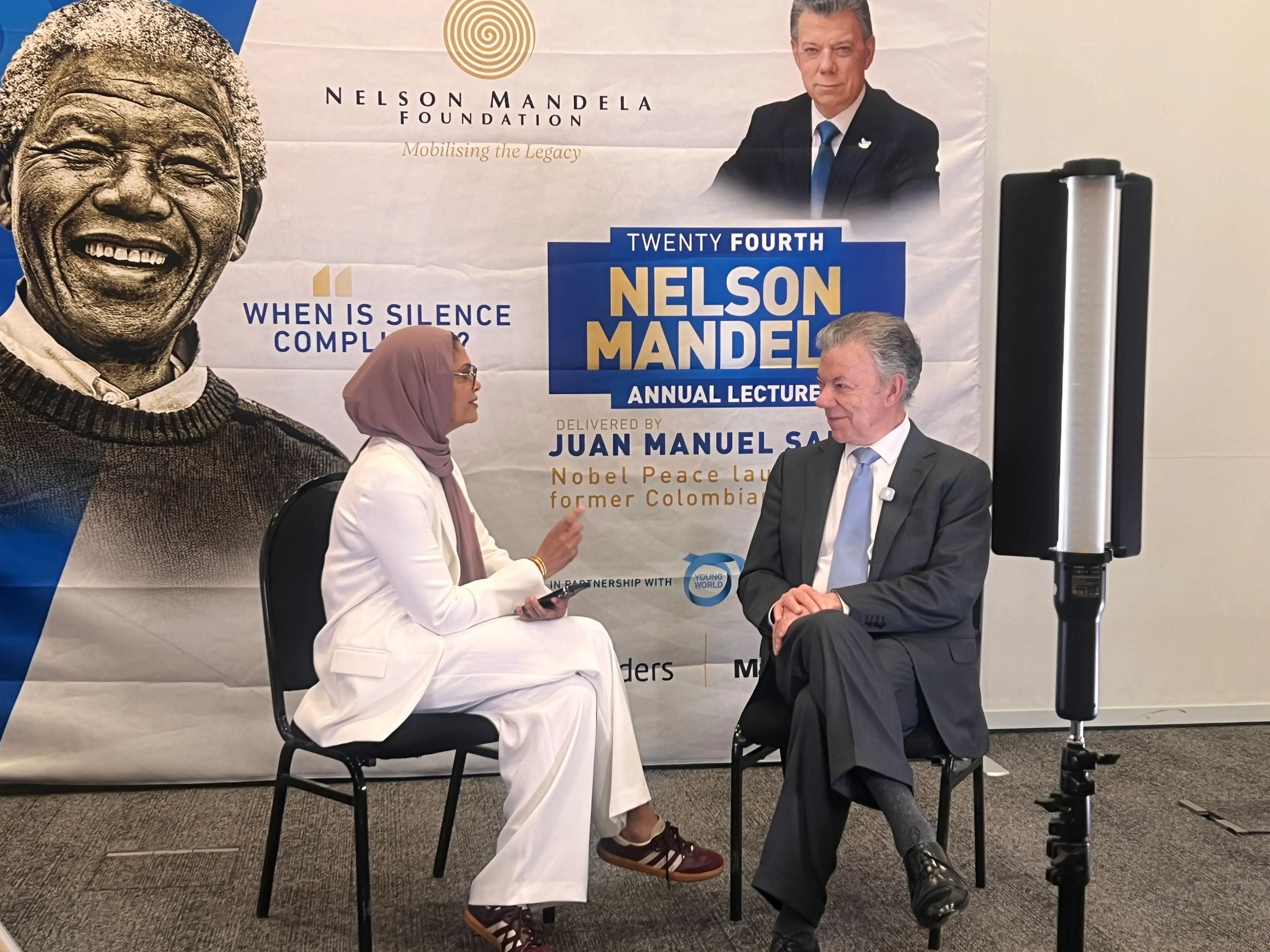
Thirty years ago, Juan Manuel Santos sat with Nelson Mandela and described a country in which violence had become so familiar that people could scarcely imagine life without it.
Colombia was descending into some of the darkest years of its armed conflict. South Africa was confronting its painful past through the Truth and Reconciliation Commission. What Santos expected to be a brief diplomatic meeting became almost three hours of conversation about violence, justice and reconciliation.
Mandela listened. Then he told his visitor that without peace, Colombia would never take off.
Returning to South Africa on Friday to deliver the 24th Nelson Mandela Annual Lecture, Santos recalled how that encounter helped give him a purpose he would pursue through war, negotiations and fierce political opposition.
But his message extended beyond Colombia’s experience. Governments that remain silent about injustice because speaking out is politically inconvenient or economically costly, he warned, help create a world governed by force.
The former Colombian president, 2016 Nobel Peace Prize laureate and chair of The Elders spoke at the Cape Town International Convention Centre under the theme “When is silence complicity?” The Elders is the independent group of global leaders Mandela founded in 2007 to advance peace, justice and human rights.
Hosted by the Nelson Mandela Foundation in partnership with One Young World, the lecture formed part of the organisation’s Cape Town summit, which brought together young leaders from around the world.
Santos warned that international law and the United Nations Charter were being openly disregarded, the International Criminal Court was being attacked and intimidated, and civilians were paying the price while diplomacy retreated.
The international order was being eroded by those who violated its principles and those who refused to defend them. When governments had the power to oppose injustice but chose inaction, their silence became complicity.
Repeated failures to respond, he argued, allowed violations to become precedents, gradually replacing the authority of law with the power of the strongest.
He paid tribute to South African jurist Navi Pillay, tracing her work from defending anti-apartheid activists to championing human rights internationally. He said her work demonstrated that peace must rest on the strength of law rather than the will of the strongest.
Yet Santos also resisted a simple equation between silence and moral failure. His experience had taught him that peace sometimes required confidentiality, patience and the discipline to listen. Words spoken prematurely or in anger could close doors that needed to remain open.
The challenge was knowing when discretion served peace and when it protected injustice.
That distinction ran through his account of Colombia’s negotiations with the Revolutionary Armed Forces of Colombia, known as the FARC, and his recollection of Mandela’s influence.
Santos had arrived in South Africa in 1996 as a former trade minister to hand over the chairmanship of the United Nations Conference on Trade and Development. Watching the TRC hearings on television that morning had deeply impressed him.
Victims and perpetrators were confronting truths that had been denied or suppressed. Later, Mandela spoke to him about reconciliation and the courage required to imagine a future in which an enemy had a place.
Colombia, meanwhile, faced expanding armed groups, a growing drug trade and violence that had devastated communities. Mandela’s observation about peace became what Santos described as his destination.
Reaching it meant risking the political standing he had built through military success.
Former Israeli foreign minister Shlomo Ben-Ami helped him confront the choice: could he reach the end of his life knowing he had refused a chance to save lives because he feared taking the risk?
“Someone must seize the moment and lead the way by speaking out, even when silence offers the most secure and comfortable position.”
The earliest discussions required confidentiality. Eventually, however, leaders had to explain publicly why an enemy could become a partner.
Santos negotiated while the fighting continued. Each attack intensified pressure to abandon the talks. Listening to victims helped him persevere, bringing the human consequences of failure into a process threatened by political opposition and renewed violence.
He recounted the experience of Pastora Mira, whose father, husband, brother and son had been killed.
Shortly after burying her son, she cared for a wounded young man and allowed him to sleep in her son’s bed. Before leaving, he saw a photograph and confessed that he had tortured and killed her son.
In Santos’s account, Mira embraced the man. She thanked him for telling the truth and taking responsibility, explaining that this had freed her from hatred.
The story illustrated the importance Santos attached to truth, acknowledgement and responsibility. Victims were central to the peace process, he said, and their accounts renewed his determination when he felt discouraged.
The agreement his government reached in 2016 ended more than five decades of conflict with the FARC. It did not end the work of building peace.
Santos acknowledged that his government had been overconfident before voters narrowly rejected the original deal in a referendum. It had underestimated the influence of false information.
Further dialogue with opponents and renewed negotiations produced a revised agreement, subsequently endorsed by Congress.
He pointed to the reintegration process involving more than 13,000 former FARC members, transitional justice institutions and the organisation’s move into electoral politics as significant achievements.
But a decade later, communities were still waiting for the settlement’s full promise.
“It is now more important than ever to speak out and demand the full implementation of the peace agreement.”
Other armed groups and criminal networks had expanded, sustained by drug trafficking, illegal mining and other illicit economies. Santos attributed continuing insecurity principally to failures to implement the agreement, arguing that its commitments to neglected territories and effective state authority remained essential.
He acknowledged the differences between Colombia and South Africa. South Africans negotiated the end of apartheid and a new democratic order. Colombia sought to end a war within an existing democracy and address the conditions that sustained it.
Both countries nevertheless faced the task of making negotiated commitments meaningful in people’s lives through security, justice and opportunity. Former enemies had to learn to share institutions and communities.
Santos also warned about misinformation and artificial intelligence. Technology could advance health and education, but could deepen inequality and undermine the reliable information on which trust and dialogue depended.
Santos said his generation had not always given young people the world they deserved. He urged them to stand up for what was right and refuse to accept war, injustice or division as inevitable.
“The destination is peace. We must defend our common humanity. And silence is not an option.”
Keywords
Related Stories
LOCAL ELECTIONS 2026: ‘Our people are angry’ — MK party threatens to challenge election results
The uMkhonto Wesizwe party has warned that it could approach the Electoral Court of South Africa over alleged irregularities in the 2026 local government elections.

TRY FEST: Nine-try Springboks blitz Italy in Turin to set Nations Championship pace
The Springboks scored a record 66-7 (halftime 45-0) away win over Italy in a Nations Championship match in Turin on Saturday.
SPCA warns against fireworks cruelty as Diwali approaches
The Durban and Coast SPCA has urged residents to follow fireworks rules and protect pets from fear, injury and escape during Diwali celebrations.
Five wards face recounts as IEC processes 197 election objections
The IEC has upheld two of 197 objections to South Africa’s 2026 local election results, ordering recounts in five wards before the final results are announced on Sunday.
Top Stories
LOCAL ELECTIONS 2026: ‘Our people are angry’ — MK party threatens to challenge election results
TRY FEST: Nine-try Springboks blitz Italy in Turin to set Nations Championship pace
SPCA warns against fireworks cruelty as Diwali approaches

Costco members can get $5 off the reimagined Ocarina of Time

Discogs’ Kevin Lewandowski can’t live without his AeroPress
Five people killed, multiple injured in Poland market shooting

No clear winner after tight New Zealand general election
Five wards face recounts as IEC processes 197 election objections
Latest
LOCAL ELECTIONS 2026: ‘Our people are angry’ — MK party threatens to challenge election results
TRY FEST: Nine-try Springboks blitz Italy in Turin to set Nations Championship pace
SPCA warns against fireworks cruelty as Diwali approaches
Costco members can get $5 off the reimagined Ocarina of Time
Discogs’ Kevin Lewandowski can’t live without his AeroPress
Five people killed, multiple injured in Poland market shooting
No clear winner after tight New Zealand general election
Five wards face recounts as IEC processes 197 election objections