Sculpture re-creates odd optical effects of famed Lycurgus Cup
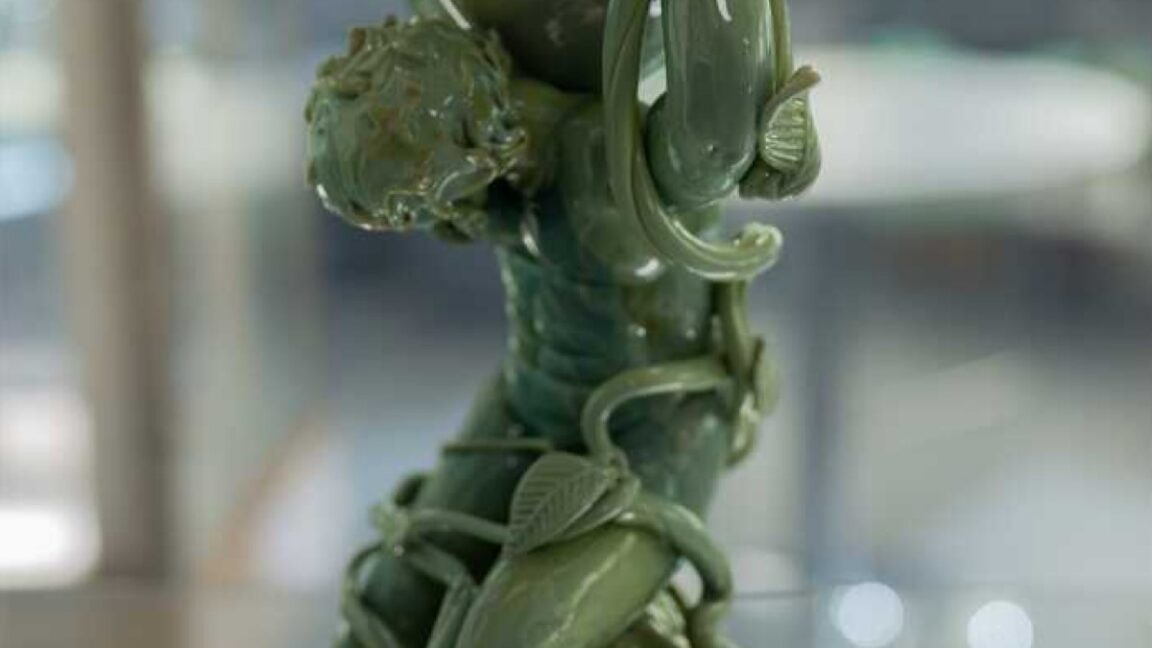
Dating back to around 400 CE and made of dichroic glass, the Lycurgus Cup is notable for exhibiting different colors depending on the light. (It gets its name from the scene depicted on its surface, of King Lycurgus of Thrace.) Light it from the front, and the cup looks green; light it from behind, and the color changes to a deep red. University of Sheffield scientists have re-created the original recipe to produce a contemporary glass sculpture with the same optical effect.
The cup is considered one of the seven glass wonders of the world, one of just 40 glass cage cups that survived. Exactly why the unusual color effects of the Lycurgus Cup occurred was a mystery until 2007, when a team of scientists discovered the color shifts were due to the presence of nanoparticles in the glass—the result of Roman artisans adding finely ground gold and silver into the mix. Those nanoparticles change how the electrons in the cup vibrate in response to light so that the color one sees shifts with the observer’s vantage point.
As we reported in 2019, it’s a similar phenomenon to the one responsible for the shifting colors of 19th-century daguerreotypes due to the scattering properties of nanoparticles. The Romans added salt when they melted the silicon (sand) to make the glass, and those salts contained gold atoms. In the melting process, those atoms aggregate and produce nanoparticles, which in turn produce the colors. It’s how any stained glass is made. It’s also similar to how the precise lattice-like structure of photonic crystals produces iridescent colors in nature, like the wings of butterflies, or opals.
There is a key difference, however: The nanoparticles are embedded into the glass of the cup, whereas with a daguerreotype, they are sitting on top of a substrate, adding some reflection that does not occur with an artifact like the Lycurgus Cup. So the scattering of the particles has a strong dependence on the substrate. Also, if one coats the surface of a daguerreotype with a layer of gold, the colors shift more to the red side of the spectrum. That’s in keeping with a 19th-century trick called “gilding,” in which the photographer would apply a solution of gold salt to the image to achieve warmer tones and sharper contrast.
An elusive recipe
In 2020, Dutch researchers reproduced the green/red dichroic effect of the Lycurgus Cup in a 3D-printable nanocomposite material by embedding small amounts of silver and gold nanoparticles of the proper size and shapes. But nobody had yet devised a consistent, replicable recipe. University of Sheffield scientists Lisa Hollands and Caroline Jackson—the latter an expert on Roman glass—worked together to come up with one, experimenting with different furnace types, materials, oxygen levels, and at one point including sugar in the mix.
“I knew that making a glass of this type was likely to be a complex task, as it is not just a case of adding nanoparticles to glass,” said Hollands. “I’ve studied and worked with glass for over 25 years, so I used the knowledge and experience I’ve gained, coupled with a modern scientific understanding of what I was trying to achieve—although if the Romans could have seen me experimenting, they’d probably laugh and ask: ‘Why does she not know how to make this?’”
The experimentation paid off when Hollands found a mix that produced glass with the desired optical effects, appearing green in reflected light, red when backlit. Her initial glass piece was exhibited at LightFest, which is part of Molecular Photonic Breadboards, a UK project geared toward designing new materials that harness the power of light for sustainable technologies. Project leaders next decided to commission UK glass artist Elliott Walker—the S2 winner of Netflix’s Blown Away competition—to create a contemporary sculpture to pay homage to the original Lycurgus Cup.
“It is a very rare thing to have the opportunity to work with glass developed from ancient mixtures and recipes, and it is always a very exciting one,” said Walker. “You can really get an idea of how the glass makers of the past would have adapted to this sort of glass; it’s like shaking their hands. I wanted to keep the sculpture quite classical in form and to carry through the original story of Lycurgus shown on the cup, but we needed a blown element within this to really show the dichroic glass. The piece is a blend of the Lycurgus story and the Farnese Atlas sculpture, with the globe replaced by a cup.”
The public will get its chance to see Walker’s sculpture in person when it is unveiled at the Millennium Gallery next month during the University of Sheffield’s Festival of the Mind. After that, it will have a permanent home on display at the university’s Turner Museum of Glass.
 1.
Highway thieves are spoofing GPS to steal millions in data center-bound cargo
Related Topics
Keywords
Related Stories
Jackery made its portable power stations even smaller
Jackery announced a new portable power station that uses the safer and longer-lasting lithium iron phosphate (LFP) batteries the company first introduced in 2023. But what makes the new Explorer 100D stand out is that it's Jackery's smallest power station to date, measuring only…

NASA hopes the commercial space industry can help save Hubble
Gravity is a cruel mistress, slowly dragging the famed telescope ever closer to its ultimate demise with every day. Hubble is in no immediate danger of burning up in the Earth's atmosphere, but its time will run out in the early to mid 2030s unless its orbit is boosted. So NASA…

Flock keeps ignoring requests to cancel its contracts
While more cities are canceling their contracts with Flock Safety, just as many are discovering how difficult that can be in some instances. Plymouth, Minnesota's city council voted to terminate its contract with Flock in September, but failed to respond to the city's request.…

Apple’s HomeView could add security camera features
Reddit user pdfu found hints hidden in the HomeView 27.2 code that Apple could be adding security camera features to its smart home hub. The strings describe a security camera mode with motion detection, live streaming, and recording options, as well as privacy functions.…

Top Stories

Afghanistan asks US to act responsibly on deporting Afghan immigrants back home

Bulgaria’s Iotova wins presidential runoff, near-final results show

China’s Xi says Middle East should not become battleground for great power rivalry

PZ Cussons shareholders approve N9.926bn dividend payout
Martin Meyer urges KZN special voters to turn out for local elections

Fake alerts warn of nuclear danger as Ukraine and Russia report emergency app hacks
China-Africa green energy forum strengthens research ties in Jinan

Ryanair says it may freeze workers' pay and raise airfares


Latest
Afghanistan asks US to act responsibly on deporting Afghan immigrants back home
Bulgaria’s Iotova wins presidential runoff, near-final results show
China’s Xi says Middle East should not become battleground for great power rivalry
PZ Cussons shareholders approve N9.926bn dividend payout
Martin Meyer urges KZN special voters to turn out for local elections
Fake alerts warn of nuclear danger as Ukraine and Russia report emergency app hacks
China-Africa green energy forum strengthens research ties in Jinan
Ryanair says it may freeze workers' pay and raise airfares