Seven coastal communities oppose proposed La Mercy cemetery and crematorium
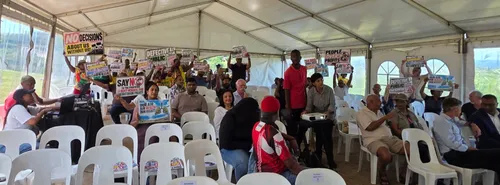
Residents from seven La Mercy-area communities have opposed a proposed 33,800-grave memorial park and six-unit crematorium, citing concerns about consultation, traffic, LPG safety, emissions and the development’s impact on future investment.
At a recent public participation meeting residents of Desainagar, Seatides, La Mercy, Westbrook, Lungelani, Pholani and Thuthukani strongly objected to the memorial park.
The Coastal Joint Task Team (CJTT) – a group formed by residents to oppose the development - challenged DA Ward 58 councillor Geoff Pullen over his handling of the proposed development.
They shouted and booed Pullan as he attempted to address the gathering.
The meeting, convened by environmental assessment practitioners NFZ Environmentals, was plagued by delays and frustration, with residents questioning why they had not been adequately consulted about a development.
Residents questioned why their elected representative had not convened community meetings to explain the proposal, establish their views and communicate their concerns to the relevant authorities.
Community representatives alleged that Pullen had known about the development since 2023 but had not held public meetings to inform affected residents.
The meeting eventually had to be called off.
Anand Desai of the CJTT said the residents were strongly opposed to the cemetery and crematorium.
Desai said the CJTT was established following a community meeting approximately three to four weeks ago, after residents became aware of the development and began investigating its approval process.
“The CJTT reports that not a single resident from the affected area supports this project,” he said.
The development is proposed on former sugar-cane land opposite King Shaka International Airport, on the seaward side of the N2.
While the crematorium forms part of the second phase of the project, which is currently at the draft Environmental Impact Assessment Report stage, residents said they were shocked to discover that an earlier phase had already been approved.
Desai said the communities would continue pursuing all lawful avenues to oppose the development.
Michael Singh of the CJTT said they had been unaware of the proposal until recently.
He said residents had canvassed the surrounding informal settlements and engaged community leaders to establish whether people knew about the project.
“There was no one who knew about it,” Singh said.
He questioned whether the consultation process for the first phase had adequately reached the communities most likely to be affected.
“Whether they had done an appropriate Phase One consultation leaves a lot to be questioned because people had no idea at all,” he said.
Singh said the community's opposition was not simply about rejecting a development but about what residents believe is an unequal approach to investment and infrastructure along the coastline.
He compared the proposed cemetery and crematorium to the developments found in neighbouring coastal areas such as Umdloti and Ballito.
“We feel that there is an ongoing prejudice and bias against us - whether it is through the developers or government,” he said.
He questioned how the area would attract tourism, commercial investment and residential development if a large cemetery and industrial-scale crematorium was built there.
“How can we have ecotourism or other positive development, malls, and other development of nice housing estates if we are going to put a crematorium?” he asked.
The communities surrounding the proposed site include established residential neighbourhoods, farms, three informal settlements and expanding housing developments.
Residents also pointed to the area's proximity to schools, particularly Seatides Combined School and Crawford North Coast, as reasons they believe the development required rigorous scrutiny.
Community representatives place Seatides Combined School approximately 700 to 761 metres from the proposed site.
They are demanding detailed assessments of potential emissions, cumulative air pollution, LPG safety, emergency response arrangements, traffic and the implications for future development.
For Desiree Singh, a Desainagar resident who lives on Park Avenue, the prospect of LPG tankers travelling past her home is particularly alarming.
She said residents discovered the proposal after a community member riding a bicycle through the sugar-cane fields spotted a notice.
“I am very upset about this, because we definitely did not know this was going on in our backyard. We did not get sufficient notice,” she said.
She said residents subsequently began investigating the development and organised objections.
“One of the main objections for me is that instead of building a road to their new development, they are choosing to use the road that goes past my house to transport LP gas,” she said.
Singh raised concerns about the road's steep gradients, speed bumps and sharp bends, questioning whether articulated vehicles carrying LPG could safely navigate the route.
She also questioned the potential consequences of an accident involving a gas tanker.
Her reference to a potential 361-metre danger radius and a 50% casualty rate reflected her concerns about the risks.
The proposed access arrangements have become a major flashpoint for residents, who fear that funeral processions, construction traffic, service vehicles and gas deliveries could compromise road safety and restrict access to their properties.
Desiree said the impact could extend beyond the immediate residents of Park Avenue.
She warned that alternative routes, including Genazzano and Dolphin Avenue, could bring additional traffic past the school if the primary access road became unsuitable.
Residents are also concerned about possible effects on the area's appeal to future investors, tourism operators and homebuyers.
Desiree claimed that the development appeared to serve wealthier communities.
“Umdloti just got two malls? Build us a mall. Do not build us a crematorium to service rich people,” she said.
She said the development had intensified feelings of marginalisation among residents of a predominantly Black coastal area where three informal settlements continued to face their own infrastructure and development challenges.
The residents were demanding full disclosure of the project's ownership, operational responsibility, specialist assessments and approval records, as well as proper consideration of alternative sites and access routes.
When the sundaytribune.co.za spoke to Pullen at the meeting, he said his decision not to lodge formal objections against developments in his ward stemmed from legal advice he received after an earlier application involving a cellphone mast in Seatides.
“The reason I do not object to any developments in the ward - in fact, in the whole city - is because some years ago, there was an application for a cell mast and I deliberately do not put in objections to any developments in the ward anymore,” he said.
He explained that he had objected to the cellphone mast before having to recuse himself when the matter reached an appeal because of his position on the appeals committee.
“I put in my comments, I make suggestions, but I do not put in any objection, because then I have to recuse myself,” he said.
Pullen said the same principle applied to other members of the committee.
“That is just a fact of life. You can scream and shout as much as you like, but in fact, it means you just have to stand up to bullies,” he said.
Related Topics
Keywords
Related Stories
BENT COP: Cape Town cop convicted of murder, supplying intelligence to the 28s Mobsters gang
A Western Cape High Court judgment has laid bare the danger of organised crime penetrating the very institution tasked with fighting it.

Reporter’s Notebook: The sewer still fouling the Cradle is emblematic of local government failure
The discharge of raw sewage through this area is nothing short of a crime against South Africa’s scientific and cultural heritage. Indeed, it is a crime against humanity’s collective heritage – it is a World Heritage Site, for crying out loud, and it is being treated like a…

Investment firm VFD Group posts 96% surge in nine-month profit on higher investment income
Net investment income climbed 58.8 per cent to N72.2 billion, further boosted by lower investment and similar expenses. The post Investment firm VFD Group posts 96% surge in nine-month profit on higher investment income appeared first on Premium Times Nigeria.

Nigeria’s lithium boom struggles to benefit its communities
With the right policies, Nigeria could boost economic growth, create jobs, and improve rural livelihoods. But in the rush to exploit its reserves, local communities may also pay a price through environmental pollution, land degradation, and insecurity that often accompany poorly…

Top Stories
BENT COP: Cape Town cop convicted of murder, supplying intelligence to the 28s Mobsters gang
Reporter’s Notebook: The sewer still fouling the Cradle is emblematic of local government failure
Investment firm VFD Group posts 96% surge in nine-month profit on higher investment income
Nigeria’s lithium boom struggles to benefit its communities

Shop freezers in six European countries hit by suspected cyber-attack

Scotland lose Ritchie and Millar Mills through injury

Nigerian health chiefs confirm negative results in Ebola cases

Train attacker said 'I am the baddest', trial hears
Latest
BENT COP: Cape Town cop convicted of murder, supplying intelligence to the 28s Mobsters gang
Reporter’s Notebook: The sewer still fouling the Cradle is emblematic of local government failure
Investment firm VFD Group posts 96% surge in nine-month profit on higher investment income
Nigeria’s lithium boom struggles to benefit its communities
Shop freezers in six European countries hit by suspected cyber-attack
Scotland lose Ritchie and Millar Mills through injury
Nigerian health chiefs confirm negative results in Ebola cases
Train attacker said 'I am the baddest', trial hears