Software squeezes more data out of Webb Telescope for imaging exoplanets
With a huge and still-growing catalog of exoplanets, researchers are eager to take the next steps: trying to infer what conditions are like on them, either by imaging them directly or by capturing the light that has passed through their atmosphere. Both are substantial challenges, given the presence of stars that are far, far brighter than light that has come to us via the planet.
While telescopes can be fitted with devices called coronagraphs that block out much of a star’s light, there are limits to their effectiveness, caused by noise from subtle variations in the telescope’s configuration and pointing between observations. Now, researchers have developed a new software package that optimizes a physical model of the telescope in a way that allows us to better model these differences, producing low-noise imaging of exoplanets.
Point spreads
Central to this work is the concept of a point spread function. If you use a telescope to image a single point of light, it will not appear that way in the actual image. Instead, it will be slightly blurry and spread out, due to imperfections in the telescope hardware and the limits of our ability to keep it pointed accurately through the time it takes to image something. The mathematical description of how a telescope distorts a point of light is called its point spread function.
There are two ways to figure out what the point spread function is. One is to use the telescope to image a known target and use those observations to derive a mathematical description of the point spread function. This is effective at reducing noise but has its limits, as the behavior of the telescope hardware can change over time, and the point spread function may vary with the wavelengths being imaged.
The alternative is to try to model the hardware’s behavior and use that model to derive a point spread function. But modern telescopes are incredibly complicated instruments, with many, many factors feeding into their performance in ways that can be difficult to ascertain, even with the full engineering schematics. As a result, these models simply contain too many parameters that need to be tuned to make this route computationally tractable.
But anyone paying attention to the world of AI developments will recognize that we’ve become quite successful at tuning billions of parameters in neural networks, in part through a mathematical technique called gradient descent. And, because this is central to training large neural networks, people have put a lot of work into optimizing the performance of gradient descent on GPUs.
So a team of researchers has developed a process they’re calling FLIP (a non-acronym for Physics-based Learning for Imaging Planets) that uses a physical model of the hardware (in this case, the NIRCam on the James Webb Space Telescope) with 106 possible parameters, and then uses software to optimize all its parameters. The optimization starts with a simulated point spread function, then uses gradient descent to optimize its performance on data from an actual star. Run on a current GPU, this process only takes a bit more than half an hour.
The researchers then fine-tune the results on the actual scientific image they are analyzing. This last part of the process is critical, since some variables will differ between observations.
Good results
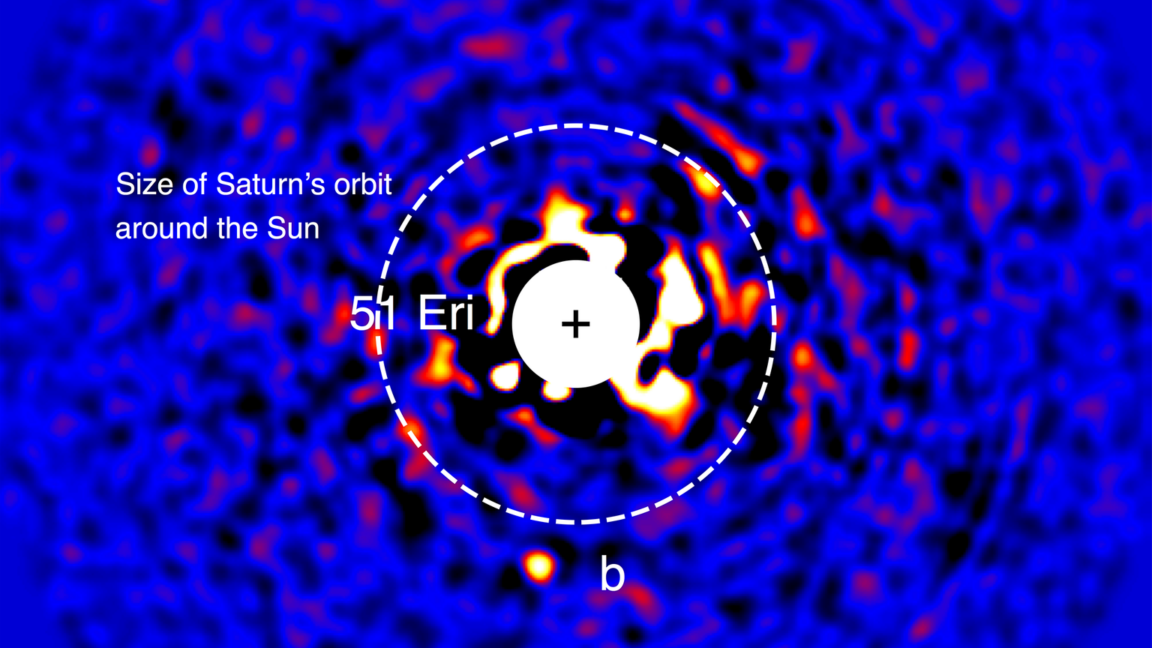
To test how this works, the researchers used observations of two stars with known exoplanets (HIP 65426 and 51 Eridani), along with a third (TYC 5899) that doesn’t have any known exoplanets but is known to vary a lot between observations. These are young stars, and two of them have massive planets that are still warm from their gravitational collapse, allowing them to have been imaged previously.
Using Webb data, the team used FLIP to boost the signal-to-noise ratio by a factor of 1.5 to 2, depending on the observations. At a wavelength that can be used to detect carbon dioxide, they were able to spot one of the planets in the Webb data for the first time. For TYC 5899, the approach boosted the sensitivity of the observations by a factor of 15.
The researchers point out that the applications go beyond getting a better view of known planets. By lowering the noise, it should also be possible to spot dimmer (and hence older or lower-mass) ones that had previously eluded detection. They also think they can modify FLIP to highlight where it’s making the most dramatic changes to the model, which can potentially tell us useful things about what’s going on with the telescope’s hardware.
Nature, 2026. DOI: 10.1038/s41586-026-11213-z (About DOIs).
 1.
After Texas' blue wave, what happens to Elon Musk and SpaceX?
Keywords
Related Stories
Perplexity launches its own take on AI agents for work
Perplexity is taking on OpenAI and Anthropic with its own work-focused AI agents. The startup's new always-on "Teammates" can take on multiple roles within a workspace, while pulling existing projects, skills, and memory from the Perplexity tools you already use. Teammates…

Salon is shutting down after 31 years
Salon launched 31 years ago as one of the first online-only news magazine outlets, and it announced today in an unsigned post that it's ceasing publication. The company said that the "business realities of independent digital journalism have changed profoundly over the years,"…


The midterms proved once and for all that X is not real life
A week before the midterm elections, Vice President JD Vance hosted a town hall in Texas with Fox News host Jesse Watters. It was a friendly event with a friendly audience in what should have been a friendly state, and maybe that's why Vance couldn't help himself. When a college…

Top Stories

LOCAL ELECTIONS 2026: DA draws coalition red lines as Nelson Mandela Bay results take shape

USMNT's Gold Cup path to look different as Concacaf unveils revamped group-stage format

Best horse racing betting sites: Where to bet on horse racing

Gov Abiodun declares Ogun ready for state police

Former Cross River PDP chair doubts party’s 2027 chances

Cowboys stars reject George Pickens trade talk ahead of NFL deadline
Türkiye and SA look to a bigger future together

Firms told to publish salaries in job adverts ahead of new law

Latest
LOCAL ELECTIONS 2026: DA draws coalition red lines as Nelson Mandela Bay results take shape
USMNT's Gold Cup path to look different as Concacaf unveils revamped group-stage format
Best horse racing betting sites: Where to bet on horse racing
Gov Abiodun declares Ogun ready for state police
Former Cross River PDP chair doubts party’s 2027 chances
Cowboys stars reject George Pickens trade talk ahead of NFL deadline
Türkiye and SA look to a bigger future together
Firms told to publish salaries in job adverts ahead of new law