The artificial ice pyramids saving India's mountain villages

 AFP via Getty Images
At an altitude of almost 4,000m (13,000ft) and receiving almost no rainfall, the Himalayan village of Sakti is a hostile place to be a farmer.
"Ladakh has a brutal, single-cultivation season," says Gelak Gutme, who has been growing wheat, peas and potatoes there for most of his 65 years.
"It is a desert with an extreme climate," he says.
Conditions have become worse in his lifetime. Global warming means that the smaller, low altitude glaciers they relied on to water their crops have disappeared.
"Now there is scarcity of water. Last year I lost everything - my entire field got dried due of lack of water," Gutme says.
 Acres of Ice
"For generations, small glaciers sitting right above the valleys acted like frozen water towers, holding onto water all winter and releasing it right when spring farming began," explains Lobzang Fardod, who is a member of a local water management committee in Ladakh.
"Now that those lower glaciers have completely vanished into a desert of dry rock, there is nothing left at the top to melt," he says.
The mountain summer is short, so farmers have to plant their crops by May, otherwise the crops will not be ready before the winter hits again.
A reliable source of water in early spring is crucial for them.
To secure that vital resource, in the early 2010s some Ladakh villages attempted to create their own reservoirs of ice.
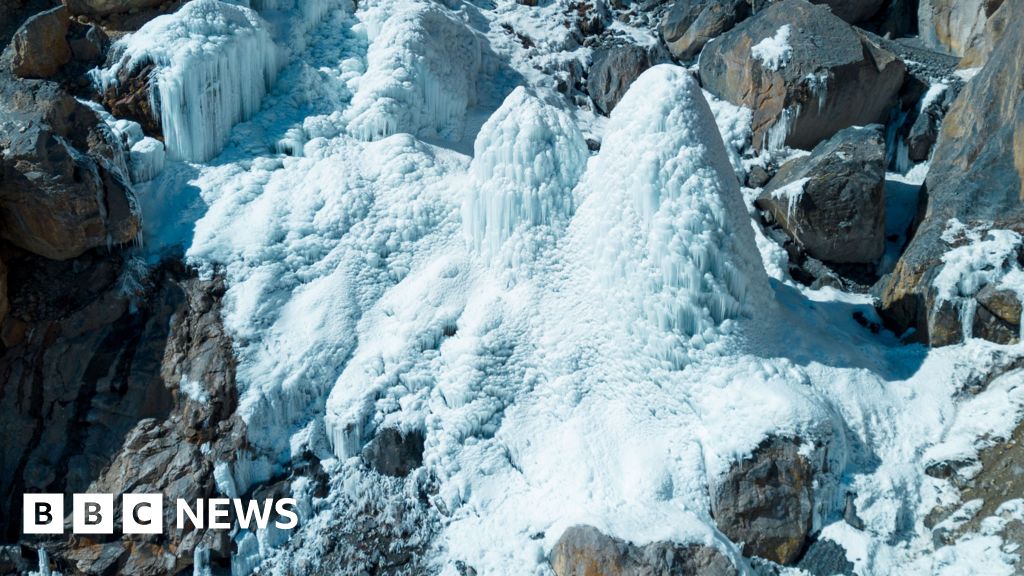
The system involved piping water from higher up in the mountains during the winter and spraying it into the air, where it would freeze, and over time form large towers of ice, called ice stupas.
They successfully supplied melt water in the spring, but were a "nightmare" to manage under harsh winter conditions, says Fardod.
If temperatures dropped quickly below minus 20C, or sometimes minus 30C, the water in the pipes was liable to freeze, cracking the pipes and ruining the whole system.
To guard against that, during the winter teams of four or five farmers would camp high-up, near the water source, rushing to any potential blockages with boiling water, often during the night when temperature drops were most likely.
But enduring those freezing, winter nights high in the mountains could be phased out.
"Because traditional water systems are failing, Leh-Ladakh has become a hub for innovative, grassroots hydraulic engineering," says Murtaza Ali, executive engineer in the Irrigation and Flood Control Division, at the Ladakh Autonomous Hill Development Council.
Leh is the capital of Ladakh, a disputed region in Indian-administered Kashmir that is sandwiched between China to the east and Pakistan to the west.
 Acres of Ice
As well as the potential for cracked pipes, the ice stupa system was not very efficient, says Ali.
Because water flowed constantly, on warmer days fresh water would melt the ice that had already formed.
But over the last couple of years that method has undergone a tech upgrade.
In partnership with private company Acres of Ice, a new system has been developed which precisely controls ice production.
Called an Automated Ice Reservoir (AIR), the process also involves piping water down from higher up in the mountains.
The water arrives at the valley floor under pressure and shoots out of a vertical nozzle like a "massive fountain", says Dr Suryanarayanan Balasubramanian, the founder of Acres of Ice.
That flow is computer controlled from a weatherproof control box, powered by solar panels and a battery.
The control system is connected to a weather station, which monitors, environmental conditions, including the water temperature inside the pipe.
If the sensors detect that the air temperature is dropping too fast, or the water temperature inside the pipe approaches a dangerous threshold, the control system takes action.
It shuts off the valve at the top of the stream and opens a valve at the bottom to completely drain the standing water out of the pipe.
That avoids the ruinous problem of cracked pipes, but the system is also more efficient at creating ice. Instead of continuously spraying water, AIR fires a burst of mist, coating the existing ice, and then shuts off.
"The system waits precisely long enough for that layer of water droplets to freeze solid based on current wind and humidity, then fires the spray again," explains Balasubramanian.
He says that AIR converts almost all of the diverted water into ice.
The whole system runs automatically and uses a local wireless network to connect the control box and the various valves. But the villagers do have a manual override, if needed.
It all appears to be making a difference to village life.
"When we speak to the villagers, they are saying the groundwater is getting recharged and spring sources are getting revived. They are getting water in time. We are also planning a scientific study now to see exactly what impact it has made," says Ali.
 Acres of Ice
During the winter of 2025, Acres of Ice and the local government ran 10 AIR projects across Ladakh.
"Our biggest challenge right now is to push the envelope in the technology to see how we can multiply the number of ice reservoirs we are building. With the same system that previously used to build only one ice reservoir, can we build a dozen?," says Balasubramanian.
Back in Sakti, farmer Gutme is more optimistic about the future. The single AIR system has created a more reliable water source and he hopes the village will build at least two more of the artificial glaciers.
"I am a farmer, land is all that I have to survive on. I don't know the technology, all that I know today is that I have water to grow my crops.
"We live in harsh climate that makes our life difficulty and lack of water was creating more issues. Many of youths in the village wated to go to cities to work. That would have been a disaster."
Technology of BusinessInside the secretive and lucrative world of orchid breeding
International BusinessTechnology of BusinessKeywords
Related Stories
Binance users withdraw $3.6bn after record crypto hack
The exchange froze transactions in the wake of the incident, which impacted $6.3bn worth of digital assets.

Don't get caught out by new Buy Now Pay Later rules
New affordability checks mean you could be blocked from using Buy Now Pay Later but here are ways to avoid it.

Thousands of jobs at Virgin Media O2 to be cut
The broadband provider has not finalised the number of roles to be axed but it will likely be a sizeable chunk of its workforce, the BBC understands.

Shops looted as German cost-of-living protests turn violent
The protests in cities across Germany - including Berlin, Hamburg and Frankfurt - came on the same day hundreds of thousands also protested in France.

Top Stories
UN peacekeeping mission in Western Sahara ends after 35 years, UN chief says

Week 8 overreactions: Time for Vikings to bench Kyler Murray? Colts should fire Steichen?

NFL Week 8 winners and losers: Cowboys suffer epic collapse, Joe Burrow delivers historic heroics

How Antonelli 'blew everyone away' to make Formula 1 history

Why is Ashton Jeanty not getting carries? Another Raider emerges as Vegas' top RB in Week 8

Russia and Ukraine accuse each other of hacking emergency alert apps

NFL Week 8 grades for every team: Cowboys get an 'F' for choking, Steelers surge to 'A+'

Ukraine air raid app apparently hacked as users receive false radiation threat, Air Force says
Latest
UN peacekeeping mission in Western Sahara ends after 35 years, UN chief says
Week 8 overreactions: Time for Vikings to bench Kyler Murray? Colts should fire Steichen?
NFL Week 8 winners and losers: Cowboys suffer epic collapse, Joe Burrow delivers historic heroics
How Antonelli 'blew everyone away' to make Formula 1 history
Why is Ashton Jeanty not getting carries? Another Raider emerges as Vegas' top RB in Week 8
Russia and Ukraine accuse each other of hacking emergency alert apps
NFL Week 8 grades for every team: Cowboys get an 'F' for choking, Steelers surge to 'A+'
Ukraine air raid app apparently hacked as users receive false radiation threat, Air Force says