‘There are no barriers in the music’: The Savoy Ellingtons and H.B. Barnum
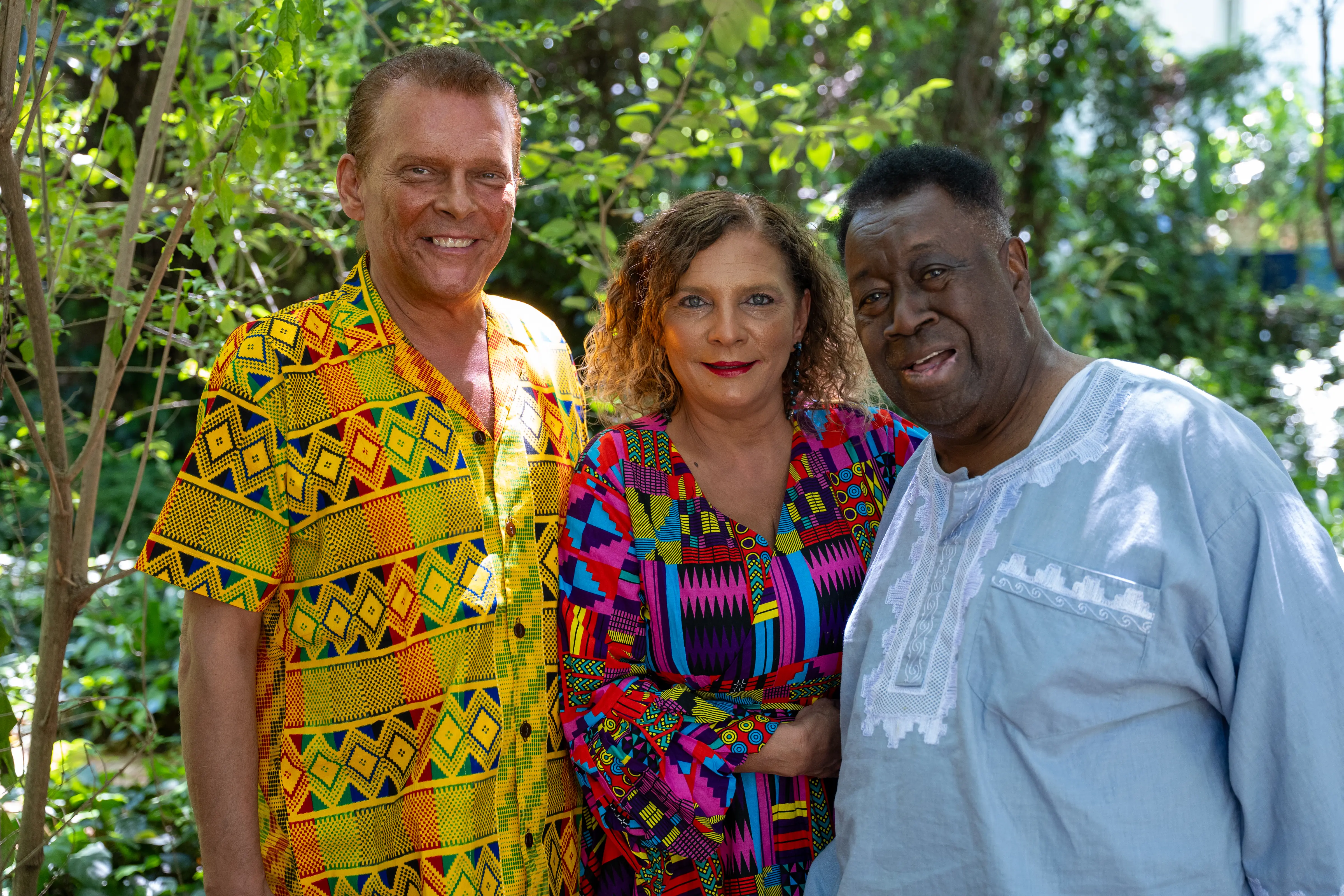
Last month, a 90-year-old arranger who once worked alongside Aretha Franklin, Frank Sinatra and The Supremes stood in the Cradle of Humankind, a Unesco World Heritage Site in Gauteng, and conducted jazz.
H.B. Barnum was in South Africa for the first time for the Our Origin Festival, held at Kromdraai Impact Hub in Krugersdorp from 16 to 18 October. With him were The Savoy Ellingtons, siblings Edward and April Ellington, who carry one of music’s heaviest surnames and were also making their South African debut.
Barnum’s career spans some seven decades as a producer, arranger, composer and conductor. He became a Motown mainstay in the 1960s and spent 42 years as Aretha Franklin’s musical director. The Savoy Ellingtons have performed internationally for more than four decades.
We spoke to all three about identity, inheritance and what it felt like to land in the Motherland.
This was your first time in South Africa. What did it mean to you?
Edward: Performing in South Africa for the first time is incredibly meaningful to us. We were so excited to come to the Motherland, a place whose rich musical heritage has been part of my life since childhood. Music was always playing in our home, from classical to jazz and everything in between. I grew up listening to South African legends like Miriam Makeba, Thandi Klaasen and Hugh Masekela, so to finally be here, walking on the same soil where these extraordinary artists were born and created their music, is deeply moving. It feels like a homecoming in many ways.
April: It has been an extraordinary, exhilarating, spiritual and truly life-changing experience. Being here, connecting with its roots, its music, its movement and its unique energy and frequency has meant the world to us. South African jazz has such a rich and vibrant legacy, with extraordinary artists like Abdullah Ibrahim, also known as Dollar Brand. Having the opportunity to perform alongside our musical conductor and godfather, H.B. Barnum, and collaborate with talented South African musicians has been phenomenal. We look forward to returning.
H.B.: They took me to a distant land called Johannesburg and they never introduced me to Tarzan, but otherwise I love them.
How do you establish your own musical identity while performing music so closely tied to Duke Ellington?
April: My identity is established simply because I am who I am. My lineage is what it is, and having the DNA of my father, I would say that I bring my own gifts to the feast. When we’re performing Ellington music, it is us delivering it but keeping it true to its originality. We bring our own interpretation without adulterating the compositions that were written, sometimes painstakingly, to arrive at a particular melody or lyric.
Edward: I approach music as a storyteller. The notes may be the same but the way we express them is entirely individual. My musical identity is rooted in believing in myself, believing in the music and believing in the lyrics. It’s like baking a cake. You bring together all the ingredients, mix them with care and hope to create something beautiful.
H.B.: When you honour the past, you create the future as you go. Right now, we’re honouring one of my idols and heroes, Mr Duke Ellington. But Mr Ellington didn’t invent it all. What he did was take his brain and mix the soup a little different. And what I’m doing is mixing the soup a little different. It wouldn’t diminish what he did. It wouldn’t make mine any greater or less. It would just be what we have.
What was your relationship with Duke Ellington and how did it shape you?
Edward: First, that of a father and son. He spent approximately 320 days a year on the road, and my mother would take us to visit him wherever he was performing around the world. What shaped my career most profoundly was witnessing his extraordinary dedication, passion for composing and commitment to performance. Those experiences planted seeds within me from an early age.
April: I was Daddy’s girl. As my brother and I often say, he belonged to the world, but he was our father. His influence shaped not only my musical career but also my spirituality, my perspective on life and my respect for all life. I made my stage debut dancing at just four years old. Although I famously refused to sing when handed a microphone, that was my introduction to show business.
You’ve performed for audiences around the world. What has surprised you?
Edward: The incredible diversity of audiences who embrace jazz, from children as young as 10 to people in their nineties. Everyone has a favourite song that takes them back to a particular person, place or moment in their lives. When we perform those songs, you can see the emotions light up their faces, and that’s the magic of music.
April: After more than 42 years of performing internationally and singing in multiple languages, what continues to move me is how jazz connects with people across cultures and generations. My mission when I step onto a stage is simple: if I can touch even one person in an audience of a thousand, I feel I’ve done my job. As for the big band era, I don’t believe it ever died. Jazz is the foundation of American music. Its timeless appeal brings artists and audiences back, generation after generation.
H.B., what makes music cross genres and borders?
H.B.: Music is feeling. Music is tones, arranged in certain ways that tingle your ear, tingle your soul. Nobody’s ever made one song that everybody bought, so there must be something in all music that someone somewhere wants to hear. I’ve worked with artists from different countries, and at rehearsal we couldn’t even communicate in the same language. We’d have a translator sitting there. But when we started doing the music, they sang the song in their language, I played the music in the music language, and it worked. There are no barriers in the music.
You’ve seen enormous change in the industry. What has technology given and taken?
H.B.: Actually, I don’t find any changes in the music. No one’s invented any new notes or come up with any new scales. What we’ve done is rearrange. I used to punch the little numbers on the telephone, then we had a dial, and now we’re back to punching numbers on our cellphones. The music will never change. It’ll just be arranged differently and the technology makes the sounds different. Same notes, same scales but we’ve added different kinds of echoes. I like the advancement. Anybody who doesn’t should go back to a string and a tin can.
What we risk losing is relying on the technology alone. If you want to be creative, you still need to know the scale. You still need to know the chords. I like it when I can use my phone to add up numbers but if it goes dead, I know how to add them up with my fingers. It just takes me a little longer. The brain will always be the source.
How did the collaboration between you come about?
Edward: It began over 42 years ago, when my sister April was based in Los Angeles and I was living in New York. We were both pursuing our musical careers but had always dreamt of coming together creatively. From that shared vision, The Savoy Ellingtons were born. Alongside H.B. Barnum, April and I each contribute our own interpretations and sensibilities. The beauty is that our individual differences become one unified musical expression. Music is about finding harmony, not only in the notes we play and sing but in the relationships we build.
H.B.: We’re having a potluck party right now. April’s bringing something, I’m bringing something, there are musicians bringing something, and we’re all going to eat, and hopefully it all tastes good. Is it the best that’s out there? Maybe not. But it’s what we have and we bring it to the party. Somewhere out there is somebody who thinks we’re fantastic and somebody who thinks we’re terrible. Doesn’t matter. We love doing it, and we love that we’re making a decent living and don’t have to do other things to put bread on the table.
What has helping other artists taught you?
H.B.: The reason I can help other people is because I had tremendous help from people who got me started and sustained me. Somebody can push you up the hill, then you go down and get back up again. I’m only going to be here a certain amount of time. I want music to continue to heal people, to bless people, to support people. So I’m just passing on what was given to me.
Some guy will say, man, you can’t steal my sound. But where did his sound come from? Whatever you’re creating, somebody somewhere in the universe is on the same wavelength. They call us successful but we’re the lucky ones. There’s somebody out there who does what I do better, who does it easier. They’re just not discovered yet.
Keywords
Related Stories
I have a picture for you! 01 November-06 November
The First Thing newsletter's Ever-lasting Subscriber Photo Gallery.

ENVIRONMENTAL JUSTICE: African climate voices demand fair funding and influence before COP31
The winds, drought and excessive rains of climate change are blowing in Africa and it’s time for the Global North to listen and deliver on its climate finance promises. At COP31 in Turkey, which runs from 9-20 November, African countries will need greater weight in…

Diwali lamingtons with jam and coconut
These soft cake squares are coated in raspberry jam and desiccated coconut for a simple twist on the classic lamington.

ActionSA to negotiate for Nasiphi Moya to serve another five years as Tshwane mayor
ActionSA National Chairperson Michael Beaumont has thrown his weight behind Dr Nasiphi Moya serving another term as Tshwane mayor, saying the party will negotiate to ensure she remains at the helm of the metro for five more years.
Top Stories
I have a picture for you! 01 November-06 November
ENVIRONMENTAL JUSTICE: African climate voices demand fair funding and influence before COP31

Met chief says he wouldn't be surprised if more allegations made about Brand after rape conviction
Diwali lamingtons with jam and coconut

Train worker recalls repelling attacker with frying pan
ActionSA to negotiate for Nasiphi Moya to serve another five years as Tshwane mayor

Katherine Ryan says she feels 'grief and relief' after Russell Brand conviction

Two Gloucester schools in lockdown after boy hurt in incident
Latest
I have a picture for you! 01 November-06 November
ENVIRONMENTAL JUSTICE: African climate voices demand fair funding and influence before COP31
Met chief says he wouldn't be surprised if more allegations made about Brand after rape conviction
Diwali lamingtons with jam and coconut
Train worker recalls repelling attacker with frying pan
ActionSA to negotiate for Nasiphi Moya to serve another five years as Tshwane mayor
Katherine Ryan says she feels 'grief and relief' after Russell Brand conviction
Two Gloucester schools in lockdown after boy hurt in incident