This space company is betting its future on a propellant available everywhere
Robert, Ryan, and Kirby Carlisle are three engineers who worked at SpaceX during the Falcon 9 era, seeing the revolution in the global launch industry from the inside.
The brothers launched rockets, refurbished rockets, and sold rockets. But when it came time for them to leave SpaceX and start their own space company—a lifetime dream for the Carlisle brothers—they chose not to build rockets. Rather, they focused on spacecraft.
In late 2022, the three Carlisles founded Argo Space to build infrastructure in space. Their vision was not just in-space transportation but also removing the need to use propellants from Earth to move around the heavens. They chose water, which is potentially harvestable on the Moon and found all over the Solar System, as a means of propulsion.
“We based the company on water,” Robert Carlisle said in an interview.
The availability of water is key to the company’s vision for building a transportation network between low-Earth orbit, geostationary orbit, and the Moon. This would open up a large number of affordable logistics options, such as satellite resupply, refueling, repair, redeployments, and more. And in the company’s vision, water is not just a propellant; it’s also a coolant and radiation shield. Much of the spacecraft, including its thrusters to the avionics, is cooled by water. This helps increase the propellant mass fraction of the spacecraft, meaning more mass is devoted to propellant, allowing the vehicle to go farther and do more things.
“In the long run, this water-based transportation will give us a commercial incentive, a profit motive to go harvest it from the Moon’s shallower gravity well,” Robert Carlisle said.
When even former SpaceXers can’t find a Falcon 9
Argo Space flew its first demonstration mission, dubbed Navigator, in July on a Falcon 9 rideshare. The company successfully made contact with the spacecraft, but one of its two rollout solar arrays failed to deploy. Controllers spent about half a day troubleshooting the issue and gathering data on the spacecraft’s health. Unfortunately, however, the spacecraft remained power-negative, draining its battery. There was not enough energy to test the propulsion system.
“We did get to validate the flight software, the ground software, the core avionics, the structures, and everything up to flight qualification, but no propulsion,” Robert Carlisle said. “So, you know, obviously that’s going to be a key goal on these next two missions.”
What are the next two missions? The company’s next-generation spacecraft, Chiron, is intended to pack high performance into a small, roughly 200-kg package.
The company plans two Chiron missions in 2027, both flying payloads for an undisclosed national security customer. The first mission is bound for low-Earth orbit, and the second to a geostationary transfer orbit. The goal across the two flights is to demonstrate Chiron’s propulsion system, including its ability to maneuver between different orbital environments.
It’s notable that the Carlisles spent much of their working lives at SpaceX to open up access to space with the Falcon 9 rocket, but neither of Argo’s next two missions will fly on a SpaceX vehicle. That’s because the company is pulling back on the commercial availability of the workhorse launch vehicle.
So Argo’s first Chiron mission is flying on an undisclosed new commercial rocket, definitely a calculated risk. And the second is going on an unspecified government-furnished launch vehicle. Argo Space probably would have preferred a rideshare on the Falcon 9 for its first Chiron mission, but one was not available within its schedule.
“We don’t want to be waiting around for another year and a half, two years plus to go get that ride,” Robert Carlisle said. “Right now you’ve got to get on a wait list, and it’s far out. There’s not launches available for sale.”
How does water actually work as a propellant?
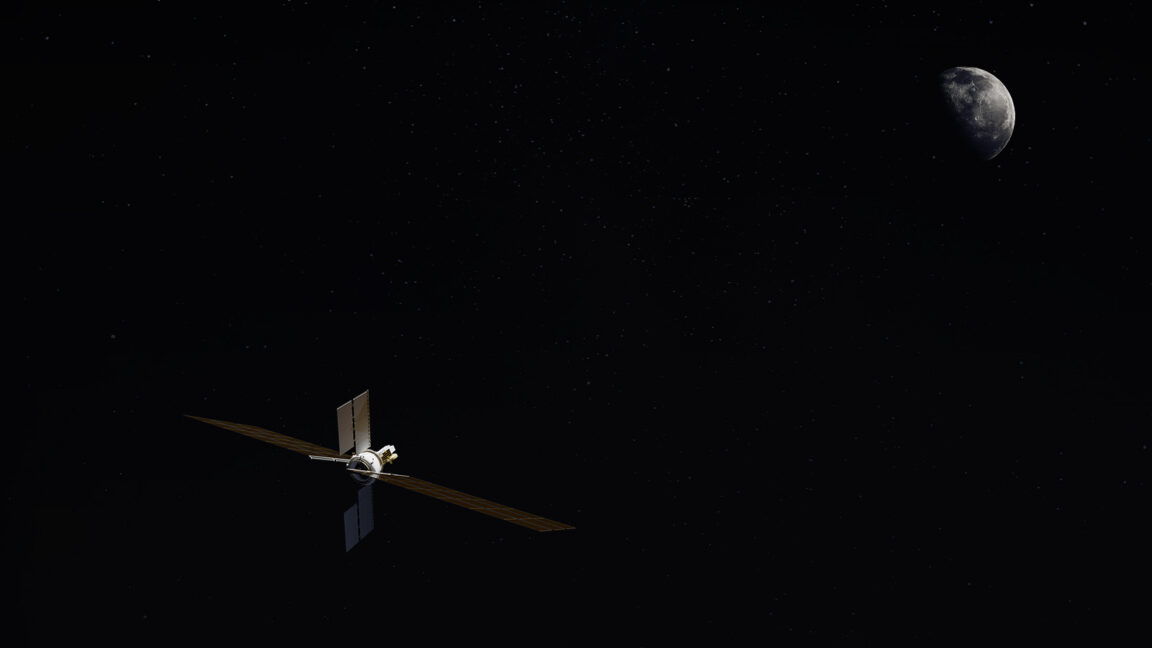
Argo says it can achieve more than 2 km/s of delta-v in a roughly 200 kg spacecraft. That’s a lot of capability for a small vehicle, allowing it to do things like raise a circular orbit at about 400 km above the Earth’s surface to more than 5,000 km. It’s also equivalent to several decades of station-keeping in geostationary orbit.
The propulsion system is basically a small rocket that uses hydrogen and oxygen as propellants. However, instead of launching with separate tanks of liquid hydrogen and liquid oxygen, Chiron starts with liquid water. In space, the vehicle uses solar power to split water into hydrogen and oxygen gases and burns them to generate thrust.
Storing these propellants in their gaseous forms retains them in a less dense form but avoids the complexity of storage at cryogenic temperatures. However, the water itself can be stored as a relatively dense liquid at modest pressures until it is needed.
Electric-based propulsion is not new, of course. But Chiron takes a different approach, using electricity to split water and then a conventional rocket engine rather than ion thrusters. This provides more thrust than a conventional electric thruster with a similar amount of power.
Argonaut coming
This isn’t the first time water has been used as a propellant in space. In late 2017, two small satellites developed by NASA demonstrated a compact water-based propulsion system to maneuver in orbit. A commercial space company, Momentus, has used water propellant for in-space maneuvering as well.
But Argo is aiming to do this on a larger scale. After Chiron, the company is working on a vehicle called Argonaut, which has a maximum payload capacity of 1,400 kg and a maximum delta-v of 17 km/s per tank. This is a much more capable vehicle, and in September, Argo Space signed a deal with ispace to deliver ispace’s Lunar Connect communication relay satellite to lunar orbit later this decade. Argonaut could start to open up the lunar economy envisioned by Argo’s founders.
This is an awful lot for a company that has raised $20 million to date and has fewer than 30 people. But it helps that spacecraft are less capital-intensive to develop than rockets, said Kirby Carlisle, who, like a lot of SpaceX engineers, spent plenty of time in McGregor, Texas, working on rockets and engines. Argo can test most of its spacecraft systems in their facilities in El Segundo, California.
“I think something that people frequently kind of discount, or just forget about with rockets, is the enormous amount of ground infrastructure that you need,” Kirby Carlisle said. “We don’t need a McGregor, right?”
 1.
Coming in 2027: Apple’s $1,000 home robot for FaceTime and switching on lights
Related Topics
Keywords
Related Stories
Canva is announcing changes and layoffs affecting 22 percent of its staff
Canva is making significant changes affecting 1,271 people, which is 22 percent of its staff, co-founder and CEO Melanie Perkins announced today. "For some people, this will mean changes to their roles or being asked to relocate to centralised hubs," says Perkins. "Sadly, it…

Sonos adds new Presets and prepares for the 27voice AI beta
Sonos is rolling out a big app update that includes new Presets and early access to its AI voice assistant. You can create a preset to play music at a specific volume in a certain room, which will appear directly on the homescreen so you can quickly start playback. If you're in…

Valve is making changes to deal with a ‘significant increase’ in Steam game submissions
In a new post today, Valve acknowledged that it's seen "a significant increase in submissions for store and page review in recent months" and says it's "running a little behind" by taking "up to 12 business days" for reviews instead of the typical 3-5 days. Indie developers have…

Binance says hackers used fake job interviews and an internal AI tool to pull off the $6.3 billion heist
The largest crypto theft to date was pulled off by combining some well-known hacking techniques over the course of a few months, according to Binance. A postmortem from the company says the process that started with one developer downloading a tampered installer in June…

Top Stories
LOCAL ELECTIONS 2026: IEC tightens security amid ballot disruptions, arrests and election intimidation
Canva is announcing changes and layoffs affecting 22 percent of its staff

PAYMENT MODELS: Riding the e-commerce buy now, pay later hype train while it lasts

Champions League expert picks, predictions, best bets: Manchester City aim for turnaround vs. RB Leipzig

2027: Tinubu’s performance enough for his re-election, says education minister Tunji Alausa

Dave Richard's Week 9 Trade Chart and rest of season rankings: Jets, Raiders RBs in flux

NBS: Enugu records lowest ‘tax revenue-to-IGR ratio’

Manchester United stun Roma with three-goal second-half Champions League comeback after dreadful start
Latest
LOCAL ELECTIONS 2026: IEC tightens security amid ballot disruptions, arrests and election intimidation
Canva is announcing changes and layoffs affecting 22 percent of its staff
PAYMENT MODELS: Riding the e-commerce buy now, pay later hype train while it lasts
Champions League expert picks, predictions, best bets: Manchester City aim for turnaround vs. RB Leipzig
2027: Tinubu’s performance enough for his re-election, says education minister Tunji Alausa
Dave Richard's Week 9 Trade Chart and rest of season rankings: Jets, Raiders RBs in flux
NBS: Enugu records lowest ‘tax revenue-to-IGR ratio’
Manchester United stun Roma with three-goal second-half Champions League comeback after dreadful start