ULA's Vulcan rocket is set to return to flight on Friday the 13th
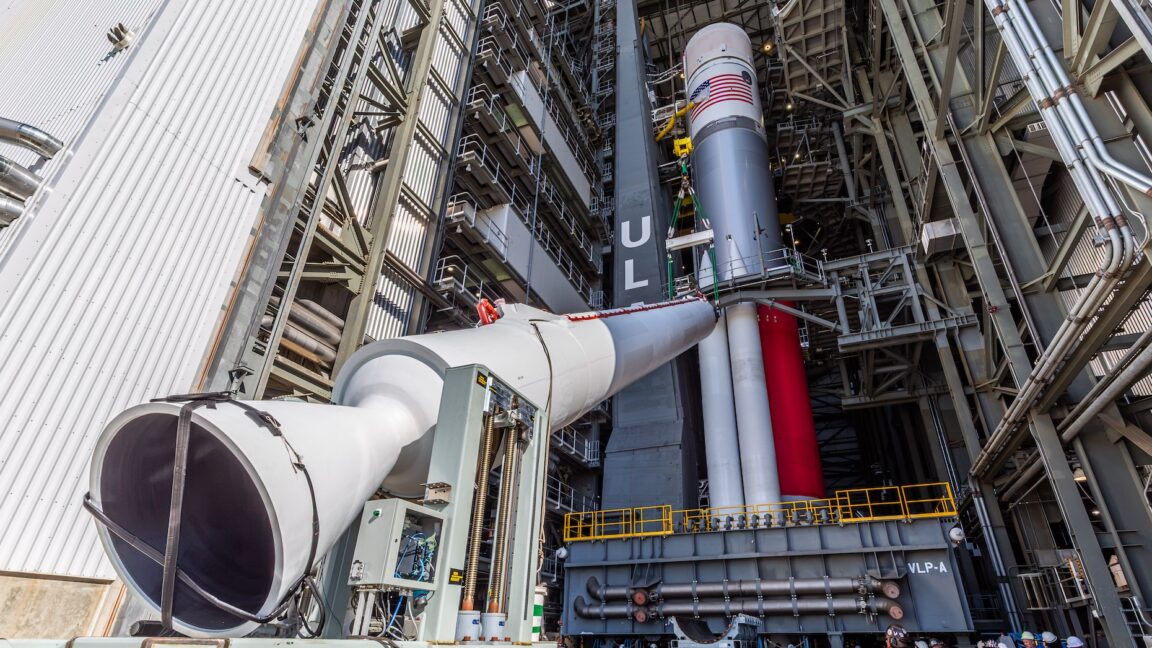
United Launch Alliance announced Wednesday it plans to return its Vulcan rocket to service on November 13, nine months after a solid rocket booster anomaly threw the company’s 2026 launch schedule into oblivion.
The return-to-flight mission will launch 40 satellites for the Amazon Leo broadband constellation, the first of 38 Vulcan flights Amazon has booked to deploy the bulk of its network. The mission will lift off from Cape Canaveral Space Force Station, Florida, and ULA said the launch date is pending range approval.
The launch is critical for ULA after its new flagship rocket suffered nozzle failures on its solid rocket boosters on two of its first four missions, most recently during a flight in February. In both cases, the rocket overcame the nozzle failure and completed its mission, but officials at the US Space Force, ULA’s primary customer, lost confidence in Vulcan.
Space Force officials will closely scrutinize Vulcan’s return-to-flight mission. The Pentagon has entrusted ULA’s Vulcan rocket for roughly half of its major launches through the early 2030s. The Space Force certified the Vulcan rocket for national security launches in 2025, then flew two missions on Vulcan before its grounding after the February booster incident.
Making strides
In a statement, United Launch Alliance said engineers “made great strides” in understanding the booster anomaly that occurred in February. Engineers “have identified several potential contributors, which have been mitigated through design and process improvements to the nozzle,” ULA said.
“To support our customers, this upcoming launch will utilize the improved nozzle design, and additional testing and analysis will continue in parallel with the mission,” ULA said. “By flying the improved design, ULA gains valuable flight data that validates these improvements and is the most beneficial path in support of all our customers.”
ULA and Northrop Grumman, the booster manufacturer, have not publicly identified the root cause of the nozzle malfunction in February. Investigators blamed the nozzle problem’s first occurrence in 2024 on a manufacturing defect in an insulator meant to protect the nozzle’s metallic structure from the rocket’s superheated exhaust. Neither company responded to questions from Ars on Wednesday.
The Space Force is counting on United Launch Alliance, a 50-50 joint venture between Boeing and Lockheed Martin, to deliver into orbit a backlog of the military’s communications, navigation, missile warning, and surveillance satellites. Amazon Leo, a potential competitor to SpaceX’s Starlink network, also has an inventory of broadband satellites in storage waiting for rides on the Vulcan rocket.
With ULA’s delays, the Space Force has moved six missions off the Vulcan rocket to expedite their launch on SpaceX Falcon 9 and Falcon Heavy rockets. ULA received six future missions originally assigned to SpaceX, the military’s other certified launch provider.
The swaps included three GPS satellites that moved off ULA’s Vulcan rocket for launches last year and earlier this year on SpaceX Falcon 9s. Space Systems Command, which oversees military launch acquisition and procurement, also swapped one ULA launch for the Space Development Agency with another on SpaceX.
A launch carrying the Air Force Research Laboratory’s Oracle-M lunar mission will now fly on SpaceX’s Falcon Heavy rocket instead of ULA’s Vulcan, which will receive a future SpaceX-assigned launch in compensation. Space Systems Command completed a similar swap to move a large strategic missile warning satellite from Vulcan to Falcon Heavy.
So far the swaps have had no effect on the number of missions the Space Force has awarded to ULA and SpaceX. The trades are separate from the Space Force’s assignment of unallocated future missions to launch providers, which may already be hamstrung by SpaceX’s plans to retire the Falcon rocket family.
“These swaps are executed in coordination with and with the support of both launch service providers,” a Space Systems Command spokesperson said. “We are grateful for the flexibility shown by our launch service providers during these swaps to help us ensure we can deliver capabilities to the warfighter when and where they are needed.”
Brig. Gen. Eric Zarybnisky, the chief rocket buyer at Space Systems Command, said the military wants to see data from commercial flights on the Vulcan rocket before clearing ULA to resume national security launches. At least two Amazon Leo missions are on the Vulcan launch schedule before it flies another national security mission, perhaps early next year.
“Those flights will have a significant number of solids,” Zarybnisky said. “It’ll depend a lot on what we see, not only on the engineering and tests that we’re doing on the ground, but also what we see from the flight data from the commercial missions they fly.”
The Vulcan launch next month will be the first to fly with a full complement of six solid rocket boosters. The flight will also debut an extended payload fairing to accommodate Amazon’s satellite stack and a shortened Centaur upper stage optimized for low-Earth orbit missions.
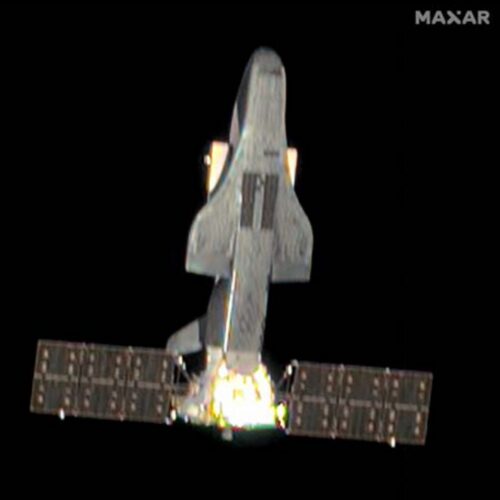 1.
China's top-secret spaceplane can't hide in low-Earth orbit
Related Topics
Keywords
Related Stories
NASA hopes the commercial space industry can help save Hubble
Gravity is a cruel mistress, slowly dragging the famed telescope ever closer to its ultimate demise with every day. Hubble is in no immediate danger of burning up in the Earth's atmosphere, but its time will run out in the early to mid 2030s unless its orbit is boosted. So NASA…

Flock keeps ignoring requests to cancel its contracts
While more cities are canceling their contracts with Flock Safety, just as many are discovering how difficult that can be in some instances. Plymouth, Minnesota's city council voted to terminate its contract with Flock in September, but failed to respond to the city's request.…

Apple’s HomeView could add security camera features
Reddit user pdfu found hints hidden in the HomeView 27.2 code that Apple could be adding security camera features to its smart home hub. The strings describe a security camera mode with motion detection, live streaming, and recording options, as well as privacy functions.…

A fully playable version of Portal prequel F-Stop leaked
Leakers have pieced together a playable version of the canceled Portal prequel F-Stop. Most of the assets came from the massive 12-terabyte leak that dropped this August. That didn't include the game's source code or map data, but those final pieces apparently hit the Valve Cut…

Top Stories
UN peacekeeping mission in Western Sahara ends after 35 years, UN chief says
Week 8 overreactions: Time for Vikings to bench Kyler Murray? Colts should fire Steichen?
NFL Week 8 winners and losers: Cowboys suffer epic collapse, Joe Burrow delivers historic heroics

How Antonelli 'blew everyone away' to make Formula 1 history

Why is Ashton Jeanty not getting carries? Another Raider emerges as Vegas' top RB in Week 8

Russia and Ukraine accuse each other of hacking emergency alert apps
NFL Week 8 grades for every team: Cowboys get an 'F' for choking, Steelers surge to 'A+'

Ukraine air raid app apparently hacked as users receive false radiation threat, Air Force says
Latest
UN peacekeeping mission in Western Sahara ends after 35 years, UN chief says
Week 8 overreactions: Time for Vikings to bench Kyler Murray? Colts should fire Steichen?
NFL Week 8 winners and losers: Cowboys suffer epic collapse, Joe Burrow delivers historic heroics
How Antonelli 'blew everyone away' to make Formula 1 history
Why is Ashton Jeanty not getting carries? Another Raider emerges as Vegas' top RB in Week 8
Russia and Ukraine accuse each other of hacking emergency alert apps
NFL Week 8 grades for every team: Cowboys get an 'F' for choking, Steelers surge to 'A+'
Ukraine air raid app apparently hacked as users receive false radiation threat, Air Force says