Western Cape election results set stage for hung councils and coalition battles
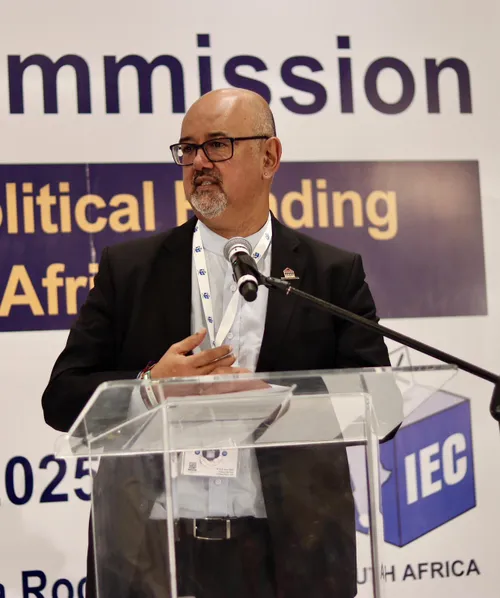
Western Cape Electoral Officer Michael Hendrickse.
An increasingly fragmented political landscape in the Western Cape is setting the stage for coalition negotiations, with political parties being urged to put their differences aside and prioritise stable governance and service delivery.
The Electoral Commission of South Africa (IEC) said 65% of the 4 040 result slips expected from municipalities across the Western Cape had been captured and audited by 2 pm on Thursday, as the province continued processing the outcome of Wednesday's local government elections.
The commission said the results verification process was progressing well, with several municipalities already finalised.
These included Prince Albert, Langeberg, Oudtshoorn, Kannaland, Swellendam, Knysna, Cape Agulhas, Bitou, Matzikama, Cederberg, Bergrivier and Swartland.
The DA has emerged as the largest party in several municipalities, although a number of councils remained without an outright majority, potentially opening the door to coalition negotiations.
The IEC said the City of Cape Town was expected to be among the last municipalities to be finalised.
The IEC said Gauteng recorded the highest number of voters of about 3 million.
It was followed by KwaZulu-Natal with 2.5 million, then the Western Cape with 1.5 million, the Eastern Cape with 1.4 million, Limpopo with1.1 million, Mpumalanga with 854 000, North West with 702 000, the Free State with 588 000, and the Northern Cape at 299 000.
Counting of votes in the Western Cape has finished, with results now being captured, IEC Western Cape Electoral Officer Michael Hendrickse said on Thursday evening.
"They are going through verification and auditing. That is the process we are currently at in our province. In terms of the counting at the voting stations, we are all done with that," Hendrickse said.
On turnout, Hendrickse said early indications were positive. "Overall, I think the turnout has been good, relatively speaking, as it relates to local government elections. Obviously, the final numbers in terms of turnout will only be known when the final results are announced. But for now, we are very hopeful that we will have a good turnout," he said.
Political analyst Dr Levy Ndou said the proliferation of political parties had contributed to the fragmented election results, with votes spread across numerous parties, making coalition arrangements increasingly necessary.
“The results are not surprising at all. Since 2016, 2021 and now, we have seen an increase in hung councils, and, as expected, we are seeing the same happening even now. There is an abundance of political parties in South Africa, and that is why citizens are spoiled for choice. When they are spoiled for choice, their votes get spread, and that is why we are finding ourselves in this situation,” he said.
Ndou added the biggest challenge ahead would be whether political leaders could put aside their differences and ensure that coalition arrangements did not undermine governance and service delivery.
“The huge task ahead would be the level of maturity from the different politicians in terms of how they ensure that these councils are properly constituted and maximise issues of governance and, indeed, do their work in a manner that actual service delivery is not disrupted,” he said.
VF Plus deputy chairperson in the Western Cape Grant Marais said the results showed that voters wanted greater representation and a voice in decisions affecting their communities.
“I think it is a clear message to all political parties that there is no single political party that the electorate is trusting at the moment. They want coalitions, they want representation, and they want to be included in the decisions going forward.”
Marais said parties would need to demonstrate political maturity and set aside their differences to ensure stable coalition arrangements.
"The good news is that the Freedom Front Plus has grown. We've secured a seat in Knysna, where we've never had a seat before. We've also won a seat in Bergrivier, where we've never had representation before,” he said.
Marais said the party was prepared to enter into coalitions with any political party that subscribed to its values.
Meanwhile, ANC head of mobilisation in the Western Cape Thando Dedezane said the elections had run smoothly, but argued that more needed to be done to encourage participation, particularly in townships.
He criticised what he described as political public relations stunts by the DA, including its portrayal of the ANC and EFF as a “coalition of chaos”.
Dedezane said voter participation in townships was about 31%, which he attributed to several factors, including a lack of understanding about the responsibilities of local and national government.
"Our people are unable to differentiate between local government and national government in terms of service delivery. They don't understand that service delivery falls within the responsibility of the City of Cape Town or the municipalities, which are currently run by the DA,” he said.
DA leader Geordin Hill-Lewis has warned against coalition governments, saying they often result in political instability and poor service delivery.
“Wherever we've seen coalitions in South Africa, we've seen that, by and large, they come along with chaos, and they don't do good for service delivery,” Hill-Lewis said.
He cited changes in mayoral leadership in several municipalities, including Johannesburg and Tshwane, arguing that coalitions were generally not in the public's best interests.
“Coalitions bring chaos. They're not the best outcome for the public. Sometimes they are unavoidable, given the results, but in general, if we have an option, we should try to unite behind the DA, and that is what we are calling on South Africans to do,” he said.
Keywords
Related Stories
WHAT WE’RE WATCHING: Resident Evil — a horror video game adaptation with a wicked sense of humour
While it’s probably too far removed from its source material narratively to please hardcore fans who want to see their favourite Resident Evil characters and storylines on the big screen, Zach Cregger’s reboot successfully captures the spirit, the rules and the essence of the…
TOURISM BOYCOTT BOMB: The Honeybadger’s revenge: Former minister Dion George’s nuclear war over SA’s captive lions
The former South African environment minister is prepared to back international economic pressure against his own country to shut down the ‘disgusting’ captive lion industry.
New wave of bomb hoaxes hits dozens of flights across Europe
ROME/WARSAW/EVREUX, France, Nov 5 (Reuters) - Hoax bomb threats disrupted dozens of passenger flights across Europe on Thursday, forcing unplanned landings by some planes and prompting fighter jets to escort or intercept others, in a dramatic escalation after an initial wave…

FG, Enugu align on agro-industrialisation, market access to boost food security
The two governments restated their shared policy objective on Thursday at the 48th Regular Meeting of the National Council on Agriculture and Food Security, hosted by the Enugu State Government The post FG, Enugu align on agro-industrialisation, market access to boost food…

Top Stories
TOURISM BOYCOTT BOMB: The Honeybadger’s revenge: Former minister Dion George’s nuclear war over SA’s captive lions
WHAT WE’RE WATCHING: Resident Evil — a horror video game adaptation with a wicked sense of humour
New wave of bomb hoaxes hits dozens of flights across Europe
FG, Enugu align on agro-industrialisation, market access to boost food security

Police car set alight in Glasgow amid Bonfire Night trouble
LIVE | LGE 2026: ANC under pressure as DA closes gap to just seven points in election count
WATCH: Navi Pillay calls on South Africans to uphold human rights in Diwali message

Trump signs order preventing future presidents from changing Oval Office

Latest
TOURISM BOYCOTT BOMB: The Honeybadger’s revenge: Former minister Dion George’s nuclear war over SA’s captive lions
WHAT WE’RE WATCHING: Resident Evil — a horror video game adaptation with a wicked sense of humour
New wave of bomb hoaxes hits dozens of flights across Europe
FG, Enugu align on agro-industrialisation, market access to boost food security
Police car set alight in Glasgow amid Bonfire Night trouble
LIVE | LGE 2026: ANC under pressure as DA closes gap to just seven points in election count
WATCH: Navi Pillay calls on South Africans to uphold human rights in Diwali message
Trump signs order preventing future presidents from changing Oval Office