What Europe can learn from Africa’s mobile banking success


Africa is no longer simply a continent catching up with the rest of the world. In mobile banking, product simplicity and the ability to combine tradition with technology, it is ahead of many markets considered developed, Marta Mróz-Sipiora of Asseco Poland tells Euronews.
Sub-Saharan Africa is undergoing a rapid financial transformation. According to the World Bank’s Global Findex 2025 report, the proportion of adults with a financial account rose from 34% in 2014 to 58% in 2024.
One of the main drivers of this change is mobile money. Some 40% of adults in the region had a mobile money account in 2024.
According to the GSMA, an international organisation representing companies across the mobile ecosystem, Africa had 1.1 billion registered mobile money accounts in 2024, up 19% from the previous year. Of these, 286 million were active each month, an increase of 12%.
Users carried out 81 billion transactions during the year, with a combined value of $1.1 trillion.
Marta Mróz-Sipiora, Director of Global Development and Innovation at Asseco Poland, specialises in the strategic development and digital transformation of financial institutions across international markets.
Drawing on her experience with projects in Kenya, South Africa and other countries in the region, she says technology has demonstrated its ability to reach communities that traditional banking would never have served. In several areas, she believes Africa has already overtaken Europe.
However, the same World Bank data also highlights significant differences in financial account ownership between African countries.
Kenya leads with 90% of adults holding an account, followed by Mauritius at 89%. At the other end of the spectrum, just 14% of adults in Niger and 20% in Chad have accounts.
The power of simplicity
One of the strongest examples of African financial innovation is M-Pesa, launched by Safaricom PLC, Kenya’s publicly listed mobile network operator.
While European banks spent years developing separate financial products, mobile money in Africa emerged directly from the needs of people who owned mobile phones but had no bank accounts.
“Safaricom created something remarkable for the global market. They added financial services to their mobile network, making it possible to carry out very simple money transfers through a mobile operator,” Mróz-Sipiora explains.
From microlending to mass-market banking
Another example of African innovation highlighted by Mróz-Sipiora is Capitec Bank in South Africa, which reported 26 million active clients for the financial year ended February 2026.
“The bank was established in 2001 on the foundations of a microlending business. Its original target market consisted mainly of lower-income individuals with limited access to traditional banking,” she says.
According to Mróz-Sipiora, Capitec began by offering simple loans before gradually developing an online banking platform and later introducing mobile banking services.
During its early development, the physical accessibility of bank branches remained an important part of its business model.
For Mróz-Sipiora, Capitec’s success demonstrates that technological sophistication should not translate into a complicated customer experience.
Modern technology architecture, automation and scalable platforms should instead allow banks to offer more services while making them easier to use.
European banks, however, often appear to be moving in the opposite direction, she argues.
“Today, we have highly sophisticated mobile applications, but most of their features are never used by customers. Banks forget to phase out these unused functions, which in turn generates significant system maintenance costs,” she explains.
Mobile banking: A future Africa is already embracing
Mróz-Sipiora points to a simple reality: customers almost always have their phones with them.
According to her, African markets offer valuable lessons for European banks, particularly in developing products that respond to the immediate financial needs of businesses.
One example she highlights is a fixed-term deposit that pays interest upfront.
“This is an interesting example of how a traditional banking product can be reconsidered from an entrepreneur’s perspective. Instead of waiting until the end of the deposit term to receive interest, a company can receive it earlier and use the money for day-to-day operations, paying invoices, making investments or meeting other working capital needs. At the same time, the bank secures funds for a specified period,” she explains.
She stresses that the conditions governing early withdrawal are equally important, including how interest already paid is settled and whether additional fees apply.
The attractiveness of such a product depends not only on the interest rate but also on its flexibility and its actual impact on a company’s cash flow.
“This shows that innovation in banking does not always mean creating entirely new products. Sometimes, simply changing the structure of a familiar solution is enough to better meet customers’ needs.”
A partnership built on shared experience
Mróz-Sipiora emphasises that cooperation between Europe and Africa should be based on mutual respect and the exchange of experience.
“The idea is not for Europe to arrive in Africa believing it has ready-made solutions to every challenge. This is a partnership in which both sides have a great deal to offer each other.
“Africa is an excellent example of how mobile banking and financial services can be developed innovatively to meet customers’ real needs.
“In many areas, it is European banks that can draw inspiration from African experiences and adapt proven solutions to their own markets,” Mróz-Sipiora concludes.
Related articles
Mobile banking hailed as a key driver for financial inclusion in Africa
Mobile banking sparks revolution for DR Congo's civil servants
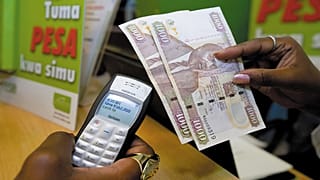 01:50
Mobile banking hailed as a key driver for financial inclusion in Africa
Mobile banking sparks revolution for DR Congo's civil servants
01:50
Mobile banking hailed as a key driver for financial inclusion in Africa
Mobile banking sparks revolution for DR Congo's civil servants
AFRICANEWS TODAY 10:00 Niger: Algerian military personnel have arrived in Agadez [Africanews Today]
NEWS 01:03 President Ruto seeks compensation for Kenyans recruited into Russian military
 NEWS
02:19
Russia-Africa Summit: Putin seeks to expand ties with the continent
INTERVIEW 08:00 How the Svalbard seed vault could help protect Africa's food future
 NEWS
01:49
Nigeria can stop Ebola spread, former disease control chief says
NEWS 01:06 Africa overtakes Europe in Catholic population as global mumbers reach 1.422 billion
01:30 Elections Disruptions to basic services loom over South Africa's local polls
01:19 King Charles III King Charles addresses 'monstrous injustice' of slavery as UK PM mulls apology
01:22 Democratic Republic of Congo UN peacekeeping head meets leaders of rebel coalition in eastern DRC
Related Topics
Keywords
Related Stories
LOCAL ELECTIONS 2026: IEC tightens security amid ballot disruptions, arrests and election intimidation
Ballot storage facilities have been targeted, election materials damaged and arrests made across several provinces, leaving thousands of police and the IEC racing to secure the voting process ahead of Wednesday’s polls.
PAYMENT MODELS: Riding the e-commerce buy now, pay later hype train while it lasts
National retail turnover from e-commerce is expected to hit 10% by the end of 2026, with more than half of it coming from buy now, pay later. Online shopping is becoming the domain of those who don’t quite have it now.
2027: Tinubu’s performance enough for his re-election, says education minister Tunji Alausa
"There are objective programmatic deliveries that President Bola Tinubu has made in transforming this country for good in a way that it's never been transformed before," Mr Alausa said. The post 2027: Tinubu’s performance enough for his re-election, says education minister Tunji…

NBS: Enugu records lowest ‘tax revenue-to-IGR ratio’
According to statistics published on StatiSense's verified X handle, only N51.52 billion, or 12.67 per cent of the N406.7 billion in IGR generated by Enugu State in 2025, came from tax revenues, while the rest came from non-tax revenues. The post NBS: Enugu records lowest ‘tax…

Top Stories
LOCAL ELECTIONS 2026: IEC tightens security amid ballot disruptions, arrests and election intimidation

Canva is announcing changes and layoffs affecting 22 percent of its staff
PAYMENT MODELS: Riding the e-commerce buy now, pay later hype train while it lasts

Champions League expert picks, predictions, best bets: Manchester City aim for turnaround vs. RB Leipzig
2027: Tinubu’s performance enough for his re-election, says education minister Tunji Alausa

Dave Richard's Week 9 Trade Chart and rest of season rankings: Jets, Raiders RBs in flux
NBS: Enugu records lowest ‘tax revenue-to-IGR ratio’

Manchester United stun Roma with three-goal second-half Champions League comeback after dreadful start
Latest
LOCAL ELECTIONS 2026: IEC tightens security amid ballot disruptions, arrests and election intimidation
Canva is announcing changes and layoffs affecting 22 percent of its staff
PAYMENT MODELS: Riding the e-commerce buy now, pay later hype train while it lasts
Champions League expert picks, predictions, best bets: Manchester City aim for turnaround vs. RB Leipzig
2027: Tinubu’s performance enough for his re-election, says education minister Tunji Alausa
Dave Richard's Week 9 Trade Chart and rest of season rankings: Jets, Raiders RBs in flux
NBS: Enugu records lowest ‘tax revenue-to-IGR ratio’
Manchester United stun Roma with three-goal second-half Champions League comeback after dreadful start