Why China is backing nuclear fuel rod production in Namibia

China is backing Namibia’s bid to move beyond raw material exports by supporting the domestic processing of critical minerals and uranium.
In a joint communique issued on Friday following talks in Beijing between Foreign Minister Wang Yi and his counterpart, Selma Ashipala-Musavyi, China pledged to help transform Namibia’s natural resources into higher-value products through domestic processing and downstream cooperation.
Namibia has exported unprocessed minerals for decades. It is now seeking Chinese investment to process lithium, cobalt and uranium, a key fuel for nuclear energy reactors.
In 2023, Namibia followed Zimbabwe in banning the export of unprocessed lithium and other critical elements, aiming to capture more value from the mineral supply chain.
With Beijing’s support, Namibia aims to improve its industrialisation and local processing capacity to “promote Namibia’s further integration into the global value chain”, especially in new energy, green hydrogen, oil and gas, mining and infrastructure, according to the joint statement.
“Cooperation between China and Namibia is of great significance for increasing the added value of key mineral resources, including uranium,” the joint statement noted, with Namibia inviting Chinese firms to invest and do business in the country to jointly promote the smooth development of major economic cooperation projects.
Aly-Khan Satchu, a sub-Saharan African geoeconomic analyst, said that as the United States behaved like a hegemon and seized resources, as seen in Venezuela and potentially Cuba, China was “playing a much smarter 21st century game”.
“This kind of partnership effectively makes China and Namibia shareholders in the beneficiation business, and is a plainly more sustainable model,” Satchu said.
The Namibian minister’s visit and a trip by Wang to Namibia last year align with China’s move to secure fuel for its expanding nuclear reactor fleet.
As the world’s third-largest uranium producer, Namibia hosts two major Chinese-owned mines – Husab and Rossing – that supply a significant share of China’s requirements.
Namibia is leveraging this Chinese presence to ultimately transition from exporting yellowcake – a crude, powdered form of uranium oxide – to potentially producing nuclear fuel rods.
Former president Nangolo Mbumba highlighted this ambition during a meeting with Wang last year.
Mbumba was seeking to attract Chinese investment in nuclear and renewable energy to “add value to our uranium for the peaceful development of nuclear energy”, a strategy that has already begun to lure fresh capital into the sector.
In February, China’s CNNC Overseas Limited (CNOL) signed a US$321.5 million deal with Australia’s Bannerman Energy for a 45 per cent stake in the Etango project, one of the world’s largest undeveloped uranium deposits. Under the agreement, CNOL will provide debt-free construction funding in exchange for a 60 per cent life-of-mine offtake entitlement.
The acquisition expands China’s footprint in Namibia, where the Husab mine – which is operated by Swakop Uranium and majority-owned by China General Nuclear Power Group – stands as the country’s largest producer with an annual designed capacity of 6,000 tonnes. It is joined by the long-running Rossing mine, controlled by China National Uranium Corporation, which recently secured a life-of-mine extension to 2036.
During the talks in Beijing on Friday, Wang pledged to align Chinese investment with Namibia’s “Vision 2030” and Sixth National Development Plan. To support this, Beijing confirmed that Namibia would benefit from its new zero-tariff policy for African imports set to begin on May 1.
“China is willing to strengthen the alignment of development strategies with Namibia [and], make good use of the benefits of China’s zero-tariff policy, advance projects in key areas such as agriculture, people’s livelihoods and youth, and safeguard the overall friendly cooperation between the two countries,” Wang said.
During her week-long visit, Ashipala-Musavyi, Namibia’s minister for international relations and trade, pitched investment opportunities to business leaders in Shenzhen. As China’s leading technology hub, the location served as a strategic backdrop for courting investment in Namibia’s burgeoning industrial and processing sectors.
Ashipala-Musavyi outlined a vision to move the relationship beyond raw exports towards “local beneficiation for industrialisation”.
Noting that China was a top-three trading partner, Ashipala-Musavyi highlighted a “classic asymmetry” in which Namibia sent raw materials and received finished goods.
“Our goal is to rebalance this equation,” she said, offering a solution that would involve moving processes such as refining and manufacturing closer to the source.
She invited innovators to “build factories rather than just buy raw commodities”, adding that the future lay “not merely in what is extracted from the earth, but in what is built together upon it”.
Namibia is also rich in graphite, copper and rare earth elements – all in high demand for the green energy transition – giving the country huge green processing and manufacturing potential.
Keywords
Related Stories
HEART FOR ART: Award-winning artist Annette Kamfer paints her way back after Parkinson’s diagnosis
After achieving international recognition for her watercolour paintings, acclaimed artist Annette Kamfer stepped away from art to focus on her health. Now she is back, and has brought her latest collection home to Nelson Mandela Bay.
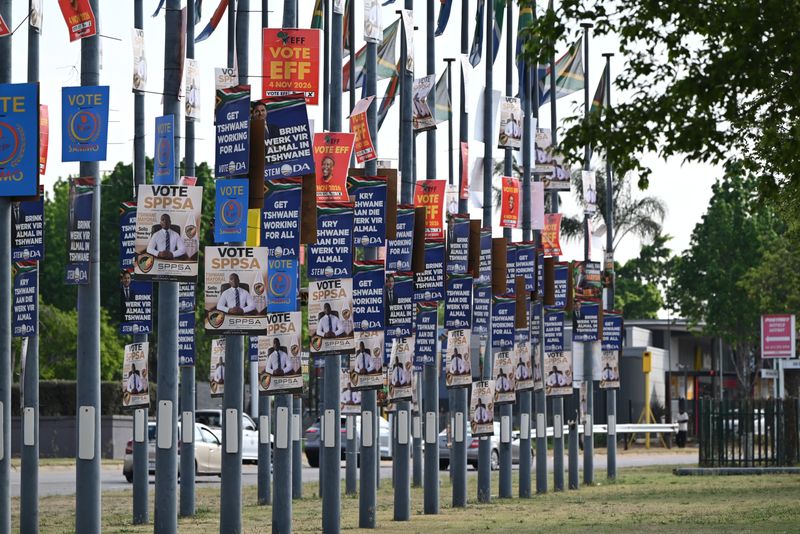
LOCAL ELECTIONS 2026: Ten critical questions as South Africa heads into high-stakes poll
With the ANC under intense pressure, the DA seeking gains and smaller parties eyeing roles as kingmakers, voters face a contest that could reshape municipal government.
Sanwo-Olu makes runaway appearance at Lagos Fashion Week (PHOTOS)
It is his second runway appearance. The post Sanwo-Olu makes runaway appearance at Lagos Fashion Week (PHOTOS) appeared first on Premium Times Nigeria.

EXCLUSIVE: Ebola: 34-year-old pilot, wife identified as suspected cases who tested negative in North-east Nigeria
The Nigeria Centre for Disease Control and Prevention (NCDC) on Saturday announced that two suspected Ebola cases had been identified in the North-east. The post EXCLUSIVE: Ebola: 34-year-old pilot, wife identified as suspected cases who tested negative in North-east Nigeria…

Top Stories
HEART FOR ART: Award-winning artist Annette Kamfer paints her way back after Parkinson’s diagnosis
LOCAL ELECTIONS 2026: Ten critical questions as South Africa heads into high-stakes poll
Sanwo-Olu makes runaway appearance at Lagos Fashion Week (PHOTOS)

Valkyries win WNBA title in their second season
EXCLUSIVE: Ebola: 34-year-old pilot, wife identified as suspected cases who tested negative in North-east Nigeria
Zuma to make first public appearance since hospital discharge

When youths move, society changes: The 2026 barricades, By Owei Lakemfa

Why war makes Ukraine media more determined than ever to hold power to account
Latest
HEART FOR ART: Award-winning artist Annette Kamfer paints her way back after Parkinson’s diagnosis
LOCAL ELECTIONS 2026: Ten critical questions as South Africa heads into high-stakes poll
Sanwo-Olu makes runaway appearance at Lagos Fashion Week (PHOTOS)
Valkyries win WNBA title in their second season
EXCLUSIVE: Ebola: 34-year-old pilot, wife identified as suspected cases who tested negative in North-east Nigeria
Zuma to make first public appearance since hospital discharge
When youths move, society changes: The 2026 barricades, By Owei Lakemfa
Why war makes Ukraine media more determined than ever to hold power to account