'Best. Mars. Mission. Ever.' Scientists hail MAVEN's legacy as NASA retires Red Planet orbiter

Breaking space news, the latest updates on rocket launches, skywatching events and more!
Become a Member in Seconds
Unlock instant access to exclusive member features.
You are now subscribed
Your newsletter sign-up was successful
Want to add more newsletters?
Join the club
Get full access to premium articles, exclusive features and a growing list of member rewards.
Following months of unsuccessful recovery efforts, NASA has officially begun decommissioning the MAVEN orbiter, bringing to a close an 11-year mission that transformed scientists' understanding of Mars and became one of the agency's most valuable assets at the Red Planet.
The decision follows the loss of contact with the spacecraft in December 2025. That loss happened after a routine communications blackout while the probe passed behind Mars. Mission controllers spent months attempting to restore contact, including sending commands designed to reboot the spacecraft's computers, but MAVEN remained silent.
A review board convened by NASA in February found the spacecraft had been operating normally in the weeks leading up to the anomaly. Fragments of telemetry later recovered from recorded radio signals indicated that MAVEN emerged from behind Mars in a safe mode while spinning at roughly 2.7 revolutions per minute — an unexpected state for a spacecraft that was not designed to rotate during normal operations. Investigators found that the rotation likely drained the spacecraft's batteries over several hours, eventually causing its communications system to lose power.
The underlying cause of the anomaly remains unknown, however, and a final report is expected later this year.
"The conclusion is that the spacecraft is not recoverable," Mike Moreau, MAVEN's project manager at NASA's Goddard Space Flight Center, said during a press conference earlier this month. "The team really has experienced the loss of a loved one with the end of the mission."
Yet as scientists mourn the spacecraft, they are also celebrating a mission that far exceeded its original goals.
"The team is certainly broken up about this," said Shannon Curry, MAVEN's principal investigator and a scientist at the University of Colorado Boulder. "But at the same time, we are incredibly proud of the science we've accomplished over the last decade."
Launched from Cape Canaveral in November 2013, MAVEN — short for Mars Atmosphere and Volatile Evolution — arrived at Mars less than a year later as NASA's first mission devoted to understanding the planet's atmosphere. Originally planned to last just two years, the spacecraft was tasked with determining how Mars lost the thick atmosphere that once allowed liquid water to persist on its surface.
Long before MAVEN arrived, scientists knew Mars had not always been the cold, dry world seen today. Ancient river valleys, lake beds, deltas and other geological features pointed to a wetter past, when liquid water flowed across the landscape. For those conditions to exist, Mars would have required a much denser atmosphere than the thin envelope of gas surrounding the planet today.
For more than a decade, MAVEN circled Mars in a highly elliptical orbit, measuring particles escaping into space and observing how the atmosphere responded to solar activity. Among its most significant findings was evidence that solar storms can dramatically accelerate the loss of atmospheric gases, helping explain how Mars evolved from a potentially habitable world into the cold, barren planet seen today.
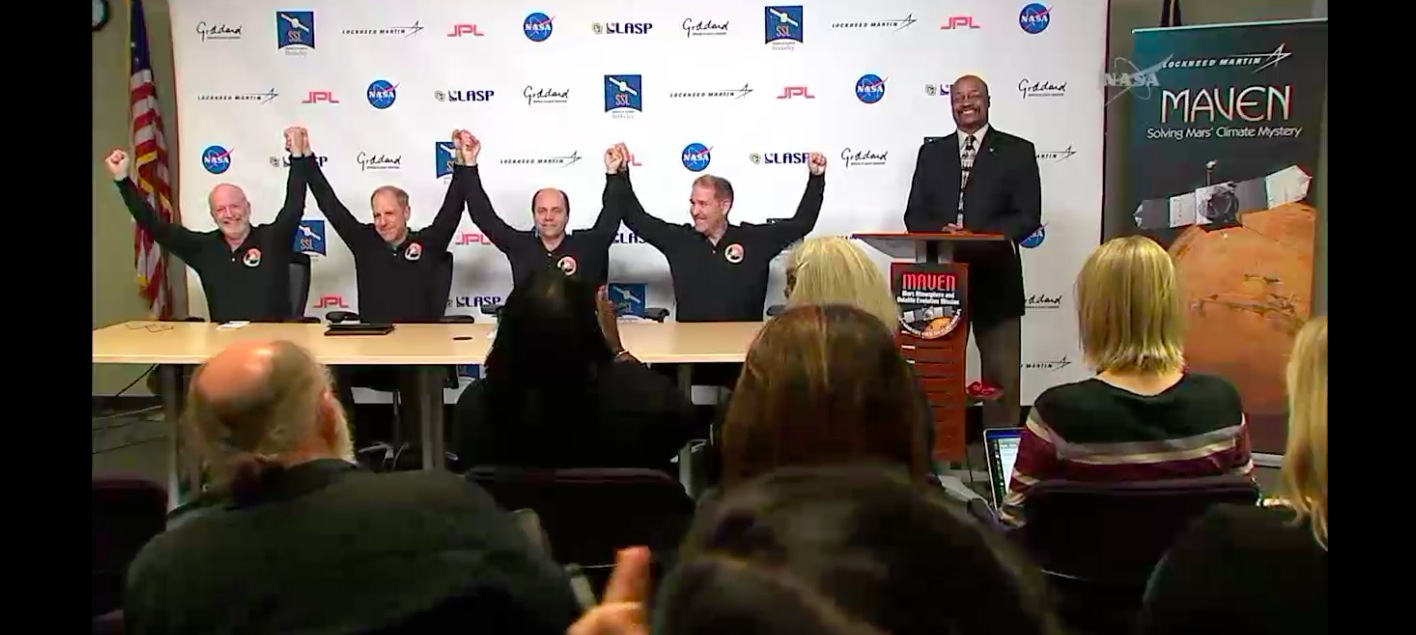
The mission also discovered new types of planetwide auroras, revealed how global dust storms can accelerate the loss of water from Mars, and provided the first direct observations of atmospheric sputtering, a process in which energetic particles strike the upper atmosphere and eject atoms into space.
"We now have a better understanding of atmospheric escape at Mars than at any other planet, including Earth," Curry said.
Over its lifetime, the mission contributed to more than 800 scientific publications, according to NASA, helping establish the clearest picture yet of the forces that transformed Mars over billions of years.
As NASA's fleet of Mars missions grew, MAVEN's importance came to extend well beyond atmospheric science. Although it supported just over 8% of relay sessions during its lifetime, the spacecraft returned nearly 18% of all science data transmitted from the Martian surface, underscoring its value as a high-capacity communications asset.
The four remaining active orbiters — Mars Odyssey, Mars Reconnaissance Orbiter, Mars Express and the European Space Agency's Trace Gas Orbiter — have adjusted operations to compensate, and NASA is exploring a future commercial telecommunications network to help fill the void.
Its loss leaves a noticeable gap in the network, but not an unmanageable one, scientists say.
"There is a slight delay on occasion, because we don't have as many assets in view, to getting our science data back, and MAVEN was critical in returning science data versus operational data," said Tiffany Morgan, the director of NASA's Mars Exploration Program. "The Mars Relay Network is resilient enough at this point in time to accommodate, for the most part, the loss of MAVEN with the added delay."

The timing of its loss does bring some missed opportunities. MAVEN will no longer be able to complement observations from NASA's ESCAPADE mission, a pair of spacecraft launched last year to further investigate the Martian magnetosphere and atmospheric escape.
Even in retirement, however, MAVEN's story may not be entirely over.
Curry said mission scientists may attempt additional imaging campaigns later this year using cameras aboard Mars rovers, although previous efforts to spot the silent spacecraft from the surface have proven unsuccessful. Beyond offering a final glimpse of the orbiter, any successful observation could provide investigators with additional clues about the spacecraft's final movements.
The spacecraft is expected to remain in orbit around Mars for another 50 to 100 years before atmospheric drag eventually pulls it into the planet's atmosphere, where it will burn up like a shooting star.
Asked what she would write on MAVEN's tombstone, Curry did not hesitate:
"Best. Mars. Mission. Ever."
Sharmila Kuthunur is an independent space journalist based in Bengaluru, India. Her work has also appeared in Scientific American, Science, Astronomy and Live Science, among other publications. She holds a master's degree in journalism from Northeastern University in Boston.
You must confirm your public display name before commenting
Please logout and then login again, you will then be prompted to enter your display name.
Related Topics
Keywords
Related Stories
Democrat endorses Republican candidate in key Michigan Senate race as party spat escalates
Haley Stevens, who lost out on the Democratic Senate nomination to Abdul El-Sayed, endorses his opponent days before the vote.

Armed police start patrols in Sydney after Bondi Beach attack
The new police unit is a security measure in response to last year's deadly shooting attack at a Hanukkah festival.

Lindsay Clancy is back in court - where will her case go next?
The Massachusetts mother, accused of murdering her three children, is expected back in court as she awaits a decision on whether her case will be retried.

Israeli strikes in Gaza kill eight including child, hospitals say
Five officers from the Hamas-run police have been killed in Khan Younis and three people, including a child, killed in Gaza City, officials say.

Top Stories

Binance sees spike in withdrawals as exchange returns online after $6.3 billion heist

LOCAL ELECTIONS 2026: The top four parties’ final campaign pitches

Ukraine evacuates civilians from parts of Kherson region as expiry of Oleshky ceasefire nears

ARTIFICIAL INTELLIGENCE OP-ED: Forget future existential threats — AI is automating gendered violence and misogyny right now

LOCAL ELECTIONS 2026: What happens after the vote? Councils, coalitions and (maybe) controversies

OUR CITY NEWS: Eighty-three parties contest crowded Joburg local government elections

Troubled port: Transnet and foreign operator face scrutiny over backlog at Durban Gateway Terminal

BUSINESS REFLECTION: Crossed Wires: The internet’s technical debt is due, and we can’t pay
Latest
Binance sees spike in withdrawals as exchange returns online after $6.3 billion heist
LOCAL ELECTIONS 2026: The top four parties’ final campaign pitches
Ukraine evacuates civilians from parts of Kherson region as expiry of Oleshky ceasefire nears
ARTIFICIAL INTELLIGENCE OP-ED: Forget future existential threats — AI is automating gendered violence and misogyny right now
LOCAL ELECTIONS 2026: What happens after the vote? Councils, coalitions and (maybe) controversies
OUR CITY NEWS: Eighty-three parties contest crowded Joburg local government elections
Troubled port: Transnet and foreign operator face scrutiny over backlog at Durban Gateway Terminal
BUSINESS REFLECTION: Crossed Wires: The internet’s technical debt is due, and we can’t pay