Lula, Brazil’s iconic working class president, wins historic fourth term in dramatic comeback
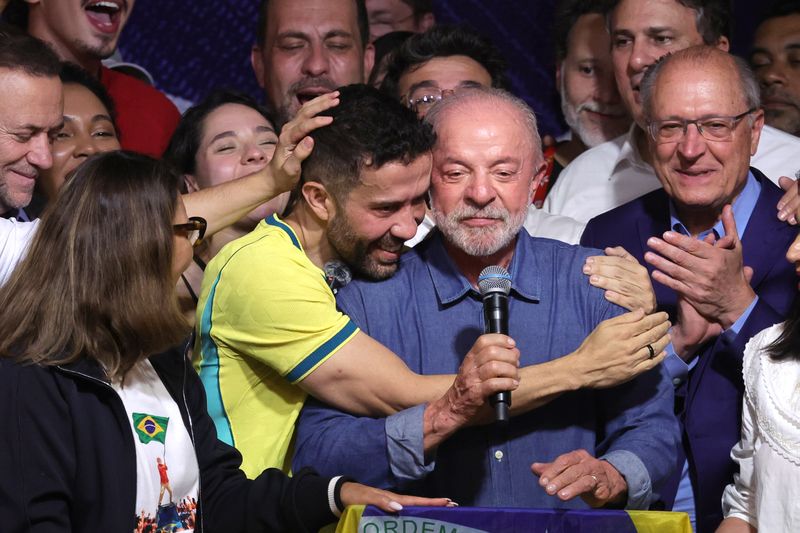
SAO PAULO, Oct 25 (Reuters) - Brazilian President Luiz Inacio Lula da Silva won an unprecedented fourth term on Sunday, the country's electoral court said, in a shock result that defied polls, precedent and global anti-incumbent sentiment to put the brakes on a wave of right-wing election victories across Latin America.
By Lisandra Paraguassu, Brendan O'Boyle and Luciana Magalhaes
Lula, an icon of the global left and the most dominant force in Brazilian politics this century, defeated Senator Flavio Bolsonaro, the eldest son of former President Jair Bolsonaro. The senator had finished first in the election's first round and hoped to revive his father's far-right movement.
At times, Lula's reelection looked like a long shot, as voters soured on him and his Workers' Party after years of corruption scandals and rising prices, while sweeping societal changes left the former metalworker and union leader looking out of touch with an increasingly app-based economy and its growing ranks of informal workers.
Lula's victory marks another comeback in a career full of them. The 80-year-old was jailed from 2018 to 2019 on corruption charges that were later overturned, paving the way for him to beat Jair Bolsonaro in the 2022 election.
"He is a statesman, a giant," leftist federal lawmaker Erika Hilton, who was with Lula in Sao Paulo during the vote count, told Reuters.
UNLIKELY PATH TO VICTORY
Pollsters said better-than-expected turnout had powered Lula to victory. Leonardo Barreto, the co-founder of consultancy Think Policy, said voters had chosen Lula's familiar embrace over Bolsonaro's novelty.
"People today are choosing between change, with some apprehension, and a known path, which guarantees certain rights," he said.
During the campaign, Lula pointed to a track record of falling poverty and inequality, while unemployment, illiteracy and deforestation hit record lows during his third term.
He warned Bolsonaro would cut welfare spending, backslide on social advances and hand over Brazil's sovereignty to US President Donald Trump, whose State Department led a campaign to get the Bolsonaros back to power.
Lula's win deprives Trump of a major addition to what has been a growing bloc of friendly right-wing Latin American governments that have embraced Washington's agenda on security and migration.
Celso Amorim, a former Lula foreign minister, told Reuters the leftist "would be very important for establishing a point of balance in Latin America. Lula is that balance."
COMEBACK KING
Lula becomes the first candidate since Brazil's return to democracy in the 1980s to be elected after finishing second in the first round.
Lula, who was president between 2003 and 2011, campaigned on a potent mix of pragmatism and populism that has shaped his career in national politics for half a century, rolling out a slew of reforms aimed at improving the lives of workers and poor Brazilians.
These gained steam with late-campaign pledges that ranged from free nationwide weekend public transport, which has to be formally submitted to Congress, to a 15% increase in his trademark welfare program that is already being implemented.
Lula also championed a constitutional amendment that became Brazil's biggest labor reform in decades, which passed with wide support in Congress.
CHALLENGING LEGISLATIVE REALITY
Still, Lula's fourth term could be his most difficult yet, after Brazil elected its most conservative Congress since returning to democracy in the 1980s.
Combined, Bolsonaro's Liberal Party (PL) and allied parties could control over 280 seats in the lower house and up to 50 seats in the Senate, enough for comfortable majorities in both chambers.
"He is likely to be a lame duck from the start," said Oliver Stuenkel, a professor of international relations at the Getulio Vargas Foundation in São Paulo.
The incoming legislature will likely deepen recent trends of presidents ceding power to Congress, Stuenkel said, predicting Lula will face waning influence over Supreme Court nominations, unwieldy party coalitions, and even the threat of impeachment.
ECONOMIC HEADWINDS
Lula faces an economy that his government forecasts will grow a meager 2.3% next year, adding to fiscal concerns tied to high interest rates and public debt that has risen past 82% of GDP, the highest since the pandemic.
The president's critics blame spending, though interest costs have driven most of the increase in debt.
Goldman Sachs said it expects Lula to make modest progress at most to contain spending in a fourth term, as he stays committed to a state-led growth model.
Surging household debt also concerns economists. Trying to address the issue, Lula rolled out a provisional ban on online betting and unveiled a new debt relief program during the campaign.
The incoming right-wing Congress will try to pass structural reforms that favor businesses, experts say, prompting spending cuts that could fuel social upheaval.
(Reporting by Oliver Griffin, Luciana Magalhaes and Lisandra Paraguassu in Sao Paulo; Ricardo Brito, Bernardo Caram and Brendan O'Boyle in Brasilia; Marta Nogueira in Rio de Janeiro, Trevor Hunnicutt in Washington; Writing by Brendan O'Boyle and Oliver Griffin; Editing by Alistair Bell, Christina Fincher, Andrew Heavens, Nick Zieminski and Aurora Ellis)
Related Topics
Keywords
Related Stories
CSOs urge judiciary to avoid another Imo-style embarrassment in Uzodimma’s Senate case
Coalition of civil society organisations (CSOs) advises the judiciary to use the ongoing court case involving Governor Hope Uzodimma and former governor, Rochas Okorocha to restore public confidence in the courts. The post CSOs urge judiciary to avoid another Imo-style…

Freedom advocates urge Nigeria to grant Africans visa-free entry
They advocated reciprocal arrangements among African countries, citing Kenya and Rwanda as examples of countries that had taken steps to ease entry for other Africans. The post Freedom advocates urge Nigeria to grant Africans visa-free entry appeared first on Premium Times…

Iran warns next war with US could be longer as Trump threatens further strikes
Iran warns a renewed war with the US could last longer as Donald Trump threatens further strikes, while diplomatic efforts to prevent another escalation remain uncertain.
Two women killed in N1 crash near Kranskop as highway closed
Two women have died and five people have been injured in a head-on collision involving four vehicles on the N1 near Kranskop, forcing the closure of the northbound carriageway.

Top Stories
CSOs urge judiciary to avoid another Imo-style embarrassment in Uzodimma’s Senate case

Spence 'very proud' to break WSL appearance record

Referee accidentally fractures college football player's leg
Freedom advocates urge Nigeria to grant Africans visa-free entry
Iran warns next war with US could be longer as Trump threatens further strikes
Two women killed in N1 crash near Kranskop as highway closed
AFFORDABLE HOUSING OP-ED: CT’s Tafelberg social housing units cut by Heritage assessment

Five teenagers stabbed at Halloween party
Latest
CSOs urge judiciary to avoid another Imo-style embarrassment in Uzodimma’s Senate case
Spence 'very proud' to break WSL appearance record
Referee accidentally fractures college football player's leg
Freedom advocates urge Nigeria to grant Africans visa-free entry
Iran warns next war with US could be longer as Trump threatens further strikes
Two women killed in N1 crash near Kranskop as highway closed
AFFORDABLE HOUSING OP-ED: CT’s Tafelberg social housing units cut by Heritage assessment
Five teenagers stabbed at Halloween party