Scientist publishes fresh doubts over Microsoft's quantum claims
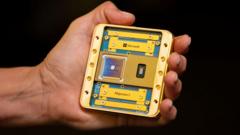
Microsoft's claims it has made major breakthroughs in quantum computing have been questioned by a UK-based physicist, in a paper published by the science journal Nature.
Dr Henry Legg, a long-term critic of Microsoft's quantum work, argued a software tool used by the tech giant to check its research contained coding errors and was not sufficiently accurate.
Legg also said Microsoft had still not proved its assertion that it has managed to create a theoretical quasi-particle called Majorana, which underpins its approach to quantum computing.
The tech giant has consistently stood by its conclusions despite scepticism from experts in the field.
It has invested heavily in the race to build quantum computers, which work very differently to traditional machines and are said to have the potential to solve difficult global challenges which are too big for even the world's most powerful supercomputers to process.
Quantum computing is already a multi-billion dollar industry despite there only being very limited devices currently in existence.
Current quantum machines are prone to start making mistakes in the event of the slightest interference such as small vibrations or a tiny change in temperature.
"Last year Microsoft claimed they had built the equivalent of a precision Swiss watch. However when I opened the case to examine the mechanism, I found what looked like a chaotic jumble of mismatched parts," Legg said.
"Something was making noise, but it didn't look like the breakthrough Microsoft had claimed."
Microsoft has stood by its results.
"At the end of the day, success is the delivery of a scalable quantum computer," said Dr Chetan Nayak, Technical Fellow and Corporate Vice President, Quantum Hardware, Microsoft.
"Scepticism and rigour are hallmarks of the scientific process, which we appreciate and have supported from various academics. We have participated in dialogue and our thorough rebuttal was accepted and published by Nature."
In that response, Microsoft states that the software Legg referred to did not "interpret" the measurements which led to its conclusions.
Legg also accused Microsoft of not sharing enough data for other scientists to scrutinise, which is how scientific research is generally either validated or dismissed by the wider expert community.
Microsoft said it was sharing all of its data with the US defence agency Darpa for independent arbitration but has claimed some of it is too commercially sensitive to publish more widely.
Legg's paper critiqued research published by Microsoft in 2025. It has since released a second generation of its Majorana chip, which it says is 1,000 times more reliable than the previous one.
This is not the first time Microsoft's quantum research has been called into question.
A paper from a Microsoft-backed lab which claimed to have found evidence of the Majorana particle was retracted in 2021.
In 2025, Nature's editors added a note to Microsoft's paper, external in which it claimed to have created the particle itself.
"The results in this manuscript do not represent evidence for the presence of Majorana zero modes in the reported devices," they wrote.
The quest to make them more reliable is an industry-wide challenge. Microsoft believes its approach is the best solution.
Quantum is a strange and complex branch of science which is still not entirely understood.
Microsoft's approach to quantum computing is equally strange: it is based on a 90-year-old physics theory and involves a state of matter which is neither liquid, solid nor gas. The tech giant has pursued this path for more than 20 years.
Quantum question time
Tech Life answers listeners' questions on how quantum computing works and what it means for the future.
Microsoft says new quantum chip 1,000 times more reliable than predecessor
- Published2 June
Microsoft says new quantum chip 1,000 times more reliable than predecessor
Powerful quantum computers in years not decades, says Microsoft
- Published19 February 2025
Powerful quantum computers in years not decades, says Microsoft
Inside the sub-zero lair of the world's most powerful computer
- Published8 January
Inside the sub-zero lair of the world's most powerful computer
Sign up for our Tech Decoded newsletter to follow the world's top tech stories and trends. Outside the UK? Sign up here.
Related topics
Related Topics
Keywords
Related Stories
Apple’s HomeView could add security camera features
Reddit user pdfu found hints hidden in the HomeView 27.2 code that Apple could be adding security camera features to its smart home hub. The strings describe a security camera mode with motion detection, live streaming, and recording options, as well as privacy functions.…

A fully playable version of Portal prequel F-Stop leaked
Leakers have pieced together a playable version of the canceled Portal prequel F-Stop. Most of the assets came from the massive 12-terabyte leak that dropped this August. That didn't include the game's source code or map data, but those final pieces apparently hit the Valve Cut…

North Korea linked to massive Binance crypto heist
The FBI says North Korea was behind the massive $6.3 billion crypto heist that hit Binance on October 29th. The FBI labeled the activity "TraderTraitor" and said that it had observed actors it has connected to hack converting the tokens to Ethereum and preparing for further…

HomePod Mini 2 first look: Three things I love and one disappointment
Apple’s second-generation HomePod Mini is a nice upgrade, but the biggest improvement hasn’t arrived yet. | Photo: Jennifer Pattison Tuohy / The Verge When I first heard about the new $149 HomePod Mini 2 at Apple's Welcome Home event last month, I was disappointed. It's been six…

Top Stories

OUR CITY NEWS: Eighty-three parties contest crowded Joburg local government elections

Troubled port: Transnet and foreign operator face scrutiny over backlog at Durban Gateway Terminal

BUSINESS REFLECTION: Crossed Wires: The internet’s technical debt is due, and we can’t pay

Investment Outlook: Did Datatec catch an AI tailwind or is it a breeze?

Okorocha chasing shadows, Uzodimma says, vows to appeal court judgement

POLITICIANS PUMMELLED: SA’s path to ‘no future’ — former statistician-general Lehohla slams ‘performative’ politics

ANALYSIS: New mayors beware — SA’s local government revolt is waiting for a spark

Mets legend Jerry Koosman dies at 83: Pitcher helped New York win 1969 World Series
Latest
OUR CITY NEWS: Eighty-three parties contest crowded Joburg local government elections
Troubled port: Transnet and foreign operator face scrutiny over backlog at Durban Gateway Terminal
BUSINESS REFLECTION: Crossed Wires: The internet’s technical debt is due, and we can’t pay
Investment Outlook: Did Datatec catch an AI tailwind or is it a breeze?
Okorocha chasing shadows, Uzodimma says, vows to appeal court judgement
POLITICIANS PUMMELLED: SA’s path to ‘no future’ — former statistician-general Lehohla slams ‘performative’ politics
ANALYSIS: New mayors beware — SA’s local government revolt is waiting for a spark
Mets legend Jerry Koosman dies at 83: Pitcher helped New York win 1969 World Series