Standard Bank faces complaint over alleged greenwashing
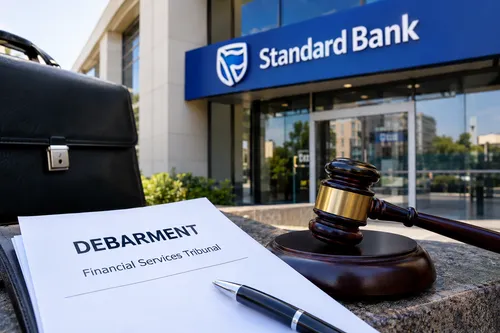
Standard Bank has been hit with greenwashing complaint.
Standard Bank faces nine counts of greenwashing and deceptive advertising for allegedly making unsubstantiated and misleading statements about its climate goals.
Climate activists submitted a complaint to the Advertising Regulatory Board (ARB) against Standard Bank for alleged greenwashing, violating the Code of Advertising Practice regarding honesty, substantiation, and environmental claims.
The complaint targets public-facing communications, specifically the Standard Bank Group Report to Society 2025, the Climate Related Financial Disclosures Report 2025, and various corporate website investment advertisements, arguing they qualify as advertisements aimed at shaping public perception and promoting services.
It alleges that the bank systematically and deceptively misrepresents itself as an industry leader in sustainability through unqualified claims about its commitments to achieving net-zero financed emissions by 2050, expanding renewable energy financing, and reducing lending exposure to fossil fuels and thermal coal.
The complaint was filed by Lawyers for Human Rights on behalf of Fossil Free South Africa (FFSA) and StopEACOP coalition on Wednesday.
ARB chief executive officer Gail Schimmel confirmed that the complaint has been received, adding that the regulatory body would assess the complaint to determine whether it is valid.
Standard Bank spokesperson Ross Linstrom said the bank is aware of the reports regarding the complaint with ARB, adding that the lender takes any complaint of this nature seriously.
Linstrom said while the bank remains firmly committed to supporting Africa's transition to a lower-carbon economy and to meeting its publicly stated sustainability commitments and targets, it does not believe that supporting renewable energy and sustainable finance is incompatible with responsibly supporting Africa's broader energy and economic development needs as part of a Just Transition.
“Our approach recognises that Africa's decarbonisation pathway must be inclusive, balanced and responsive to the realities of the continent's development requirements. We are one of Africa's leading financiers of renewable energy and sustainable infrastructure, and continue to grow our support for projects that advance the continent's transition to a more sustainable future.
“All financing decisions are subject to rigorous governance processes and comprehensive environmental, social and governance assessments. We apply recognised international frameworks and standards when evaluating projects and consider a range of factors, including environmental impacts, social considerations, human rights, governance requirements and economic development objectives. Our approach is further guided by our publicly available Climate Policy,” said Linstrom.
The activists argued that Standard Bank’s environmental claims are misleading and untruthful due to its operational funding of the East African Crude Oil Pipeline (EACOP).
The project is a massive 1 443-kilometre transboundary heated pipeline stretching from Uganda to Tanzania that will lock both governments into heavy oil extraction for nearly three decades to recover capital costs. At peak production, the project is projected to emit up to 34 million tons of carbon dioxide equivalent (CO2e) annually, totalling 379 million tons over its 25-year lifespan, while its path cuts through vital freshwater networks, 158 Ugandan wetlands, eleven rivers, and 44 protected ecological areas.
The complaint stated that by utilising clean-energy imagery and hyperbolic claims while simultaneously funding a major fossil fuel project, the bank allegedly violates the ARB Code, which strictly requires environmental marketing to be truthful, fully substantiated, and transparent without omitting critical contradictions.
It also alleged that the bank violated multiple clauses of Section II of the ARB Code, which mandates that advertisements be prepared honestly and responsibly without exploiting consumer trust.
The complaint also argued that Standard Bank violated the Appendix G of the ARB Code, which establishes the Special Standard for Environmental Claims, requiring all direct or indirect environmental representations, including corporate targets, declarations, and visual imagery, to be accurate, highly specific, appropriately qualified, and entirely free from vague or incomplete commentary.
The complaint also stated the bank’s advertisements were also found to breach Appendix rules because its statements and imagery make direct and indirect environmental claims about their financial services that are vague, exaggerated, incomplete, or unqualified.
The activists said the advertisement risks misleading consumers and abusing public trust by failing to provide substantiation, omitting key details about the bank's involvement in oil, gas, and infrastructure development, and presenting aspirational goals without realistic plans.
The activists added that the complaint seeks to force Standard Bank to back up or retract its climate claims, offer proof concerning its EACOP response, and face penalties for Code violations.
They added that the bank’s environmental advertisements constitute greenwashing because they exaggerate its sustainable finance leadership and omit material facts about its ongoing fossil fuel financing, creating a misleading overall impression that violates advertising codes.
Related Topics
Keywords
Related Stories
CSOs urge judiciary to avoid another Imo-style embarrassment in Uzodimma’s Senate case
Coalition of civil society organisations (CSOs) advises the judiciary to use the ongoing court case involving Governor Hope Uzodimma and former governor, Rochas Okorocha to restore public confidence in the courts. The post CSOs urge judiciary to avoid another Imo-style…

Freedom advocates urge Nigeria to grant Africans visa-free entry
They advocated reciprocal arrangements among African countries, citing Kenya and Rwanda as examples of countries that had taken steps to ease entry for other Africans. The post Freedom advocates urge Nigeria to grant Africans visa-free entry appeared first on Premium Times…

Iran warns next war with US could be longer as Trump threatens further strikes
Iran warns a renewed war with the US could last longer as Donald Trump threatens further strikes, while diplomatic efforts to prevent another escalation remain uncertain.
Two women killed in N1 crash near Kranskop as highway closed
Two women have died and five people have been injured in a head-on collision involving four vehicles on the N1 near Kranskop, forcing the closure of the northbound carriageway.

Top Stories
CSOs urge judiciary to avoid another Imo-style embarrassment in Uzodimma’s Senate case

Spence 'very proud' to break WSL appearance record

Referee accidentally fractures college football player's leg
Freedom advocates urge Nigeria to grant Africans visa-free entry
Iran warns next war with US could be longer as Trump threatens further strikes
Two women killed in N1 crash near Kranskop as highway closed
AFFORDABLE HOUSING OP-ED: CT’s Tafelberg social housing units cut by Heritage assessment

Five teenagers stabbed at Halloween party
Latest
CSOs urge judiciary to avoid another Imo-style embarrassment in Uzodimma’s Senate case
Spence 'very proud' to break WSL appearance record
Referee accidentally fractures college football player's leg
Freedom advocates urge Nigeria to grant Africans visa-free entry
Iran warns next war with US could be longer as Trump threatens further strikes
Two women killed in N1 crash near Kranskop as highway closed
AFFORDABLE HOUSING OP-ED: CT’s Tafelberg social housing units cut by Heritage assessment
Five teenagers stabbed at Halloween party