Transport dialogue challenges government to deliver on South Africa’s mobility crisis
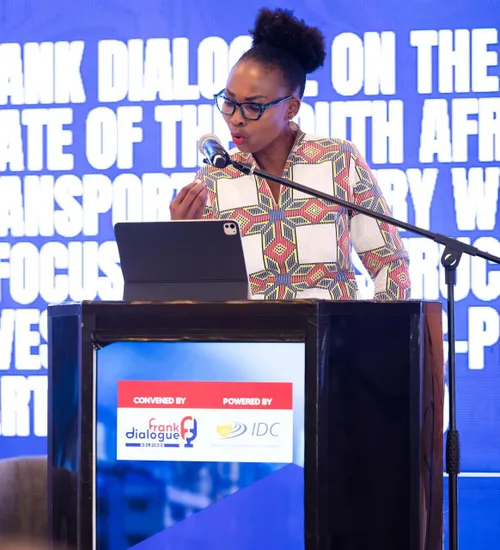
Mesela Nhlapo, chairperson of the Integrated Transport Sector B-BBEE Charter Council, speaking at the Frank Dialogue on the state of South African Transport in uMhlanga on Wednesday.
The Frank Dialogue on the South African Transport Industry to wrap up Transport Month ended in uMhlanga on Thursday with a clear message to policymakers and state-owned entities to stop talking and start delivering on the country's transport challenges.
The dialogue held at the Radisson Blu Hotel was facilitated by Professor Onkgopotse JJ Tabane and featured contributions from Transport Minister Barbara Creecy; Dr Nishal Khusial, cyber adviser at the Department of Transport; Mesela Nhlapo, chairperson of the Integrated Transport Sector B-BBEE Charter Council; Mark Goliath, acting divisional executive for manufacturing at the Industrial Development Corporation (IDC); Passenger Rail Agency of South Africa (Prasa) group CEO Hishaam Emeran; Charles Shilowa, acting CEO of Airports Company South Africa (Acsa); and Solly Letsoalo, group chief operating officer at Transnet, alongside representatives from the taxi industry.
Nhlapo, in her delivery, invoked industrial engineer Hendrik van der Bijl, who is credited for building Eskom and Iscor, emphasising that true national transformation cannot rely on symbolic inclusion.
"Presence is not power. Use is not ownership. Procurement is not industrialisation, and financial close is not proof that a project has transformed the country that carries its cost," said Nhlapo, urging delegates to judge major infrastructure transactions not by participant scorecards, but by what repeatable technical capability remains inside South Africa after delivery.
B-BBEE Commissioner Tshediso Matona echoed these concerns, presenting findings from a decade-long compliance dataset comprising over 28 000 certificates.
"The problem with B-BBEE is that measurement is on inputs, spend, activities, points scored, as opposed to measuring what really matters. Are we measuring what is easy to count, or are we measuring what is significant in terms of growth?"
Matona also highlighted legislative limitations, humorously lamenting that he is a "commissioner who doesn't have handcuffs" when dealing with entities that fail to submit compliance reporting or engage in fronting.
The afternoon session began with an examination of the minibus taxi sector and its uneasy coexistence with rapid transit systems and digital e-hailing platforms. This was followed by working-group presentations outlining recommendations for the Department of Transport and state-owned entities.
Co-facilitator of the taxi industry discussion, Thomas Radebe; Santaco KwaZulu-Natal secretary and eThekwini Metro Taxi Council chairperson Mathula Mkhize; and CityCon Africa head of integrated public transport networks Vuyi Majola during the Frank Transport Dialogue in uMhlanga on Thursday.
Opening the urban transport panel, co-facilitated by life coach and pastor Thomas Radebe, Vuyi Majola, head of integrated public transport networks at CityCon Africa, highlighted the scale of the informal transport economy.
Using conservative estimates, Majola pointed out that, at R15 per trip across 10 million daily journeys, the minibus taxi sector generates approximately R750 million a week.
Despite this substantial turnover, Majola noted that commercial banks continue to classify taxi operators as high-risk, while urban town planning largely treats the industry as an afterthought.
"It is very sad to say that government has failed the taxi industry, but also the taxi industry has failed itself with an inability to pull resources together so that they can have bigger bargaining power."
Majola also warned that the domestic e-hailing sector was expanding rapidly. Currently valued at approximately R26 billion, with 70 000 vehicles, it is projected to reach R70 billion within five years, growing at a compound annual rate of 17%.
She urged traditional taxi operators to adapt and capitalise on the lucrative last-mile suburban and feeder markets rather than viewing emerging platforms merely as competitors.
Responding to these concerns, South African Taxi Council (Santaco) provincial secretary and eThekwini Metro Taxi Council chairperson Mathula Mkhize stressed that the sector was actively modernising and moving away from violent turf disputes towards formal business structures, despite various setbacks caused by the Covid-19 pandemic and government's unwillingness to transform the industry.
Addressing commuter frustrations over erratic driver behaviour, Mkhize pointed to the legacy of structural and spatial planning under apartheid.
"The acts that forced us to be in our locations and the acts of the previous government is the very same question I want to throw to our government strategies: Is it realistically practical to move a million people from a location which was not designed by Santaco to our industries? (With) everyone wanting to make it at 8 o'clock in the morning, including your gardeners and cleaners, while you are also complaining about taxis breaking the rules and hitting (red) robots.
"The phenomenon is that there is you and your wife in your car going to a luxury school while the taxi is carrying 15 gardeners to try and bring service to your home while you are enjoying your lavish life complaining."
Mkhize added that Santaco was transitioning family-owned taxi operations into registered companies and strengthening dedicated structures, including its Women's Desk, to protect widows who inherit taxi fleets from exploitation.
He also apologised for drivers' erratic behaviour on the roads, acknowledging that pressure to reach destinations on time often comes from taxi owners and bosses.
Prasa group CEO Hishaam Emeran defended the rail agency's intercity's bus operations.
Responding to concerns raised during the dialogue that the Prasa was "stealing passengers" on long-distance routes by introducing new buses between Durban and Johannesburg, Emeran clarified the agency's strategy.
The Group CEO pointed out that Prasa and its subsidiaries, including Translux and City to City, had operated long-distance bus services for decades. He said the recent introduction of new buses represented fleet modernisation rather than an attempt to compete aggressively with the taxi industry.
"We do not run commuter [bus operations]. We run long-distance intercity bus services... it is not targeted at being a competitor to the taxis. We coexist in an ecosystem where integration is key: backbone, feeder, and distribution."
Working groups identified five priorities for action within 90 days: cracking down on B-BBEE fronting and non-performing contractors, rehabilitating domestic refineries to ease fuel costs, introducing fairer public transport subsidies that include the taxi industry, integrating small hauliers into rail-road freight operations and rebuilding government engineering capacity.
Related Topics
Keywords
Related Stories
BENT COP: Cape Town cop convicted of murder, supplying intelligence to the 28s Mobsters gang
A Western Cape High Court judgment has laid bare the danger of organised crime penetrating the very institution tasked with fighting it.

Reporter’s Notebook: The sewer still fouling the Cradle is emblematic of local government failure
The discharge of raw sewage through this area is nothing short of a crime against South Africa’s scientific and cultural heritage. Indeed, it is a crime against humanity’s collective heritage – it is a World Heritage Site, for crying out loud, and it is being treated like a…

Investment firm VFD Group posts 96% surge in nine-month profit on higher investment income
Net investment income climbed 58.8 per cent to N72.2 billion, further boosted by lower investment and similar expenses. The post Investment firm VFD Group posts 96% surge in nine-month profit on higher investment income appeared first on Premium Times Nigeria.

Nigeria’s lithium boom struggles to benefit its communities
With the right policies, Nigeria could boost economic growth, create jobs, and improve rural livelihoods. But in the rush to exploit its reserves, local communities may also pay a price through environmental pollution, land degradation, and insecurity that often accompany poorly…

Top Stories
BENT COP: Cape Town cop convicted of murder, supplying intelligence to the 28s Mobsters gang
Reporter’s Notebook: The sewer still fouling the Cradle is emblematic of local government failure
Investment firm VFD Group posts 96% surge in nine-month profit on higher investment income
Nigeria’s lithium boom struggles to benefit its communities

Shop freezers in six European countries hit by suspected cyber-attack

Scotland lose Ritchie and Millar Mills through injury

Nigerian health chiefs confirm negative results in Ebola cases

Train attacker said 'I am the baddest', trial hears
Latest
BENT COP: Cape Town cop convicted of murder, supplying intelligence to the 28s Mobsters gang
Reporter’s Notebook: The sewer still fouling the Cradle is emblematic of local government failure
Investment firm VFD Group posts 96% surge in nine-month profit on higher investment income
Nigeria’s lithium boom struggles to benefit its communities
Shop freezers in six European countries hit by suspected cyber-attack
Scotland lose Ritchie and Millar Mills through injury
Nigerian health chiefs confirm negative results in Ebola cases
Train attacker said 'I am the baddest', trial hears