Turning a solar power system into its own backup
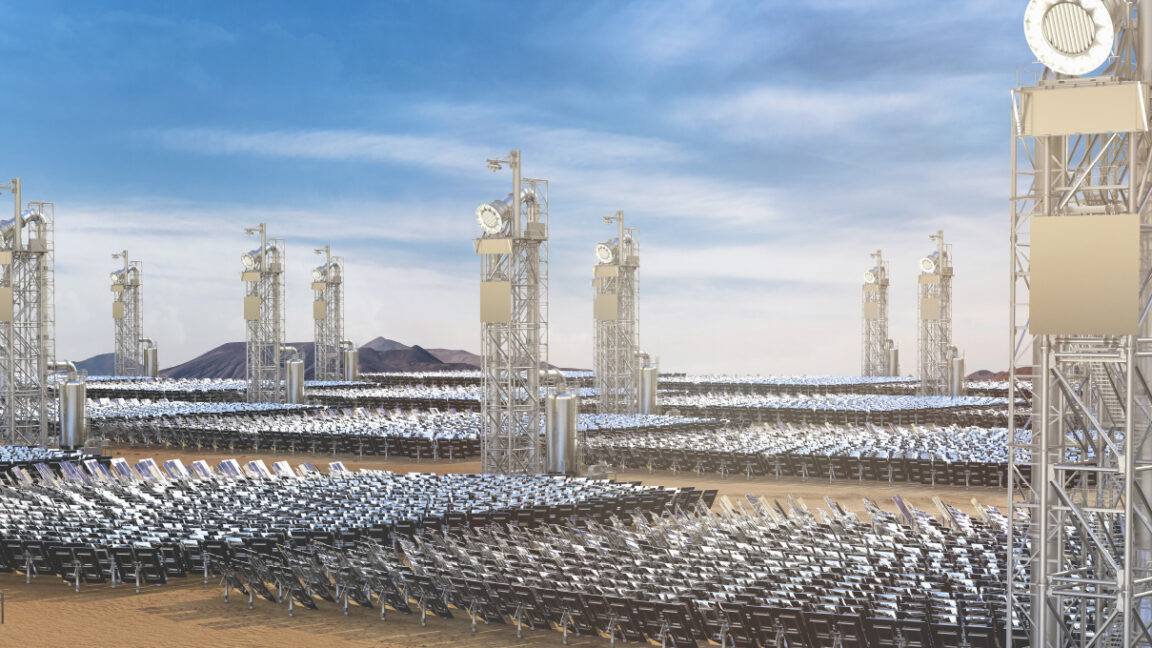
Rather than directly converting photons into electricity, concentrated solar energy uses mirrors to turn sunlight into heat, which can then be used to drive traditional generating turbines. Up to about a decade ago, there was a case to be made that concentrated solar energy had a bright future, as improvements in heat storage had turned it into a way to generate power around the clock.
It wasn’t to be. While concentrated solar costs fell enough to compete with nuclear power, the price of photovoltaics plunged, making solar panels the cheapest source of power in most locations. Currently, if you have a good site to generate solar power, then the economics of PV panels are hard to beat.
That has left us needing to build a mixture of other facilities—typically batteries and natural gas facilities—to handle overnight needs or weather-driven shortfalls. But a small company is promising that it can help avoid the need to build a separate facility. Its version of concentrated solar is designed so that a fossil-fueled backup system shares most of the generating hardware with the solar side.
Back to the future?
Concentrated solar, also called solar thermal, is pretty simple in principle. Most of the site is covered with heliostats, devices that incorporate mirrors and a motorized tracking system that can keep their focus on a single point as the Sun moves across the sky. The point of focus is in a tower, where sunlight heats a working fluid. The hot fluid can then be used to power a traditional steam turbine, or its heat can be stored and used to generate power overnight.
There are many potential variations, however: different working fluids and methods of heat storage, trough-shaped mirrors that eliminate the need for a tower, and so on. All of those variants are meant to reduce some of the issues inherent to solar thermal: lots of moving parts, potentially corrosive fluids, and so on. Those issues and the lack of standardization have helped ensure that the costs of these plants haven’t come close to keeping pace with photovoltaics.
Without any incentive to generate renewable power overnight, there hasn’t been any way for concentrated solar to compete. Construction of new plants has largely stopped, and a number of sources have simply stopped tracking the economics of it.
So it was a bit of a surprise to hear that India had contracted with a US-based startup called 247Solar to build and operate a small concentrated solar plant. While the plant will be extremely small (1 megawatt) and mix in photovoltaics, the company had a unique angle: The same hardware that is handling the solar thermal output can simply be run using fossil fuels if there is a significant shortfall in renewable generation.
“Our systems are their own backup,” said 247Solar’s Mark von Keszycki. “During times of low solar resource—long duration, bad weather, whatever the case may be—they’re able to burn a variety of fuels.”
To understand how this works, it’s best to step back and understand the entire system being built, which includes details about how the 247Solar team hopes to avoid some of the problems faced by other solar thermal systems and provide a great deal of flexibility in terms of how its systems get put to use.
Hot air
Like other concentrated solar systems, 247Solar’s will be using a field of heliostats. But the receiver—the hardware that they focus the sunlight on—is distinctive, in that it works with ambient-pressure air. (It’s an updated version of hardware developed by a German company.) Air exits this hardware at approximately 970° C. That air can potentially be used directly for industrial process heat or sent on to the hardware that generates electricity. But in most cases, it will be directed to heat storage.
Rather than dealing with molten salts and potential phase transition, 247Solar heats up ceramic pellets roughly the size of a golf ball. Depending on the details of the storage configuration, von Keszycki says that the heat from the storage could be used to generate power for anywhere from nine to 20 hours after the Sun sets. Hours will obviously be shorter if some of the heat is used to generate power during the day, but 247Solar plans to pair its system with photovoltaic installations for daytime generation.
Wherever the hot air comes from, it will be sent to a heat exchanger. This is designed as a drop-in replacement for a combustion unit on a traditional turbine to heat up compressed air to drive generation. “The heat exchanger does the same job as the combustor did,” 247Solar’s Bruce Anderson told Ars. “It’s in the same place in the turbine assembly as the combustor was: after the compression stage and before the expander.” The initial installation will pair two 200 kW generators; aside from the heat exchanger, everything else is part of a standard off-the-shelf package.
This is the point where the system’s flexibility comes in: It doesn’t care how the air in the exchanger gets heated. So, any of a variety of fuels can be burned to provide the equivalent heat. von Keszycki suggested that adding the capability to the system to burn fossil fuels tacks on less than 10 percent of its total cost.
The air coming out of the heat exchanger is still quite hot, in the neighborhood of 250° C, and von Keszycki called it “a separate usable resource” that could be directed to a variety of applications, including industrial processes and absorption cooling. Again, if intermediate temperatures are needed, it could potentially be mixed with some hot air coming directly from the storage medium, albeit at the cost of generation.
Scaling up
The first installation will be small, with a pair of 200 kW generators, and so will mostly serve to validate the system’s engineering—Anderson said the biggest worries are “unknown unknowns.” But the system is designed to be modular, and the company is already working through the engineering of a 3 megawatt facility that combines multiple units that share a single tower that holds multiple receivers and heat storage.
The installation will also give the company a sense of how the system actually works out financially. On a typical grid, there are few incentives for providing around-the-clock renewable energy. And the cost of ensuring that there is enough generation to back up solar plants is often absorbed by other parties. The ability to generate fossil-fuel-based backup power without having to build a dedicated facility can definitely save someone money, but markets aren’t always set up so that it’s easy to extract those savings.
So, it’s not surprising that 247Solar has other markets in mind. It’s especially excited about remote mining sites, which typically require diesel to be shipped in, often at considerable expense. The 247Solar system would avoid that expense, while potentially providing process heat that could be useful for some of the ore processing. And powering mining operations without emissions would work well for companies that are required to account for the carbon emissions of their supply chain.
Still, there might be a space for this sort of facility on the grid, if it does successfully avoid the need for dedicated fossil fuel plants that only ever run for a small fraction of the night—provided the price and incentives line up.
 1.
China's top-secret spaceplane can't hide in low-Earth orbit
Related Topics
Keywords
Related Stories
North Korea linked to massive Binance crypto heist
The FBI says North Korea was behind the massive $6.3 billion crypto heist that hit Binance on October 29th. The FBI labeled the activity "TraderTraitor" and said that it had observed actors it has connected to hack converting the tokens to Ethereum and preparing for further…

HomePod Mini 2 first look: Three things I love and one disappointment
Apple’s second-generation HomePod Mini is a nice upgrade, but the biggest improvement hasn’t arrived yet. | Photo: Jennifer Pattison Tuohy / The Verge When I first heard about the new $149 HomePod Mini 2 at Apple's Welcome Home event last month, I was disappointed. It's been six…

Prop 45 in California could be hiding a loophole for data centers
A high-stakes California ballot measure pitched as a fast track for "essential" infrastructure could wind up giving data center developers a loophole to evade public scrutiny, environmental advocates warn. Proposition 45 would shorten timelines for state-mandated environmental…

New Zelda and GTA represent a games industry that no longer exists
This is The Stepback, a weekly newsletter breaking down one essential story from the tech world. For more on the biggest game releases of the year, follow Andrew Webster. The Stepback arrives in our subscribers' inboxes on Sunday at 8AM ET. Opt in for The Stepback here. How it…

Top Stories

CSOs urge judiciary to avoid another Imo-style embarrassment in Uzodimma’s Senate case

Spence 'very proud' to break WSL appearance record

Referee accidentally fractures college football player's leg

Freedom advocates urge Nigeria to grant Africans visa-free entry
Iran warns next war with US could be longer as Trump threatens further strikes
Two women killed in N1 crash near Kranskop as highway closed

AFFORDABLE HOUSING OP-ED: CT’s Tafelberg social housing units cut by Heritage assessment

Five teenagers stabbed at Halloween party


Latest
CSOs urge judiciary to avoid another Imo-style embarrassment in Uzodimma’s Senate case
Spence 'very proud' to break WSL appearance record
Referee accidentally fractures college football player's leg
Freedom advocates urge Nigeria to grant Africans visa-free entry
Iran warns next war with US could be longer as Trump threatens further strikes
Two women killed in N1 crash near Kranskop as highway closed
AFFORDABLE HOUSING OP-ED: CT’s Tafelberg social housing units cut by Heritage assessment
Five teenagers stabbed at Halloween party