Wazirin Tinubu: The influence and burden of Ibrahim Masari, By Umar Farouk Bala

As a young Nigerian involved in TMS, the political culture I want to see is one grounded in evidence, respectful dialogue, accountability and measurable performance. If Masari’s political philosophy truly rests on results over rhetoric and honest engagement over inflated claims, then those principles deserve attention.
As a young Nigerian involved in TMS, the political culture I want to see is one grounded in evidence, respectful dialogue, accountability and measurable performance. If Masari’s political philosophy truly rests on results over rhetoric and honest engagement over inflated claims, then those principles deserve attention.
When the Tinubu Movement for Sustainable Governance Foundation, widely known as Tinubu Must Stay (TMS), inaugurated its national leadership in Abuja, I accepted the responsibility of serving as its National Youth Leader. For me, it was more than an appointment. It raised a larger question about the political culture into which young Nigerians are being invited.
Join the Premium Times WhatsApp Community For Quick Access To News and Happenings Around You.
The Foundation’s structure includes a Board of Trustees, National Coordinators and six directorates focused on citizen engagement and evidence-based communication. It is chaired by Kashifu Inuwa Abdullahi, director-general of NITDA, while Dr Benjamin Obi Nwoye serves as national coordinator (South). Former Obidient coordinator, Marcel Ngogbehei, was appointed director-general, with Engineer Ibrahim Uba overseeing mobilisation and data management.
At its inauguration, Kashifu Inuwa Abdullahi emphasised simplifying government reforms, connecting data to everyday realities and confronting misinformation through technology-driven outreach, town halls and grassroots engagement. Benjamin Obi Nwoye similarly argued that many government interventions remain inadequately communicated.
Since then, one question has stayed with me: What values should define the politics young Nigerians inherit?
For me, that conversation leads naturally to Ibrahim Kabir Masari, special adviser to President Bola Ahmed Tinubu on political affairs and an increasingly influential figure in the president’s northern political engagement.
At the inauguration of the APC Presidential Campaign Council in Abuja on 14 October, Masari reportedly challenged party leaders to abandon inflated claims about votes and focus instead on measurable results at state, ward and polling unit levels. His instruction was strikingly simple: “Stop talking to yourselves and start talking to the people.” He also urged campaigners to explain the administration’s work in areas such as education, healthcare, economic reform and infrastructure; to acknowledge outstanding challenges; and avoid misinformation and hate speech.
That message matters because young Nigerians increasingly demand more than slogans. We want evidence. We want to be listened to. We want claims that can be measured against our own experiences.
Stay Ahead with Premium Times
Follow us on Google News and never miss breaking stories, investigations, and in-depth reporting.
Masari’s political journey also offers context for understanding his approach. His background includes service as national welfare secretary of the All Progressives Congress. In 2022, his name was submitted to INEC as Tinubu’s temporary running mate before Kashim Shettima emerged as the substantive vice presidential candidate. Masari stepped aside, saying the decision would give Tinubu greater flexibility to accommodate wider interests. Following the 2023 election, he was appointed senior special assistant on political affairs and was later elevated to special adviser on political affairs.
But perhaps the most symbolic indication of his growing political profile is the title increasingly associated with him: “Wazirin Tinubu.”
President Tinubu has publicly addressed Masari as “My Waziri.” In northern Nigerian usage, the traditional title carries connotations of counsel, responsibility and proximity to leadership. In this context, it is better understood as an expression of presidential trust than as a constitutional office.
Yet this is precisely where admiration should give way to scrutiny.
The significance of being Wazirin Tinubu cannot ultimately be measured by access to the president, titles or public recognition. It must be measured by what that access produces.
A trusted political adviser occupies one of the most sensitive spaces in government. He must understand the president’s priorities while remaining alert to the concerns of party members, elected representatives and citizens. He must know when to speak and when to listen, when to intervene and when restraint is more useful. Such a position demands discretion, political maturity and the capacity to reconcile competing interests. That are exactly what he does in promoting and protecting the reputation of President Tinubu.
For Masari, therefore, presidential confidence is both an advantage and a burden. Influence creates access, but access creates responsibility.
Recent reports have portrayed him as a significant convener in northern politics and one of the Ppresident’s closest political figures in the region. Such influence will naturally attract scrutiny, and it should. The closer any political adviser stands to presidential power, the more legitimate the public interest becomes in how that access is exercised.
This is why I find his emphasis on measurable performance important. If political leaders insist that campaign organisers should abandon exaggerated claims, communicate honestly and speak directly to citizens, then those principles should also become the standards against which their own influence is judged.
For those of us trying to encourage greater youth participation in public affairs, this distinction is crucial. Young Nigerians should not be introduced to a political culture in which proximity to power is itself an achievement. We should be introduced to one in which access creates an obligation to solve problems, listen to inconvenient truths and help government understand citizens beyond the atmosphere of political praise.
Nor should evidence-based politics mean communicating only achievements. Credibility also requires acknowledging shortcomings. A genuine conversation about government must have room for what worked, what did not work and what still needs correction. Otherwise, “evidence-based communication” risks becoming another sophisticated name for political marketing.
This is perhaps the heavier meaning behind the Waziri symbolism. Counsel is valuable when it tells power what it needs to hear, not merely what it wants to hear.
Ibrahim Kabir Masari today occupies a position from which political relationships can be built and disagreements mediated. His emergence as one of Tinubu’s prominent northern political interlocutors makes his choices consequential.
The ultimate question, therefore, is not how close Masari is to the president. It is what that closeness achieves for governance and political engagement.
As a young Nigerian involved in TMS, the political culture I want to see is one grounded in evidence, respectful dialogue, accountability and measurable performance. If Masari’s political philosophy truly rests on results over rhetoric and honest engagement over inflated claims, then those principles deserve attention.
But they also deserve consistent application. Because the greater the influence, the heavier the responsibility. And for Wazirin Tinubu, that may ultimately be the real burden of presidential trust which he has so far performed exceedingly well.
Umar Farouk Bala is national youth leader of Tinubu Must Stay (TMS).
Share this:
Discover more from Premium Times Nigeria
Subscribe to get the latest posts sent to your email.
Type your email…
Subscribe
Mutilated body of motorcyclist found as similar mystery killings rise
UBA launches Group-Wide Climate Action Week to advance green finance and sustainability across Africa
Premium Times
More News
STEP-X: Building Nigeria’s next generation of exporters, By Kabir Abdulsalam
Ato Quayson and the challenge to Ghana: Rethinking the past and Future, By Toyin Falola
From vision to abandonment: Nigeria’s unfinished development, By Dipo Baruwa
We do not think, yet here we are, By Uddin Ifeanyi
$110 oil price: Windfall or warning?, By Posi Olatubosun
Dele Cole (1940-2026) and his public service, By Eric Teniola
Keywords
Related Stories
Reporter’s Notebook: The sewer still fouling the Cradle is emblematic of local government failure
The discharge of raw sewage through this area is nothing short of a crime against South Africa’s scientific and cultural heritage. Indeed, it is a crime against humanity’s collective heritage – it is a World Heritage Site, for crying out loud, and it is being treated like a…

Investment firm VFD Group posts 96% surge in nine-month profit on higher investment income
Net investment income climbed 58.8 per cent to N72.2 billion, further boosted by lower investment and similar expenses. The post Investment firm VFD Group posts 96% surge in nine-month profit on higher investment income appeared first on Premium Times Nigeria.

Nigeria’s lithium boom struggles to benefit its communities
With the right policies, Nigeria could boost economic growth, create jobs, and improve rural livelihoods. But in the rush to exploit its reserves, local communities may also pay a price through environmental pollution, land degradation, and insecurity that often accompany poorly…

Nigerian health chiefs confirm negative results in Ebola cases
Health authorities investigating two suspected Ebola cases in north-eastern Nigeria confirmed on Monday that both samples were negative after two rounds of testing.

Top Stories
Reporter’s Notebook: The sewer still fouling the Cradle is emblematic of local government failure
Investment firm VFD Group posts 96% surge in nine-month profit on higher investment income
Nigeria’s lithium boom struggles to benefit its communities

Shop freezers in six European countries hit by suspected cyber-attack

Scotland lose Ritchie and Millar Mills through injury
Nigerian health chiefs confirm negative results in Ebola cases

Train attacker said 'I am the baddest', trial hears
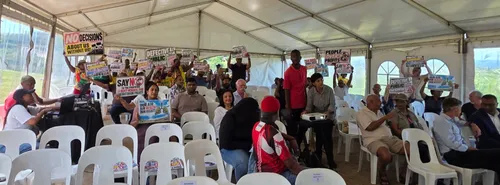
Seven coastal communities oppose proposed La Mercy cemetery and crematorium
Latest
Reporter’s Notebook: The sewer still fouling the Cradle is emblematic of local government failure
Investment firm VFD Group posts 96% surge in nine-month profit on higher investment income
Nigeria’s lithium boom struggles to benefit its communities
Shop freezers in six European countries hit by suspected cyber-attack
Scotland lose Ritchie and Millar Mills through injury
Nigerian health chiefs confirm negative results in Ebola cases
Train attacker said 'I am the baddest', trial hears
Seven coastal communities oppose proposed La Mercy cemetery and crematorium