Africa must shift gears from imports to industry
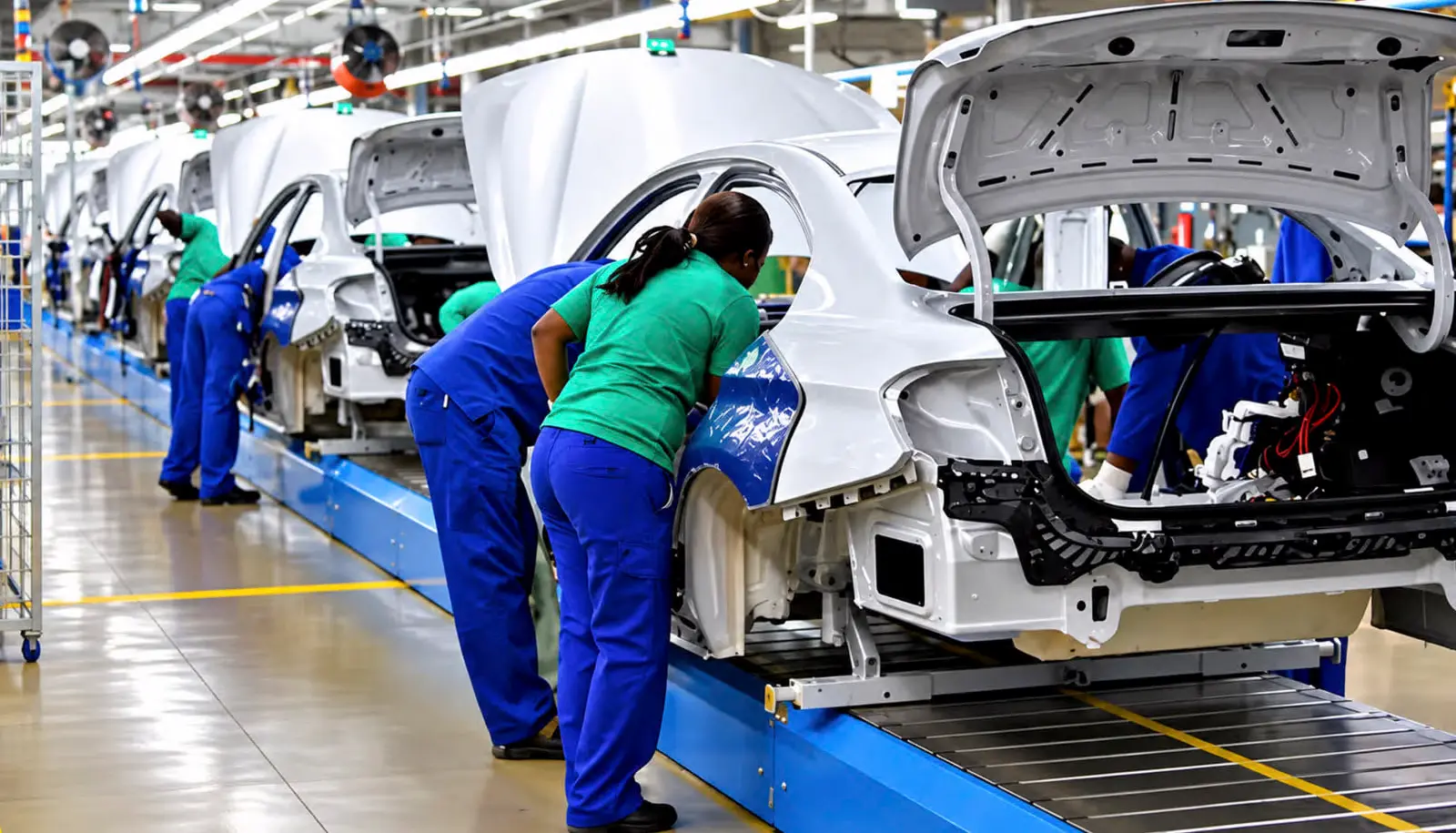
Africa’s automotive opportunity is sub-stantial. The challenge is to turn it into factories, suppliers, jobs and affordable mobility. The African Continental Free Trade Agreement (AfCFTA) provides a framework for doing so but its success will depend on what governments and industry build together. Africa remains one of the world’s most significant untapped automotive growth opportunities.
Low motorisation, a growing population and accelerating urbanisation create an expanding need for mobility.
Yet demographic potential does not automatically become demand for new vehicles. Affordability, access to finance and the cost of ownership will determine how much of that opportunity can be realised.
Africa accounts for only a small share of global automotive production. Yet it possesses many of the fundamentals for growth, including established manufacturing centres, mineral resources, and a rapidly expanding population.
The opportunity now lies in strengthening regional integration and value chains to unlock this potential at scale.
This was central to the discussions at the Africa Automotive Investment Forum in Alamein, Egypt, earlier this month. With automotive rules of origin now agreed under the AfCFTA, the task is to translate that framework into investment, production and employment.
Few industries connect as many parts of an economy as automotive manufacturing. A vehicle plant creates demand for components, metals, plastics, glass, textiles, electronics, logistics, energy, finance, training and retail infrastructure. This makes the sector a practical test of the AfCFTA’s promise: enabling African countries to manufacture, trade and create value together.
For automotive, that means a hub-and-spoke model. Not every country can or should assemble complete vehicles. Assembly requires scale, policy certainty, infrastructure, skills and access to large markets. But participation in the industry need not begin and end with an assembly plant.
One hub might assemble vehicles while suppliers elsewhere produce wiring harnesses, upholstery, tyres, glass, batteries or plastic components. Other countries can pro-cess minerals for future mobility. Logistics corridors, ports, distribution centres, dealer networks, finance providers and training institutions all form part of the same chain.
The proposed automotive pact between the Southern African Customs Union and Egypt, outlined at Alamein, illustrates this approach. Its emphasis on complementary pro-duction and supplier development offers a way to connect industrial capabilities across regions.
It remains a proposal but the principle matters: integration should create viable production networks rather than duplicate small assembly operations.
Scale is fundamental. Africa cannot build a globally competitive automotive industry while its market remains divided by incompatible standards, homologation requirements and cumbersome customs procedures. It must increasingly operate as a connected market.
Agreed rules of origin are an important foundation. They must now be implemented consistently, alongside aligned standards, efficient borders and predictable industrial policies. A component made in one African country should reach an assembly operation in another efficiently. A vehicle manufactured on the continent should not face unnecessary regulatory duplication at every border.
Stellantis can contribute through its manufacturing operations in Morocco and Algeria and its commercial and dealer presence across African markets. Kénitra in Morocco demonstrates the value of a sustained partnership between government and industry, combining expanded production capacity with supplier development. In Algeria, investment in Tafraoui is supporting the development of another manufacturing ecosystem.
To unlock lasting economic value, manufacturing investments must go beyond vehicle assembly. Deep localisation is essential. This means designing products adapted to local needs, building competitive supplier ecosystems and developing local talent capable of supporting a modern automotive industry.
Together, these elements create resilient industrial ecosystems that generate jobs, strengthen capabilities and integrate African manufacturing into regional and global value chains.
Chinese automotive manufacturers are also reshaping the competitive landscape. Their growing presence creates opportunities for investment in manufacturing, batteries, components and new-energy vehicles.
The test should be the contribution each manufacturer makes to productive capacity and sustainable employment.
Africa should welcome fair competition and productive investment while rewarding localisation, supplier development, skills transfer and regional exports. Every manufacturer, regardless of origin, should compete under transparent rules.
Vehicle manufacturing is capital-intensive and investment decisions extend across decades. Manufacturers need policy certainty, competitive energy and logistics costs, workable labour arrangements, efficient ports and reliable access to markets. Incentives should support localisation, employment, skills and exports while addressing market distortions.
Import policy must also balance industrial development with affordable mobility. Pre-owned vehicles provide transport for millions of Africans. Legal used-vehicle imports, parallel imports, unsafe vehicles and fraudulent customs declarations should not be treated as interchangeable.
The priority should be to phase out non-compliant imports and prevent customs fraud through appropriate roadworthiness and emissions standards, accurate valuations and effective enforcement.
Where governments introduce broader restrictions to support local production, those measures should be phased and accompanied by credible, affordable alternatives.
Vehicles for Africa must suit the markets in which they operate. Depending on the country and their intended use, that means coping with long distances, demanding roads, heat, dust, varied fuel quality and limited charging or service infrastructure.
Affordability must be measured throughout a vehicle’s operating life. Fuel or electricity, maintenance, parts, finance, insurance, durability and resale value all matter. A cheap vehicle that cannot be repaired locally is not affordable.
Dealer and service networks support consumer confidence through trained technicians, parts availability, warranties and accountability, while creating local jobs.
Africa’s mobility needs will require several technologies. Efficient inter-nal-combustion vehicles, hybrids and battery-electric vehicles will have different roles across markets.
That diversity should go hand in hand with investment in African battery and electric-vehicle value chains. Production for export and adoption in domestic markets may develop at different speeds.
Governments must provide coherent industrial policies. Manufacturers must invest for the long term. Financial institutions must help turn viable projects into operating businesses and expand access to mobility.
If Africa gets this right, automotive manufacturing can connect African minerals to African components, African components to African factories, and African factories to African consumers.
That is how the AfCFTA becomes more than an agreement: through goods crossing borders, people gaining skills, businesses joining supply chains and families accessing reliable mobility.
The opportunity is clear. The next step is to build the capacity, partnerships and markets that make it real. Michael Whitfield is the managing director of Stellantis South Africa and Sub-Saharan Africa.
Originally published and reported by Mail & Guardian.
Read original coverage on Mail & GuardianRelated Topics
Keywords
Related Stories
STEPPING UP: Simon Harmer’s transition from exile to Proteas’ top Test spinner
The spin bowler will surely be in the running for future Proteas inclusion after a magnificent performance against Australia in Cape Town.

CULTURAL TENSIONS: Is halaal food becoming more common in SA? Debunking viral myths
South Africa’s halaal food debate exposes misunderstandings about Islamic slaughter, religious freedom, voluntary certification and the commercial forces behind the growing number of halaal products.

ActionSA says stronger election result could give it coalition influence
ActionSA says stronger election result could give it coalition influence

Death of the ANC: Party suffers worst municipal result since 1994 as support falls to 30.81 percent
The ANC’s support has fallen to 30.81% in the 2026 local government elections, its worst municipal result since 1994, leaving it without an outright majority in any metro and facing renewed questions about its leadership.

Top Stories
STEPPING UP: Simon Harmer’s transition from exile to Proteas’ top Test spinner
CULTURAL TENSIONS: Is halaal food becoming more common in SA? Debunking viral myths
ActionSA says stronger election result could give it coalition influence

Australia reach World Cup final after Fiji scare
Death of the ANC: Party suffers worst municipal result since 1994 as support falls to 30.81 percent

Baze University acquires two aircraft as founder expands aviation education
Cape Town property prices surge 12%, more than twice Johannesburg's increase
Two children killed in Kariega shack fire as father injured trying to rescue them


Latest
STEPPING UP: Simon Harmer’s transition from exile to Proteas’ top Test spinner
CULTURAL TENSIONS: Is halaal food becoming more common in SA? Debunking viral myths
ActionSA says stronger election result could give it coalition influence
Australia reach World Cup final after Fiji scare
Death of the ANC: Party suffers worst municipal result since 1994 as support falls to 30.81 percent
Baze University acquires two aircraft as founder expands aviation education
Cape Town property prices surge 12%, more than twice Johannesburg's increase
Two children killed in Kariega shack fire as father injured trying to rescue them