How the state let its own coal determination die
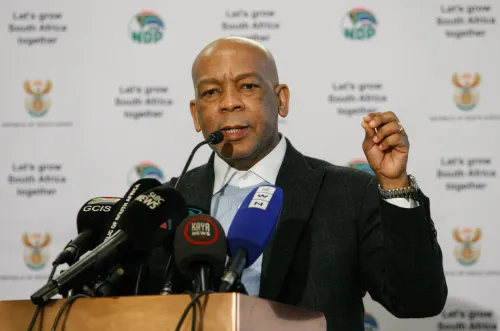
Electricity and Energy Minister Kgosientsho Ramokgopa
On 30 October, the Supreme Court of Appeal dismissed the Minister of Electricity and Energy’s appeal over 1,500MW of new coal-fired generation. The court did not rule that coal is unconstitutional, and it said expressly that nothing in its judgment endorses the High Court’s findings on the merits. It dismissed the appeal as moot, and ordered the minister to pay the costs, because the instrument he was defending no longer had anything to stand on.
That distinction matters more than the headlines will suggest. The 2020 coal determination did not die in court. It died of administrative neglect, and every step that could have kept it alive was available to the state.
Some background. On 25 September 2020, the minister published a section 34 determination under the Electricity Regulation Act for 6,800MW of solar and wind, 513MW of storage, 3,000MW of gas and 1,500MW of coal, tied to the 2019 Integrated Resource Plan (IRP). In 2023, the African Climate Alliance, the Vukani Environmental Justice Movement and groundWork challenged the coal portion. The High Court set it aside, finding that the decision limited children’s environmental rights and that the state had not justified the limitation. The minister appealed. Then, on 28 October 2025, he published IRP 2025, which contains no new coal at all.
From that moment, the appeal was substantively over. The court’s reasoning shows five things that could have saved the determination.
The first is a savings provision. When Parliament amended section 34 with effect from January 2025, and when the department published IRP 2025, neither included a clause preserving determinations already made. The court was blunt: there is no transitional provision in either the Act or the plan that keeps the 2020 coal determination alive, or allows it to be implemented under the current framework. A single clause would have changed the outcome.
The second is the plan itself. The determination was expressly linked to the coal allocation in IRP 2019 for 2023 to 2027. Under the amended Act, a determination must have regard to the operative plan, and the court held that sections 34(6) to 34(8) give IRP 2025 legal effect. Once the new plan dropped coal, the determination was anchored to a document that no longer governed anything. Carrying even a reduced coal allocation into IRP 2025 would have given it a foundation.
The third is procurement. The court recorded that there had been no procurement process for the 1,500MW, no contracts concluded and no rights acquired by Eskom. The connection timetable of 2023 to 2027 had already passed. Five years after the determination, nothing had been put to the market. Had a bid window reached the preferred-bidder stage, or had power purchase agreements been signed, there would have been vested rights and a live dispute. A determination that is never implemented becomes a statement of intent, and statements of intent do not survive a change of plan.
The fourth is a fresh determination. The court left this door open. If the minister still wants new coal, he can make a new determination under the amended Act. Because IRP 2025 contains no coal, that would be a deviation from the plan, permitted only in an emergency or where necessary in the national interest, and only after a notice inviting public comment. The court rejected the argument that the old determination could simply be revived on emergency grounds. Section 34(6), it said, is not a free-standing power to disregard the plan.
The fifth goes back to the original case. The High Court found the record “ominously silent” on what the additional coal capacity would mean for the environment and for the health of the nation, particularly of children. Whatever one thinks of that finding, which the appeal court neither endorsed nor overturned, it identified a real weakness. A documented assessment of emissions, health effects and alignment with South Africa’s climate commitments would have made the state’s case far harder to defeat. The regulator’s assurance that the determination was in line with the Paris Agreement was an assertion, not a record.
None of these five required the state to win an argument about coal. Each required only that policy, law and procurement be kept in step with one another. That they were not is the real finding of this case. The court went further. It held that once IRP 2025 was published, the minister ought to have known the appeal was no longer relevant or practical, and that what he was really seeking was an advisory opinion. Taxpayers will meet the costs, including two counsel for the respondents.
This case offers a lesson that reaches well beyond coal. A section 34 determination is a permission, not a power station. Its value depends on a chain: the plan must carry the allocation, the law must preserve the instrument when the plan changes, procurement must begin while the policy still holds, and the record must show the decision-maker weighed the consequences. Break any link and the determination is exposed.
On that test, the gas programme now stands on firmer legal ground than coal ever did. IRP 2025 expressly counts the existing gas determinations, including 6GW of gas, as committed capacity. That is precisely what nobody did for coal. But legal footing is only the first link. The first gas bid window closed this week without a single preferred bidder, because bidders could not secure fuel. And the plan itself acknowledges that the risk in the gas programme includes securing adequate supply “at the appropriate price”, yet models only the gas failing to arrive, never the gas arriving at a higher cost.
The coal determination failed because the chain was never maintained. The gas programme has repaired the legal link and left the commercial one open. If it falters, it will not be because a court intervened. It will be because, once again, the instruments were issued and the work of connecting them to fuel, contracts and a full assessment of the consequences was left for later.
* Matshela Koko is managing director of Matshela Energy, a former interim group chief executive of Eskom (2016–2017) and a doctoral candidate at the UNISA Graduate School of Business Leadership.
* The views expressed do not necessarily reflect those of IOl
Originally published and reported by IOL South Africa.
Read original coverage on IOL South AfricaRelated Topics
Keywords
Related Stories
STEPPING UP: Simon Harmer’s transition from exile to Proteas’ top Test spinner
The spin bowler will surely be in the running for future Proteas inclusion after a magnificent performance against Australia in Cape Town.

CULTURAL TENSIONS: Is halaal food becoming more common in SA? Debunking viral myths
South Africa’s halaal food debate exposes misunderstandings about Islamic slaughter, religious freedom, voluntary certification and the commercial forces behind the growing number of halaal products.
ActionSA says stronger election result could give it coalition influence
ActionSA says stronger election result could give it coalition influence
Death of the ANC: Party suffers worst municipal result since 1994 as support falls to 30.81 percent
The ANC’s support has fallen to 30.81% in the 2026 local government elections, its worst municipal result since 1994, leaving it without an outright majority in any metro and facing renewed questions about its leadership.

Top Stories
STEPPING UP: Simon Harmer’s transition from exile to Proteas’ top Test spinner
CULTURAL TENSIONS: Is halaal food becoming more common in SA? Debunking viral myths
ActionSA says stronger election result could give it coalition influence

Australia reach World Cup final after Fiji scare
Death of the ANC: Party suffers worst municipal result since 1994 as support falls to 30.81 percent

Baze University acquires two aircraft as founder expands aviation education
Cape Town property prices surge 12%, more than twice Johannesburg's increase
Two children killed in Kariega shack fire as father injured trying to rescue them

Latest
STEPPING UP: Simon Harmer’s transition from exile to Proteas’ top Test spinner
CULTURAL TENSIONS: Is halaal food becoming more common in SA? Debunking viral myths
ActionSA says stronger election result could give it coalition influence
Australia reach World Cup final after Fiji scare
Death of the ANC: Party suffers worst municipal result since 1994 as support falls to 30.81 percent
Baze University acquires two aircraft as founder expands aviation education
Cape Town property prices surge 12%, more than twice Johannesburg's increase
Two children killed in Kariega shack fire as father injured trying to rescue them