June 16 at 50: We won the right to learn, but still fight for the right to become
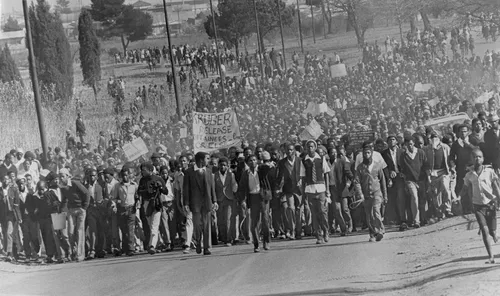
On June 16, 1976, thousands of students in Soweto took to the streets to demonstrate against Bantu Education and the imposition of Afrikaans in their schools.
Image: AFP
There is a kind of commemoration that slips into ritual without reckoning. Each June 16, we gather to honour the children of Soweto who marched against Afrikaans as a medium of teaching and learning, who were met with bullets, and who bled and died for a future apartheid refused them. We invoke their names, display the iconic image of Hector Pieterson, and declare them heroes.
And, indeed, they were; however, by the next morning, the machinery of forgetting quietly restarts. In this way, commemoration risks becoming a substitute for responsibility. We remember the courage of the students of Soweto while neglecting the uncomfortable possibility that June 16 was never meant to be merely remembered.
It was meant to be continued.
Indeed, the learners who marched in 1976 were not asking future generations to honour them. They were asking future generations to complete a task. The fiftieth anniversary should deny us the comfort of believing that the task is finished. A Golden Jubilee demands more than remembrance. It demands reckoning.
Fifty years is not merely a date on a calendar signalling time passed. It is a lifetime. It is long enough for one generation to inherit freedom, raise children within it, and hand it to the next. It is long enough to ask whether a promise has been fulfilled.
What became of the future for which those children marched? The students of 1976 are often remembered as victims, but they were not only victims. They were organisers. They were thinkers. They were political activists.
The deeper truth, however, is not found in the numbers alone. Many of the children who died were shot in the back as they fled. The tragedy of June 16 was about the murder of unarmed children, it was also a reflection of a state who confronted schoolchildren demanding dignity and answered them with gunfire.
What is beyond dispute is this: Children died demanding the right to shape their own futures.
Dumisani Tshabalala, head of Academics at the Oprah Winfrey Leadership Academy for Girls.
Image: Supplied
The march was not spontaneous. It was organised through the South African Students' Movement (SASM) and the Soweto Students' Representative Council (SSRC). Young leaders such as Tsietsi Mashinini, Khotso Seatlholo and Murphy Morobe helped coordinate what was intended to be a peaceful demonstration.
Many were teenagers. Some were younger than sixteen. They nevertheless possessed a clarity that still demands our attention. Influenced by Steve Biko and the Black Consciousness Movement, they developed a remarkably cogent understanding of something fundamental: education was never merely about language, examinations, or classrooms.
It was about freedom. We often say that the students marched against Afrikaans. This is true, but it is not sufficient. Afrikaans was the trigger. The deeper question was why the oppressor's language should determine the education of the oppressed. And beneath that lay an even deeper question: Why should apartheid determine the future of Black children at all? The students were not simply rejecting a language policy. They were rejecting a predetermined destiny.
Black Consciousness gave shape to that rejection. Bantu Education was not merely a flawed education system. It was a political project. Its purpose was not to cultivate potential but to manage it. It sought to define in advance who would lead and who would serve, who would create knowledge and who would merely receive it, who would participate fully in society and who would remain on its margins.
The students of Soweto refused that inheritance. This is what makes the fiftieth anniversary significant. Fifty years is long enough to ask whether South Africa honoured the future they imagined. The answer is complicated. South Africa today is undeniably freer than it was in 1976. Apartheid has been dismantled. Political rights are constitutionally protected. Millions more children attend school than ever before. Opportunities that were once legally reserved for a minority are now, in principle, open to all.
The paradox, however, is that freedom is not only the absence of legal exclusion. Freedom is also the presence of possibility.
Education brings this paradox into sharp relief. Access has expanded dramatically, but opportunity remains uneven. A child's postal code still shapes educational outcomes. Family income continues to influence life chances. The quality of schooling remains profoundly unequal. For many South Africans, the promise of freedom remains real but incomplete, and nothing less than a phantom.
It is useful to distinguish between access and participation. Access asks whether learners can enter classrooms and move through the education system. Participation asks whether they can access the knowledge, opportunities, networks, and influence through which futures are built. Access asks whether learners are present. Participation asks whether they can become. A society can expand access while participation remains unequal. Indeed, this is precisely the danger. Hendrik Verwoerd understood it. Defending Bantu Education, he famously asked: "What is the use of teaching a Bantu child mathematics when it cannot use it in practice?"
It was not mathematics he feared. It was possibility. The students of Soweto understood this instinctively. Their struggle was never simply for schooling. It was for the right to become. The right to become a doctor.
The right to become an engineer. The right to become a scientist.
The right to become an artist.
The right to become a teacher.
The right to become anything their talents and ambitions might allow.
This remains the unfinished work of June 16.
We dismantled Bantu Education.
But we have not yet fully dismantled the unequal distribution of possibility.
Too many children still inherit limits they did not choose.
Too many futures are still shaped in advance.
Too many young South Africans continue to encounter barriers that have changed form but have not entirely disappeared.
This is not merely an education problem.
It is a freedom problem.
The freedom to imagine.
The freedom to participate.
The freedom to contribute.
The freedom to create.
The freedom to become.
On 16 June 1976, learners demanded the right to determine their own futures.
Fifty years later, we owe them more than remembrance.
We owe them an honest answer.
Have we extended that right to every child?
Until the answer is yes, June 16 cannot be only a day of memory.
It remains a call to unfinished work.
We won the right to learn.
We are still fighting for the right to become.
Dumisani Tshabalala, head of Academics at the Oprah Winfrey Leadership Academy for Girls
Related Topics: