June 30 protests: Cachalia says SAPS is ready for any threat, March and March deny shutdown
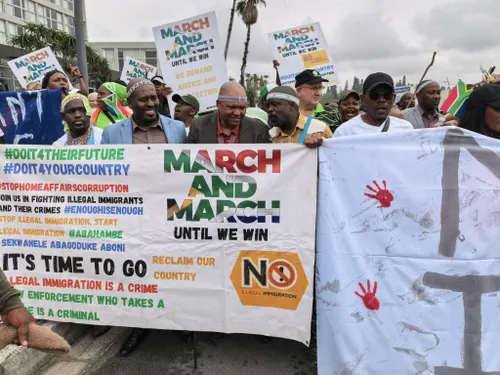
March and March
Image: Pedro Mapelo
While acting police minister Firoz Cachalia is on a mission to scuttle what he says are plans by anti-foreigner groups to destabilise the country on Tuesday, March and March said it had never called for a national shutdown.
Speaking to IOL on Wednesday morning, hours before her midday press conference, March and March leader Jacinta Ngobese-Zuma said: "Nobody even said this whole thing is a shutdown, but for some reason the government is making everyone nervous.
"We haven't even said anything, yet they've already spent R600m, and God knows for what.
"So for the police to put R600m aside is something we will address in our press conference.
"The entire purpose of our press conference is to rebut the claims that have been made because there's a lot of fear-mongering going on."
March and March is an anti-illegal immigration civic movement that has held mass marches across SA since early 2025.
It is demanding the deportation of undocumented foreign nationals, stricter border controls, and a government declaration of a state of emergency on illegal immigration.
The movement set June 30 as a deadline for undocumented foreign nationals to leave the country, a day on which protests will also take place.
Meanwhile, the SA Spaza and Tuck-Shop Association (Sasta) there was no contingency plan in place to immediately replace thousands of foreign-owned spaza shops if they were forced to close.
Sasta spokesperson Sibusiso Ngcobo told IOL: "Actually, we do not have any contingency plan, and we do not support how this thing is happening.
"We understand that the spaza shop market has been taken over by many foreign nationals.
"However, we are working on a plan that is more realistic, because even if you close them tomorrow, we need to be able to install someone who will be able to run the business."
Sasta's own 550 registered operators would trade on Tuesday.
R600m Police Operation
Cachalia announced a R600m police operation ahead of Tuesday, with SAPS deployed across all nine provinces.
"Our message is clear, everyone has the constitutional right to protest peacefully and within the confines of the law," he said.
"However, criminality, intimidation, violence, the destruction of property and any attempt to undermine public safety will not be tolerated."
He said the country could not afford a repeat of the July 2021 riots.
The 2021 riots followed the imprisonment of former president Jacob Zuma and left more than 350 people dead, thousands of businesses looted or burned, and an estimated R50bn in damage.
"That's what it costs when there are efforts to destabilise the country," he said of the R600m bill.
Ramaphosa responds
President Cyril Ramaphosa dismissed the June 30 date as not government-issued while acknowledging the frustrations behind it.
Cosatu, Fedusa, Saftu and Nactu confirmed in a joint statement that Tuesday's action was not called by any recognised labour federation and carries none of the legal protections of a strike.
The Inter-Ministerial Committee on Migration confirmed more than 40,000 people had been arrested this year for contravening the Immigration Act, with over 7 400 arrests in the past month alone.
Since 2023, Home Affairs has deported 109 344 people — a 46% surge in two years.
Home Affairs minister Leon Schreiber said: "Our message remains clear: if you are in SA illegally, self-deport now before we find you and ban you from ever entering our country legally in future."
The department also confirmed 143 arrests for inciting violence.
Gauteng premier Panyaza Lesufi said the province was in the crosshairs.
"All of us are deeply concerned about the rising tensions and planned protest on June 30," he said.
"As a home to many immigrants, Gauteng will be directly affected and we have therefore put clear, practical measures in place."
He said he was "on the side of protesters" but warned any criminality would be met with zero tolerance.
Lesufi said he would host a broad stakeholder meeting for long-term solutions.
Gauteng is rated moderate-to-high risk, with confirmed mobilisation in Tembisa, Jeppestown and the City Deep market corridor.
KZN at the epicentre
KwaZulu-Natal has been at the epicentre of the crisis, with up to 10,000 foreign nationals, mostly Malawians, split across two makeshift sites in Durban.
The first is Sherwood Hall, where the camp began more than two weeks ago.
The second is an overflow facility at the former Durban Drive-In site, set up to ease severe congestion and fast-track the deportation process.
Police used rubber bullets and stun grenades at Sherwood last week after some migrants threw rocks and refused to be moved.
Premier Thami Ntuli warned employers they would also face arrest.
"Police will arrest the foreigners together with local employers for contravention of the Immigration Act," Ntuli said.
eThekwini mayor Cyril Xaba confirmed close to 4 000 Malawians had been repatriated to date, with eight buses carrying 784 people departing in a single day.
In the Western Cape, protests spread through Khayelitsha, Kleinmond, Mossel Bay and Kraaifontein, with multiple fatalities in Mossel Bay.
Around 100 migrants sheltered in the Kleinmond town hall after mobs went door-to-door.
Ward councillor Grant Cohen said many of those sheltering were in the country legally.
In the Eastern Cape, police placed all eight districts on high alert.
In Jeffreys Bay, residents marched under the "Abahambe" banner.
"Abahambe" means they must go.
Protests also took place in Addo and Emaxesibeni.
In Limpopo, an "e-Chaile", meaning time is up, march was held in Polokwane on June 8 with further plans in place for Tuesday.
March and March member Sanele Dube said: "In Rustenburg, there will be a March and March gathering, and plans are underway in Limpopo.
"This is not a Zulu issue but a SA issue."
In the Free State, Bloemfontein and Botshabelo saw widespread looting in May after a service delivery forum protest turned violent, with 142 arrests.
North West's Rustenburg has been confirmed as an active organising node.
Fidelity Business Intelligence, a unit of SA's largest private security firm, flagged the following high-risk areas:
Fidelity Services Group CEO Wahl Bartmann confirmed the company had placed helicopter and drone pilots on standby and was prepared to deploy armoured personnel carriers.
"Our teams are on standby with comprehensive contingency plans in place to manage any potential incidents arising from the planned protest action," Bartmann said.
He said the main risks were road blockages, access restrictions, delivery delays, intimidation and temporary business closures.
Malawi's Ministry of Foreign Affairs
Malawi's Ministry of Foreign Affairs and International Cooperation issued a formal press release confirming that a voluntary repatriation exercise was imminent.
The ministry warned Malawians to beware of fraudsters.
"The ministry has not engaged any individual or institution to handle the repatriation exercise on its behalf."
Nigeria's foreign minister, Bianca Odumegwu-Ojukwu, accused SA's government of failing to forcefully denounce violence against Nigerian nationals, saying the bond forged through Nigeria's anti-apartheid solidarity had been damaged.
At least two Nigerians died in April.
Nigeria summoned SA's acting high commissioner and organised voluntary repatriation flights, with 268 Nigerians on one flight.
Senator Adams Oshiomhole called for economic retaliation, including the withdrawal of operating licences from SA companies such as MTN and DStv operating in Nigeria.
Ghana's foreign ministry confirmed its evacuation was a direct response to xenophobic attacks and raised the matter at the African Union, requesting it be placed on the agenda of the upcoming AU summit.
A charter flight airlifted 297 Ghanaians out of OR Tambo International Airport on May 27.
Mozambique said five of its citizens were killed directly as a result of xenophobic attacks and two more died in a road accident while fleeing.
More than 926 nationals departed in coordinated operations.
The Zimbabwean embassy issued a warning on April 28, calling on nationals to remain vigilant and limit unnecessary movement.
Zimbabwe Anti-Sanctions Movement chair Rutendo Matinyarare, who is based in SA, has been one of the most prominent Zimbabwean voices on the attacks.
Kenya and Lesotho also issued formal travel warnings to their nationals ahead of Tuesday.
Justice minister Mmamoloko Kubayi said: "The marches are protected.
"People's right to march is protected in the Constitution.
"However, we emphasised the importance of ensuring that these marches are peaceful."
SANDF on standby
Defence Minister Angie Motshekga confirmed the SANDF was on standby.
Economists warn a high-impact shutdown could cost SA up to R17bn and trigger up to 85 000 short-term job losses in logistics and hospitality.
IOL News