National Assembly adopts new impeachment committee rules in line with ConCourt judgment
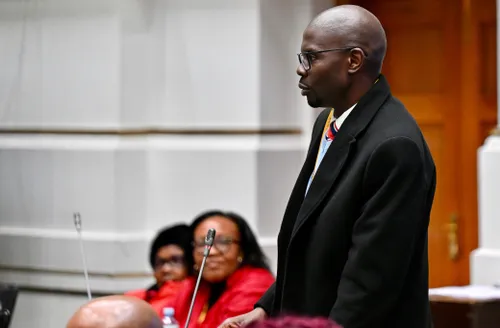
During his address, Impeachment Committee Chairperson Makashule Gana said they support the report of rules, and he also responded to Manyi’s remarks.
Image: Supplied/Parliament RSA
The National Assembly adopted the rules for the Section 89 inquiry process after Rule 129I of the Rules of the National Assembly had previously been declared unconstitutional and invalid by the Constitutional Court.
After a long day of parliamentary debates in which opposition parties questioned President Cyril Ramaphosa and criticised Speaker Thoko Didiza’s decision not to oppose his interdict, the National Assembly adopted the rules for the committee on Tuesday evening.
On Friday, 8 May, the Constitutional Court ruled that Parliament's handling of the Phala Phala report was unconstitutional and invalid, ordering that the matter must return to Parliament's impeachment committee.
The landmark judgment found that Rule 129I of the National Assembly is inconsistent with the Constitution and is invalid. Pending the formal amendment of the Rules by the National Assembly Rules Committee, the court further directed an interim reading-in and amendment of Rule 129I to govern the processing of section 89 matters.
The court also set aside the decision of the National Assembly, taken on 13 December 2022, declining to refer the Independent Panel Report to an Impeachment Committee established in terms of the National Assembly Rules.
After the judgment, Didiza formally referred the report to the Impeachment Committee.
Additionally, she referred the Constitutional Court judgment to the National Assembly Subcommittee on the Review of Rules. This subcommittee is tasked with considering and processing the amendments required to the Rules of the National Assembly, in accordance with the findings, reading-in, and directions of the court.
Subcommittee chairperson Doris Mpapane tabled the report on Tuesday evening, saying amending parliament's rule can be a challenging task “because all political parties have their own interests and views”.
“In the present case, the rules committee, on the advice of the subcommittee on rules and the parliament's legal team, considered two categories of the procedure. Amendments to the general rules contained in the assembly rule, 129A, 2129Q, and detailed procedures concerning proceedings in the impeachment committee.
“In terms of the letter, it was agreed that the detailed procedures should be conveyed to the impeachment committee, as this committee was best placed to determine how, within the context of law and rules, they ought to conduct their inquiry,” Mpapane said.
Chairperson of Subcommittee on Review of Assembly Rules, Doris Mpapane.
Image: Phando Jikelo / RSA Parliament
Mpapane said that the rules committee endorsed the read-in laws from the court, and that the proposed rules clarify the role of the National Assembly in relation to the impeachment committee - that is, which matters can or must finally be determined by the House.
“It is also important to note that the amendments to the general rules will not apply retrospectively. The most difficult issue before the rules committee involves the proposal that members appointed to the impeachment committee must be ‘fit and proper’.
“In this regard, all parties agreed that members must have the necessary capacity and character to perform their respective parliamentary duties. Indeed, this is essential if this House is to achieve its ambition, to meet the expectations of the people, but this is a difficult concept to apply within the parliamentary context,” Mpapane said.
“I should restate that our procedures must be put, principles and not have questions for those responsible for their implementation. I believe that, notwithstanding some divergent views, the rules presented today serve to ensure that Section 89 of the Constitution can be implemented in a manner invested.”
MK Party MP Mzwanele Manyi had meanwhile attacked the committee for dragging its feet, claiming that it should be further along in the process than it already is.
“There is no sense of urgency. It bears noting that the impeachment committee is chaired by a fellow traveller of the so-called GNU (Government of National Unity). Whether by coincidence or by design, the result is simply that two months later, there's been no inquiry whatsoever.
“The objective is clear: to string this process along in the hope that the High Court will undermine the Constitutional Court order and achieve what an unlawful vote of this House already failed to achieve. The people of South Africa are being played.”
During his address, Impeachment Committee Chairperson Makashule Gana said they support the report of rules, and he also responded to Manyi’s remarks.
“I think he's yearning to be part of the committee. I can talk to the leader of the opposition if he wants to be in the committee,” Gana said. “Those that are in the committee know the work that's happening.”
DA MP Glynnis Breytenbach.
Image: ParliamentRSA/Supplied
DA Chief Whip, Glynnis Breytenbach, said the report clearly sets out the process that the committee followed in amending the rules.
“The amendments are fair, certain, and in line with the Constitution. Members had ample opportunity to engage in debate.
“The Democratic Alliance's proposal on the inclusion of a ‘fit and proper’ requirement for members to serve on an impeachment committee was rejected. An impeachment investigation is a serious matter, and therefore requires equally serious consideration on who ought to participate in it,” Breytenbach said.
“The principle of ‘fit and proper’ has been thoroughly thrashed out in the courts…the meaning in law is, in fact, quite clear.
“We trust that the rules contained in this report will empower the impeachment committee to conduct a thorough investigation into the events that transpired. We hope that its work will shed light.”
The committee will meet on Wednesday morning to discuss its terms of reference and the appointment of evidence leaders.
Related Topics: