The IDC at a Crossroads: Balancing Development and Accountability
ECONOMIC TRANSFORMATION
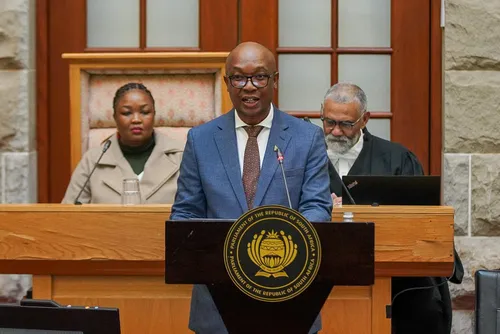
Trade, Industry and Competition Minister Parks Tau replying to questions from MPs regarding the appointment of the Industrial Development Corporation board members. Parliament has a constitutional responsibility to ensure that public entities operate in accordance with their legislative mandates, says the writer.
Image: Supplied
Siyabonga Gama
South Africa stands at a critical economic crossroads. Economic growth remains stubbornly low. Unemployment remains among the highest in the world. Manufacturing, once a major driver of employment and industrial development, continues to lose ground.
At the centre of efforts to prevent these outcomes stands the Industrial Development Corporation (IDC), one of South Africa's most important development finance institutions.
The IDC was never intended to function as a conventional commercial lender. It was set up to finance industrialisation, promote economic transformation, expand productive capacity, and create sustainable employment. Unlike commercial banks, its mandate extends beyond profitability.
That is precisely why concerns raised recently before Parliament warrant careful examination.
The National Federated Chamber of Commerce (NAFCOC) presented submissions from several black-owned industrial enterprises alleging prejudicial treatment, aggressive debt recovery measures and insufficient developmental support from the IDC during periods of distress.
It is important to state from the outset that allegations are not findings. The businesses involved have presented claims that require independent verification, and the IDC has every right to respond and defend its conduct.
However, Parliament should carefully consider whether the testimonies presented point to broader issues that merit further scrutiny.
The issue is not simply about loan agreements, debt enforcement or contractual disputes. It raises broader questions about the role of developmental finance in a country still grappling with the economic legacy of apartheid.
Development finance institutions across the world are expected to balance financial discipline with developmental objectives. Their performance cannot be measured solely by loan recovery rates and balance sheet strength. They are also judged by their contribution to industrial development, employment creation, transformation and long-term productive growth.
South Africa has experienced a succession of extraordinary economic shocks over the past decade, including electricity shortages, logistics failures, the COVID-19 pandemic and rising interest rates.
Against this backdrop, Parliament may reasonably consider whether liquidation is being used appropriately as a measure of last resort.
For generations, black South Africans were deliberately excluded from industrial ownership, productive capital and economic participation. Institutions such as the IDC were therefore given a strategic mandate to support black industrialisation and broaden participation in the productive economy.
South Africa continues to struggle with structural inequality, concentrated ownership patterns, and persistent barriers to entry. Township and rural economies are still underdeveloped. Youth unemployment continues to threaten social stability. Manufacturing capacity has steadily eroded.
For this reason, the MK Party supports the establishment of a Parliamentary Inquiry into the developmental outcomes, institutional culture and operational practices of the IDC.
Such an inquiry should be viewed as an opportunity to strengthen one of South Africa's most important development agencies.
Parliament has a constitutional responsibility to ensure that public entities operate in accordance with their legislative mandates. Oversight is accountability.
A parliamentary inquiry would allow South Africans to examine critical questions relating to funding approval patterns, business rescue interventions, industrial capacity preservation, transformation outcomes and job protection.
The IDC has acknowledged the seriousness of the concerns raised and has supported an independent investigation overseen by non-executive directors. This is a welcome development and should continue with urgency.
However, public confidence requires transparency and accountability.
South Africa needs development finance institutions that combine financial sustainability with developmental objectives.
The challenge facing South Africa is not choosing between financial discipline and development. The challenge is achieving both.
Parliament should consider establishing a time-bound inquiry with powers to compel evidence, publish findings and recommend corrective action where necessary.
Furthermore, consideration could be given to strengthening distressed-business frameworks that prioritise restructuring support, turnaround assistance and business rescue assessments before enforcement action against viable firms.
South Africa's future depends on building productive capacity, expanding industrial ownership and creating sustainable employment. Development finance institutions have a critical role to play in that mission.
The time has come for a constructive national conversation about whether they are adequately fulfilling that role.
Parliament should give careful consideration to these issues.
The IDC should continue engaging openly with the concerns that have been raised.
And South Africa should ensure that its development finance institutions remain effective instruments of industrialisation, transformation and economic development.
* Siyabonga Gama is the MK Party Trade and Industry Lead and a Member of Parliament serving on the Portfolio Committee on Trade, Industry and Competition. The views expressed are his own and those of the MK Party Parliamentary Caucus.
** The views expressed do not necessarily reflect the views of IOL or Independent Media.