“You are not African”: South Africa’s identity crisis
'US AND THEM'
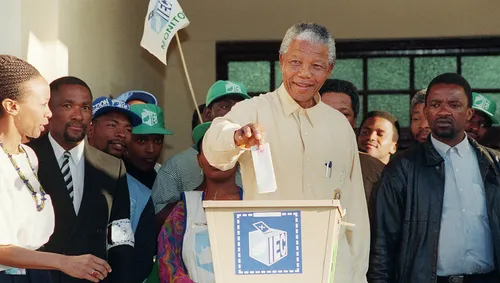
Nelson Mandela casts his vote at the John Langalibalele Dube’s Ohlange High School in Inanda, near Durban, on April 27, 1994. Division, hatred and fear have emerged from the 1994 promises of ubuntu. Have the youth chosen their new South Africa?
Image: AFP
South Africa has one of the world’s most progressive Constitutions, and it goes beyond simply ratifying international law treaties. According to South Africa’s legal position, the country acknowledges that some refugees may be fleeing their homes not only on the basis of ethnicity or language, but also because of gender-based violence or LBGT+ status.
This is particularly poignant for Ugandans, for example, who may still be stoned to death for who they love. South African law also views refugee camps as being a gross violation of international law, because they create a strong division between “us (South Africans)” and “them (migrants)”.This legal position stands in stark contrast with the reality on the ground.
Malawian repatriation: A factual background
As of late June 2026, thousands of Malawians are camped at the overcrowded old Durban drive-In. They are awaiting repatriation, in anticipation of the “Abahambe” threats looming over month-end.
The vigilante groups created a June 30 deadline, by which time, all foreigners must leave South Africa. When asked for more details about this deadline, the vigilantes have since denied creating any deadline at all (despite an abundance of evidence).
The current “refugee camp” situation began as a few dozen people seeking safety in Sherwood Hall, with the numbers increasing exponentially each day. According to Malawians, they approached Sherwood Hall under extreme duress. Many were forced out of informal settlements by disgruntled South Africans who believe foreigners to have caused the youth unemployment crisis. The country has experienced surges of xenophobic violence throughout the 21st century, peaking during the 2008 recession, and seeing consistent spikes thereafter.
During times of economic uncertainty, foreign nationals remain a convenient scapegoat. As of 2026, there are Xenowatch and United Nations reports of foreign-owned businesses being burnt, equipment destroyed, and foreign nationals being threatened by vigilante groups (especially when said foreign nationals work in the formal or government sectors and are thus highly visible).
This occurs against the backdrop of impunity by the South African Police Service(SAPS), who claim that they do not have sufficient evidence to open dockets despite
the perpetrators of xenophobic violence being frequently captured on camera, and often in vigilante regalia (March and March, Operation Dudula, and Umkhonto weSizwe are the most commonly cited perpetrators.)Amidst the thousands of Malawians, there are a flurry of Home Affairs officials, politicians, journalists, police, NGOs, and members of civil society, all with differing motives.
It is telling that despite Malawians substantially outnumbering locals at these facilities, very few journalists dare to publish anonymous statements from Malawians themselves.
Political and government presence
The Malawian crowd at Sherwood Hall initially attracted NGOs and members of civil society, who provided food and blankets. When the numbers ballooned, however, the Department of Home Affairs officials visited the site to assess possible remedies. After years of administrative backlogs, and bureaucratic delays, the Department of Home Affairs is working overtime due to political pressure.
As of June 2026, Home Affairs has been placed under scrutiny. Many other migrants are currently camping outside the Durban Refugee Reception Office (RRO) in Glenwood. In early June, they received mass communications from the Department regarding RAASA interviews, which was only possible because they were previously captured on Home Affairs systems.
Many migrants waited years for a response from the Department, so the sudden communication came as a shock. Home Affairs attempted to “streamline” processes by unilaterally reducing the 30-day notice period to a 10-day period (sometimes giving notice of a mere two working days). When civil society wrote to Home Affairs regarding this lack of due process, the Department accordingly withdrew, and scheduled RAASA interviews for early August, as provided for by legislation.
For Malawians, however, there is no legal recourse, because thousands are undocumented. They therefore may not access either the immigration or asylum systems, because both require (differing) documentation.
Escalating tensions and tribalism
Xenophobic sentiment continues to pollute the country and has resulted in the alleged death of a 19-year-old Xitsonga speaker on May 31, 2026. His crime? Speaking one of the South African official languages that the mob did not understand.
This alleged stabbing shows how tribalism is a slippery slope to other forms of bigotry.
Vigilante mobs often have a narrow view of who is a South African, and they inflict violence on anyone who is too dark-skinned, speaks the wrong language, or who dares to question their viewpoints. This tribalism was echoed by the Durban Mayor Cyril Xaba, who became frustrated during a heated argument in Sherwood Park, and swatted Yeshelen Govender away.
“Hey, I’m talking with the Africans here. Shut up your mouth. I’m not talking to you.”
Councillor Xaba then said, “Get out. You are not African.”
Govender was then removed by the police, upon instruction by the Mayor. He was later confirmed to be a South African citizen by birth and descent. The mayor’s office has since denied any racist remarks, saying, “The person was not South African. He was a foreign national who kept interjecting while the Mayor was speaking. He was very disruptive and would not allow the mayor to speak. The Mayor represents all South Africans in eThekwini and does not differentiate between South Africans based on race, colour or faith. As South Africans, we are one and should not allow others to divide us."
But who is driving the division?
Belonging: who decides?
National identity and belonging have caused wars across the world. South Africa’s most recent civil unrest looms in living memory. The legacy of apartheid casts long shadows, but the country’s youth are disillusioned with the ex-activist leadership that has hoarded wealth and power for over thirty years.
The current scapegoating of migrants allows South Africa’s youth to experience hope for the first time in decades - even if that hope is based on hatred of the “other”.
The new South Africa?
The current rise in ethno chauvinisim is simply a reprise of centuries-old conflicts. Will they, however, be the new oppressors?
Division, hatred and fear have emerged from the 1994 promises of ubuntu. Have the youth chosen their new South Africa?
Rashmika Surmon (neé Singh) is a human rights lawyer with over two years of experience. She currently works with Lawyers for Human Rights in the Refugee and Migrant Rights Programme. She also a member of the Siyafana Sonke “We Are AllThe Same” Action Campaign.
Image: SUPPLIED
Rashmika Surmon (neé Singh) is a human rights lawyer with over two years of experience.
She currently works with Lawyers for Human Rights in the Refugee and Migrant Rights Programme.
She also a member of the Siyafana Sonke “We Are AllThe Same” Action Campaign.
** The views expressed do not necessarily reflect the views of IOL or Independent Media.